
اخبار السودان – وطن نيوز
اخر اخبار السودان اليوم – اخبار السودان العاجلة
W6nnews.com ==== وطن === تاريخ النشر – 2026-02-12 19:16:00
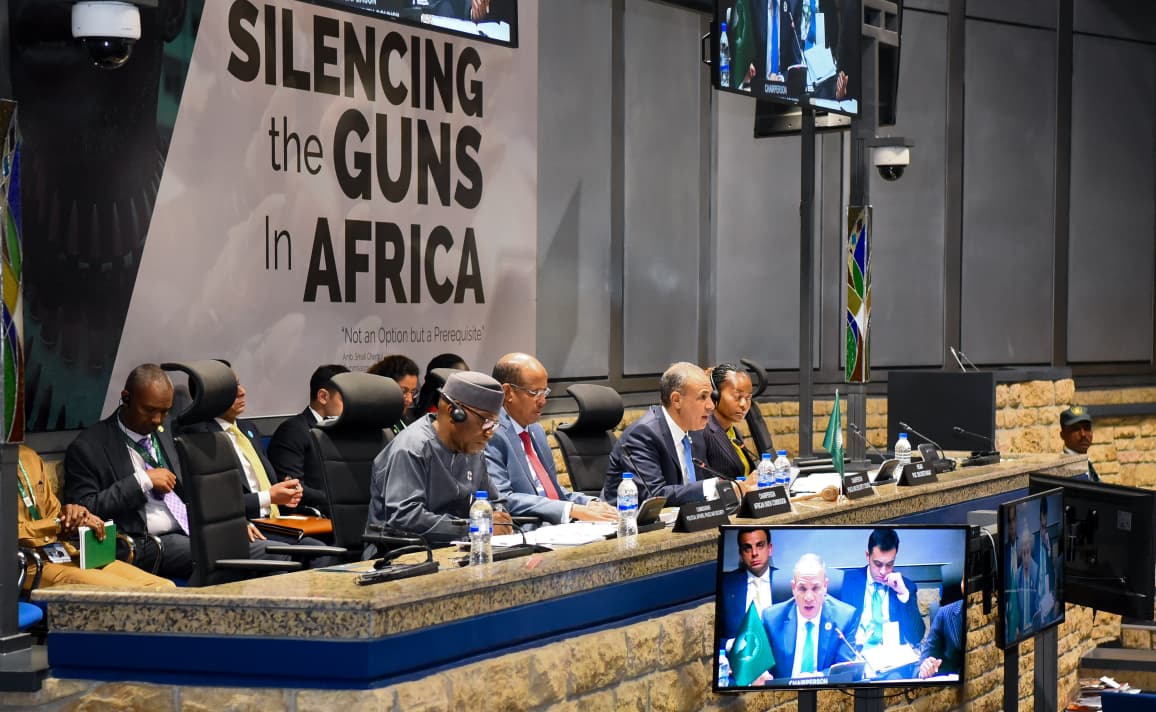
Addis Ababa, February 12, 2026 – Radio Dabanga Identical sources revealed that the ministerial meeting of the African Peace and Security Council, chaired by Egyptian Foreign Minister Badr Abdel Ati, declined to approve a proposal to unfreeze Sudan’s membership in the African Union, while both Egypt and Algeria continue their efforts to unfreeze. The African Peace and Security Council renewed its commitment to respecting Sudan’s independence, sovereignty, territorial integrity and national unity. It also expressed its deep concern about the continuation of the armed conflict in Sudan, which has resulted in loss of life, destruction of infrastructure, decline in development gains, and caused an unprecedented humanitarian catastrophe in the country. In its statement, seen by Radio Dabanga, the Council expressed its deep concern about the deteriorating humanitarian and economic situation, especially about the famine and hunger reported in the country, especially in El Fasher, and demanded unhindered access of humanitarian aid to the population in need, as well as the protection of humanitarian workers and agencies. He strongly condemned all forms of violations committed against the civilian population by parties to the armed conflict in El Fasher, in particular by the Rapid Support Forces, including systematic killings, mass displacement, ethnic targeting, and destruction of infrastructure, stressing that those responsible will be held accountable for serious violations of international humanitarian law and international human rights law. The Council called for the rapid and complete restoration of a democratically elected, civilian-led government, in line with African Union resolutions, and called for the interests of Sudanese citizens to be respected and prioritized by giving peace a chance. African Peace and Security Council Meeting – February 12, 2026 – African Union Humanitarian Truce The Council renewed its call for a humanitarian truce that leads to an immediate ceasefire, in preparation for launching a comprehensive dialogue process led by Sudanese, that addresses the security and political aspects to address the structural root causes of the conflict, and reach a consensual and lasting solution, while emphasizing that there cannot be a viable and sustainable military solution to the ongoing conflict in Sudan. Welcoming Kamel Idris’s initiative The Council also welcomed the progress made through the introduction of the Sudanese National Peace Initiative by the Prime Minister of the Sudanese Transitional Government on 22 December 2025, which emphasizes an immediate and comprehensive ceasefire, the protection of civilians, ensuring unimpeded humanitarian access, support for refugees and internally displaced persons, disarmament, security sector reform, national reconciliation, and reconstruction. The Council stressed that these components are essential for rebuilding confidence, reforming the social fabric, and consolidating the unity of the state, calling for their full implementation in line with the African Union’s road map to resolve the conflict in Sudan. In this regard, he called on the Sudanese authorities and political forces, in close coordination with the relevant authorities, to make the transitional process more comprehensive, to reach consensual arrangements that reflect the aspirations of the Sudanese people and enable a smooth return to the constitutional system through holding elections. He also urged the Sudanese authorities to continue the effective implementation of the National Peace Initiative. The African Peace and Security Council meeting resumes the comprehensive dialogue. The Council stressed the necessity of resuming a comprehensive dialogue between the Sudanese that focuses on reconciliation and the search for an amicable political solution, under the auspices of the process led by the African Union, and in coordination with the Intergovernmental Authority on Development (IGAD), the United Nations, neighboring countries, and other regional and international peace support paths, including the four- and five-party dialogues, in support of reducing the escalation, stopping hostilities, and restoring peace and stability in Sudan. In this regard, he requested the African Union Commission, IGAD and neighboring countries to continue engaging civilian actors in a comprehensive inter-Sudanese dialogue process. Centrality of the African Union The statement stressed the centrality of the African Union’s leadership of the peace process in Sudan, welcoming the efforts of the Group of Five, which are: the African Union, IGAD, the League of Arab States, the United Nations, and the European Union, in enhancing coordination of mediation efforts in order to hold a comprehensive Sudanese-led dialogue. He urged the Group of Five to continue consulting with Sudanese stakeholders on preparations to launch political dialogue, prevent overlap, and ensure a consistent approach, with the aim of reaching a negotiated and lasting solution to the conflict. He renewed his call to revitalize a comprehensive Sudanese dialogue characterized by the spirit of reconciliation and the search for a consensual political solution by facilitating the work of the Five-Year Group. Call to identify external parties The Council strongly condemned external interference in Sudan’s internal affairs, calling on all external actors to refrain from any actions that would inflame the conflict. He asked the African Peace and Security Council Sanctions Subcommittee to expedite the implementation of the Council’s statement adopted on 21 June 2024, and to work in cooperation with the Committee on Intelligence and Security Services in Africa (CISSA) and the African Union Police Cooperation Mechanism (AFRIPOL), to identify all external actors that support the parties to the conflict militarily, financially and politically, and to submit proposals to contain this support within a period not exceeding three months from February 2026. Condemnation of the parallel government The African Union reaffirmed its strong condemnation and complete rejection of the establishment of what It is called the “parallel government” in the Republic of Sudan by the Sudan Constituent Alliance (Foundation) led by the Rapid Support Forces, and asked all member states and partners not to recognize the so-called “parallel government,” while reaffirming its support for Sudan’s sovereignty and territorial integrity within its internationally recognized borders. Field Mission The African Union renewed its decision to conduct a Peace and Security Council field mission to Sudan, taking into account the security situation on the ground, to communicate with various stakeholders regarding developments, with the aim of finding lasting peace and stability. He also welcomed the return of the Sudanese transitional government to Khartoum, the permanent capital of Sudan, considering this an important step towards restoring and maintaining public administrative services, and the return of federal state institutions to better perform their duties to serve the Sudanese people. Resilience welcomes: The Democratic Civil Alliance for Revolutionary Forces, Resilience, welcomed the failure of the African Union, during the Peace and Security Council meeting, to approve the proposal to unfreeze Sudan’s membership, indicating that a large number of Council members rejected this proposal. The coalition said in a statement that the Council’s decision included many positive points, the most important of which was the assertion that there is no military solution to the conflict in Sudan, the acknowledgment of the complex nature of the Sudanese crisis, the call for an immediate humanitarian truce throughout the country, and the necessity of reaching a consensual political solution with Sudanese leadership and ownership, with the importance of coordination between international initiatives, most notably the quintet and quartet. The coalition stressed the importance of the African Union maintaining its neutrality, and not adopting unilateral initiatives such as the initiative issued by what it described as the Port Sudan Authority, indicating that this trend may lead to prolonging the conflict and increasing the intensity of internal polarization. He also affirmed his readiness to engage sincerely with all African and international efforts to bring peace, stop the bloodshed, address the humanitarian crisis, and protect civilians throughout the country. Coalition (Foundation): The African Peace and Security Council statement is biased towards the army. The Sudan founding coalition “Foundation” criticized the African Peace and Security Council statement issued today regarding Sudan, describing it as biased towards the armed forces. In its statement issued today, Thursday, the African Peace and Security Council welcomed the road map announced by Prime Minister Kamel Idris, and renewed its refusal to form a parallel government. It also welcomed the return of the transitional government to Khartoum. The coalition said in a statement seen by Radio Dabanga that the statement issued by the African Peace and Security Council was expected, indicating that it confirmed in its previous statement that the presence of the Arab Republic of Egypt at the presidency of the current session of the African Peace and Security Council will not lead to a balanced position, which was confirmed by the statements of the Egyptian Foreign Minister today. He stressed that the African Peace and Security Council’s welcome of the “road map” presented by Kamel Idris, and its welcome of the return of the “transitional government” to Khartoum, is considered a blatant bias that ignores the charters, customs and principles of the African Union, and undermines the foundations on which peace platforms have been built since the outbreak of war. He said that the statement’s condemnation of external interference in the war contradicts the clear role played by the Republic of Egypt, which presides over the current session of the Council, a role that is no longer hidden from anyone. He stated that the statement in its entirety does not serve efforts to stop the war, and does not put an end to the suffering of the Sudanese, but rather puts the current mediation role into great question. He expressed his surprise at calling what he called the terrorist group’s regime a “transitional government”, indicating that this matter raises concerns about the credibility of this Council and the future. Mediation led by the five-factor mechanism. He said this gives false and undeserved legitimacy. The Sudanese Foreign Minister criticizes Foreign Minister Mohieldin Salem’s description of the African Union’s decision to suspend Sudan’s membership as hasty, pointing out that the move lacks careful review since its issuance in 2021. He explained that the current crisis was complicated by the continued external support for the militias with weapons and mercenaries, and the refusal of these groups to lift the siege on the city of El Fasher, despite repeated international appeals to alleviate the worsening human suffering. Salem confirmed that the head of the Sovereignty Council, Abdel Fattah Al-Burhan, presented a clear road map for a solution, based on stopping the war first, then launching a comprehensive political process that will end the crisis and restore stability in the country. These statements coincide with the meetings of the Executive Council of the African Union in Addis Ababa, in preparation for the African Summit scheduled for mid-February. The Egyptian Foreign Minister, during his presidency of the African Peace and Security Council meeting, called for an Egyptian invitation. Egyptian Foreign Minister Badr Abdel Ati, during his presidency of the African Peace and Security Council ministerial meeting, called for African action in support of the unity and sovereignty of Sudan, calling on the African Union to continue its efforts and communicate with what he described as the legitimate Sudanese leadership represented by the Transitional Sovereignty Council and the government of Dr. Kamel Idris, to play a constructive role in resolving the crisis. He affirmed Egypt’s support for all relevant decisions and statements in support of the unity and sovereignty of Sudan, pointing out its adherence to a comprehensive humanitarian truce that leads to a permanent ceasefire and the urgent entry of humanitarian aid, and the necessity of enabling national state institutions to carry out their responsibilities in maintaining security and stability. The Chairperson of the African Union Commission addresses the meeting of the African Peace and Security Council, a call to stop the war. The Chairperson of the African Union Commission, Mahmoud Ali Yusuf, addressed this morning the Ministerial Meeting of the Peace and Security Council on Sudan and Somalia, on the sidelines of the forty-eighth session of the regular Executive Council of the African Union, calling for unity, cohesion and strong African leadership to resolve the crises on the continent. Regarding Sudan, he urged an immediate, permanent and verifiable ceasefire, supported by reliable monitoring mechanisms, to protect civilians, preserve territorial integrity, and pave the way for a comprehensive, civilian-led transition. Continue Reading