
اخبار العراق- وطن نيوز
اخبار العراق اليوم – اخر اخبار العراق
W6nnews.com ==== وطن === تاريخ النشر – 2026-06-02 17:23:00
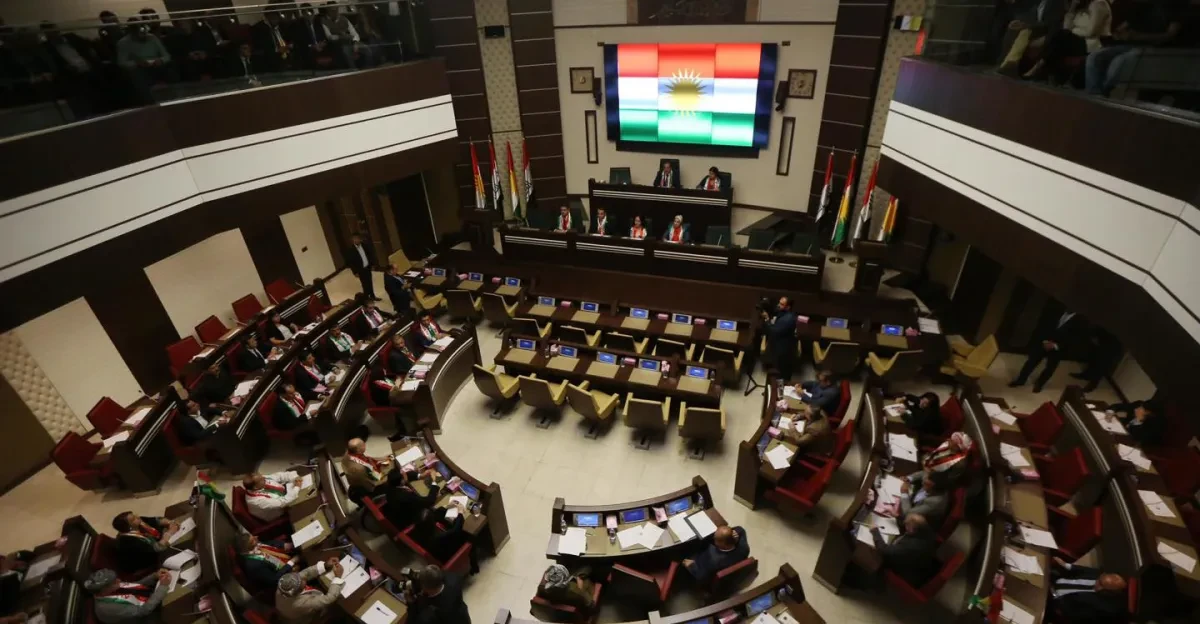
Shafaq News – Sulaymaniyah Even though more than a year and a half has passed since the Kurdistan Regional Parliament elections, the tenth government cabinet is still standing in its place amid ongoing political disputes between the two main parties, the Kurdistan Democratic Party and the Patriotic Union of Kurdistan. While the rounds of dialogue and negotiations continue without reaching a final agreement, questions are increasing regarding the real reasons hindering the formation of the government, and whether the crisis is related to the election results themselves or to the method of translating them into a political partnership capable of managing the next stage. Seat map: The Kurdistan Regional Parliament elections, which took place on October 20, 2024, resulted in a new political reality that redrew the balance of power within Parliament, but did not grant any party a comfortable majority that would allow it to form the government alone, which made consensus between the main forces a basic condition for the formation of the new government cabinet. According to the final results of the elections, the Democratic Party won 39 seats, while the National Union came in second place with 23 seats, while the New Generation Movement achieved remarkable progress by winning 15 seats. The Kurdistan Islamic Union also won 7 seats, the National Position 4 seats, and the Kurdistan Justice Group 3 seats, while the rest of the seats were distributed among other political forces and the quota seats for the components. These results clearly showed that the Democratic Party maintained its position as the largest political force in the region, but it did not obtain the absolute majority that would enable it to form the government alone, and the National Union remained the second force capable of influencing the equation of power formation. On the other hand, the rise of the New Generation movement increased the complexity of the political scene, after it turned into the third largest parliamentary bloc, which created new equations within Parliament that did not exist in previous sessions. Electoral entitlement or political partnership? A member of the Political Bureau of the Patriotic Union of Kurdistan, Saadi Ahmed Pira, confirms that the crisis related to the formation of the new government in the Kurdistan Region is not related to the results of the elections as much as it is related to the way of dealing with those results and the mechanisms for translating them into a real political partnership within the executive authority. Bera told Shafaq News Agency that the National Union believes that electoral entitlement should be the basis on which the process of forming the government and distributing responsibilities and positions is built, but the Kurdistan Democratic Party, according to his opinion, does not deal with this principle in the desired manner, as it seeks to form the government according to its own vision, and then award positions to other parties, without actually involving them in drawing up the government’s program or determining its structure and the mechanisms for distributing powers within it. He adds that the real problem does not lie in the number of seats obtained by the political forces, but rather in the absence of full recognition of the principle of partnership based on electoral entitlement. Pira points out that the Democratic Party demands that the federal government in Baghdad adhere to the principles of balance, consensus, and partnership in managing the state, which requires the application of the same principles within the Kurdistan Region when forming the new government, in a way that is consistent with the results of the elections and reflects the political will of the voters, as he put it. Regarding the calls to hold new elections for the Kurdistan Regional Parliament, he stresses that “this option does not represent a solution to the current crisis, because the new elections will not produce a fundamentally different political reality, but will largely restore the same balances produced by the previous elections, in addition to the large financial cost that will result from organizing them.” It shows that the National Union is not afraid of running in new elections, but rather believes that it enjoys a stronger political and organizational position today than it did before the last elections. However, resorting to this option does not address the root of the problem, which is the dispute over the mechanism for forming the government and respecting the electoral entitlements of the political forces. The Patriotic Union of Kurdistan calls for sitting at the dialogue table and negotiating to form a government based on the principle of true partnership, political balance, and electoral entitlement, ensuring the participation of all forces represented in the Kurdistan Regional Parliament in managing the next stage, according to what Berra explained. He also goes on to say that “regional and international interventions in the Kurdistan file” are currently characterized by a positive nature that contributes to encouraging dialogue and bringing viewpoints closer between political parties, without any negative interference affecting the course of the negotiations. The crisis began before the elections. On the other hand, the Kurdistan Democratic Party refuses to hold it responsible for the faltering negotiations, and stresses that the current crisis is linked to political positions that preceded the elections and the new alliances within Parliament that followed. The leader of the Kurdistan Democratic Party, Kamran Ghareeb, believes that the Democratic Party took the initiative to invite the National Union to enter into negotiations to form the tenth cabinet of the Kurdistan Regional Government before holding the elections for the Iraqi House of Representatives, but the National Union did not respond to that call at the time. Gharib told Shafaq News Agency that the results of the elections and the clear progress they produced for the Democratic Party, not only at the level of the Kurdistan Region, but also at the level of the Iraqi political forces in general, prompted the National Union to search for alternative political options and alliances, and this was embodied in its move towards coordination with the New Generation Movement and the formation of a joint bloc within the Parliament of the Kurdistan Region. According to a strange hadith, the New Generation Movement won 15 seats in the Kurdistan Regional Parliament, and that a large portion of these votes came from the regions of Sulaymaniyah, Garmian, Halabja, and the areas falling under the influence of the Patriotic Union of Kurdistan, as these votes essentially represented a case of objection to the policies of the Patriotic Union, and that many of the voters who gave their votes to the New Generation Movement were in previous stages of the Patriotic Union’s audience before they turned to supporting a political project opposed to it. Speaking about the demands related to the distribution of positions on the basis of the principle of “50 percent versus 50 percent,” he pointed out that this equation was linked to a previous political stage that was surpassed by the current political and electoral developments, stressing that the current stage requires respecting the electoral entitlement of each political party according to the size of its representation within the Kurdistan Regional Parliament, away from the traditional equations that prevailed in previous periods. In response to the statements made by a member of the Political Bureau of the National Union, Saadi Ahmed Pira, regarding the Democratic Party’s demand for the principles of partnership, balance, and consensus in Baghdad and their failure to apply them within the region, Gharib asserts, “When the Democratic Party demands partnership, balance, and consensus at the federal level, it is not doing so for the benefit of the party itself, but rather in defense of the rights of the Kurdish component within the Iraqi state.” It is believed that there are dozens of constitutional and legal articles related to the rights of the Kurds and the principle of partnership and balance that are not being applied as required in Baghdad. Therefore, the Democratic Party’s demand for these principles comes within the framework of protecting the constitutional and political rights of the people of Kurdistan, and not to achieve narrow partisan gains. In this context, he cited the experience that followed the rise of the Change Movement in the governorates of Sulaymaniyah, Garmian, and Halabja, where the electoral results of the National Union declined in a way that did not qualify it, according to the criterion of electoral entitlement, to obtain the position of Prime Minister of the Kurdistan Regional Government. However, the Democratic Party decided, at the request of the late President Jalal Talabani, to grant the National Union this position, as Barham Salih was assigned to head the Kurdistan Regional Council of Ministers. Gharib continues his speech by saying that the “New Patriotic Union of Kurdistan” is currently seeking to put forward demands and issues that the Democratic Party believes are not based on clear legal or democratic foundations, indicating that any successful political process must be based on dialogue, understanding, and respect for electoral entitlements, not on imposing conditions or dictates from any party. He stresses that the Kurdistan Democratic Party affirms its commitment to the principle of granting all political parties their rights and entitlements according to the election results, and within the framework of partnership and political consensus, away from any attempts to impose equations that are inconsistent with the electoral reality produced by the ballot boxes. Regarding talk about the possibility of holding new elections for the Kurdistan Regional Parliament, Ghareeb confirms that all options remain on the table in order to reactivate the legislative institution and form the new government, with the exception of any options that lead to escalation or confrontation. Regarding external interventions, Gharib concludes his speech by saying, “The countries neighboring the Kurdistan Region view the stability of the region as a common interest, and seek the presence of a strong government capable of managing the political, security, and economic files efficiently.” The roots of the crisis and between the two parties’ narratives. Observers believe that the crisis goes beyond the current disputes over ministerial positions and portfolios, and is related to a long legacy of political competition and differing visions regarding the administration of the region and its future. Political analyst Abu Bakr Karwani explained to Shafaq News Agency that the faltering consensus between the National Union and the Democratic Party is due to four main factors that interfere with each other and directly affect the path of forming the new government in the Kurdistan Region. Karwani says that the first factor is the historical legacy of political differences and conflicts between the two parties, whose roots go back decades since the 1960s, while the second factor is the current political differences and outstanding issues that are still the subject of disagreement between the two sides. The third factor is related to the difference in the visions of the two parties towards local, regional and international issues, as well as the difference in views on a number of files related to the future of the Kurdistan Region and its administration, while the fourth factor is the conflict of political interests related to the distribution of positions and powers within the next government. Karwani points out that the absence of a comprehensive institutional framework at the regional level, in addition to the reality of administrative and political division based on partisan influence in some regions, contributed to the deepening of internal disputes, which provided a suitable environment for the intervention of external parties and an attempt to exploit these differences to achieve political, national, factional or sectarian interests, which requires the political forces in the Kurdistan Region, especially the Democratic Party and the National Union, to realize the magnitude of the risks that may result from the continued state of political division and disagreement. He confirms that the current political scene in the region has not produced any force with an absolute majority that would enable it to form the government alone, indicating that the Democratic Party obtained the largest number of votes, but a number of political, legal, and realistic factors make it difficult for it to form the government alone. According to Karwani, among the most prominent of these factors is the absence of an effective constitution for the Kurdistan Region that clearly defines the mechanisms for forming the government and the party constitutionally authorized to assign it, in addition to the presence of other political complications related to the nature of the existing regime and the internal balances between political forces. According to the political analyst, these data make the understanding between the Democratic Party and the National Union a basic condition for the success of the government formation process and ensuring its stability, stressing that the most realistic option at the current stage is to form a consensual government that includes the two main forces, and is based on the principle of political partnership and national consensus. Karwani concludes by saying that the nature of the political system in the Kurdistan Region, and the weakness of the institutional structure compared to the extent of existing party influence, force the search for consensual solutions instead of the logic of the political majority, which makes the formation of a participatory government the ideal option to ensure political and administrative stability and push the situation towards greater stability and development. In light of the continuing political stalemate, the success of the dialogue between the Democratic Party and the National Union remains the most important factor in determining the form of the next government and its ability to achieve political, administrative and economic stability in the Kurdistan Region.