
اخبار تونس- وطن نيوز
اخر اخبار تونس اليوم – اخبار تونس العاجلة
W6nnews.com ==== وطن === تاريخ النشر – 2026-05-14 13:35:00
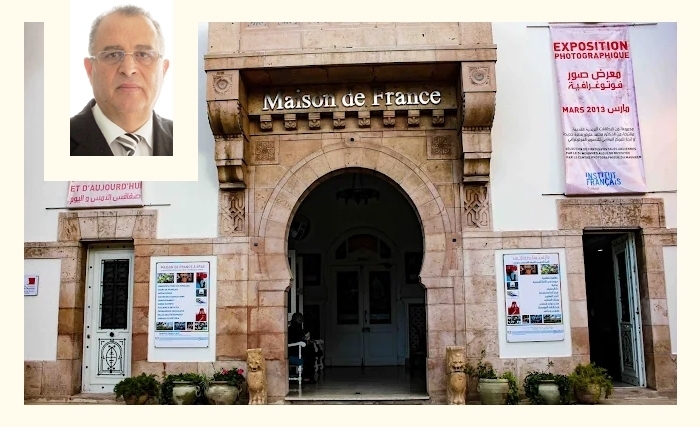
Written by Dr. Reda Al-Kalal is a historian and journalist – in the “European City” of Sfax, Bab Bahr, as we call it in our popular language, sits on Habib Bourguiba Street, an old building in the modern European style, decorated with masterpieces of local Tunisian engineering. It is the “Maison de France”, one of the buildings of colonial architecture. The Civil Controller, representative of the French authority, ruled from it and used it as his residence during the protectorate era. Then the French Vice-Consul lived in it from independence until the year 2004, and it was occupied by the French Institute in Sfax for 20 years (2006/2026). This building was built in 1897, that is, exactly 129 years ago, and it is still standing, attractive and elegant, with its European architecture, decorated with elements of the beauty of Arab-Islamic architecture and its garden. On the other hand, the architectural heritage that surrounds this building is creeping into obsolescence and neglect, with some falling apart and others being demolished…. Thus, over many years, architectural pollution has affected the buildings of the ancient city of Sfax and Bab B Bahr, with profound and successive changes, such as the architecture known as the Bank of Tunisia, the headquarters of the Sfax-Gafsa Company, and even the Kammoun building in front of the train station, which was a cosmopolitan architecture, in which Muslim, Jewish and Christian residents coexisted, as if it were A piece of Spain’s openness, closeness and tolerance. Cosmopolitan architecture is an urban style in which multiple cultures and civilizations intersect, and is clearly evident in several historical Tunisian cities, including La Goulette, Tunis, Sousse, and Sfax, and other Arab cities such as Alexandria, Casablanca, and Tangier. This is of course in contrast to the Sfax Municipal Palace, which stands tall, like the most beautiful municipal palaces in Tunisia during the era of the Tunisian Eyala. The oldest buildings in Bab Bahr: the Postal Palace (formerly the Radio) in 1892 and the Civil Control (currently the French Institute) in 1897. The House of France is in fact the second oldest building in the new city, the European city, established by the French protectorate, after the postal building in 1892, which was demolished in 1985 to build on its ruins a modern hostel that opened its doors in 1987. It has no connection to the historical architectural style on the main Habib Bourguiba Street. What is the history of this historic heritage building, which dates back to the end of the nineteenth century? Why did France choose to create this “harmony” between European/French architecture and local architecture? Did the year 1897 constitute a pivotal historical event in the French presence in Sfax and in the development of the city? How do we explain the opening of the port of Sfax in the same year, and in the same year the starting signal was also given for the railway linking Sfax and Gafsa-Metlaoui? 20 years since the founding of the French Institute in Sfax The French Institute in Sfax celebrates the 20th anniversary of its founding on May 16, 2026, at its headquarters in the “Maison de France”. This name, i.e. House of France, dates back to 2006, and the institute was established to spread French culture. The celebration falls within the context of Heritage Month, in which the Institute has traditionally participated with cultural and heritage institutions in the region, and which Tunisia commemorates annually in prominent events, to enhance awareness of the tangible and intangible cultural heritage. It coincides with a period in which UNESCO celebrates heritage globally, and ranges between International Day of Sites and Monuments (April 18) and International Museum Day (May 18). That is why this celebration of the 20th anniversary of the founding of the French Institute in Sfax was included in the core of this month, and under the banner of “Engineering Heritage.” This cultural/heritage/historical event was enough to raise a host of questions about the building, which was more than 100 years old, its architect, the historical context in which it was built, and the architectural philosophy that guided its design… Therefore, clarification requires that I point out that only two buildings were built in the last decade of the nineteenth century: the Post Office Building (1892) and the House of France (1897), and they were built, as stated in the engineering literature, according to the style Neo-Moreschi or Arabism, and I prefer to call it local Tunisian architecture, as heritage expert Dr. Nasser Al-Baklouti. Here are a number of other questions that are frequently asked: Who ordered this? This means that a political decision has been crystallized for this purpose? Who is the architect who designed it? The Civil Control Building, the oldest building in Bab Bahr. Works on the Civil Control Building were opened in October 1895. It was inaugurated by Jerome Vidal, the first Civil Controller and Vice-Consul in Sfax, on July 14, 1897, on the day that coincided with the celebration of the French National Day, or the French Revolution Day, which dates back to July 14, 1789. It is worth noting that the inauguration of the port of Sfax took place only 3 months ago, specifically on the 25th. April of the same year, in a huge celebration, with loud economic-political dimensions, and in the presence of a crowd of ministers, parliamentarians, consuls and journalists, a large number of whom came from the Metropolis. The Civil Controller represents the French Protectorate Authority and the Vice-Consul of France. He “rules” over a wide geographical area that includes 3 commands, namely the Sfax Command, the Skhira Command, and the Jebniana Command, which includes the Fifth Region and the military region in southern Tunisia. If we set the clock back to the year 1897, we find that this date carries broad and extremely important implications. The Civil Control Building (1897) can be included among the first buildings of the “New City,” the European city, outside the walls of the Old City, along with the Postal Palace, which became operational in 1892. The Postal Palace is an extension of the Postal Center that was established in 1861 in the French Quarter and was managed by Gilles Gou, who would become the first deputy commissioner of the Municipal Council from 1884-1909, given that the mayor is the head of the council, but in a formal manner. The year 1897 was accompanied by the laying of the foundation stone for the railway linking Sfax and Metlaoui, to export phosphate coming from the mines discovered by French veterinarian Philippe Thomas on the outskirts of Gafsa, between Jabal al-Thalja and Ras al-Ayoun, in April 1885. This discovery transformed the region into a major mining pole, where organized exploitation and its export through the port of Sfax began in 1899. And here too questions arise. Why did France choose to reach Sfax by this difficult railway, which is about 243 km away? It passes through completely desert areas and complains of a lack of water for works, while we find cities closer to Gafsa, and also on the coast, such as Skhira and especially Gabes! Anyway, sometimes the question is better than the answer. In general, the Civil Control Building in Sfax went through three clear and basic stages: 1897 – 1956: Offices of the Protection Authority and the residence of the Civil Controller/Deputy Consul. 1956 – 2006: Procuratorate, and a French cultural center. Note that the consulate was closed for two years from 2004 to 2006. 2006-2026: The building was named “House of France,” and a French cultural center was established, aiming to spread French culture. It works in partnership with local cultural institutions, teaching the French language to adults and children, providing a library containing 20,000 books, and opening a reception center for students wishing to continue their studies in France (Campis France)… Who is the architect who designed the Civil Control Building? He is the French architect Jean-Emile Rasplandy J-E Resplandy (1926 – 1866), which means that he worked on the design of this building when he was about 30 years old. It is known that he is the one who introduced modern art in Tunisia, and on its basis designed the municipal theater in the capital, which opened its doors on November 19, 1902, three months before the inauguration of the old municipal theater in Sfax on January 22, 1903. And once again the same question arises: how do we explain the move of the architect Resplanday from modern art to (neo-Morasque or Arabism, which we called local Tunisian architecture) in a matter of some time? The most famous? We add that another architect, Demerlé, was the one who designed the Post Palace building in the same style (local Tunisian engineering) 5 years ago. In other words, the only two buildings in Sfax before the end of the nineteenth century, in the New City/European City, which expanded on the sea after filling it in, are the Postal Palace building and the Civil Control Building. Based on the above, historical archives indicate that Raphael Guy is most likely to be the main architect of the Civil Control Building in Sfax, given his professional relationship with the architect Rasplandi, who worked with him in the same period, and had close relations with him. While we knew nothing about Raphael Guy’s relationship with Damerlai, the architect of the post office. “Half of knowledge is saying I don’t know” or “I don’t know.” The architect Raphael Guy founded the Arabization Engineering School in Tunisia and Sfax. The manifestations of colonial architecture in Tunisia cannot be understood except by returning to the French architectural experience in Algeria, in which French colonialism undermined the morphological structure of the Arab city. France benefited from the Algerian lesson, in which the “military general” imposed French authority on the land, on the stones, and on the people. That is why France changed its position after the occupation of Tunisia (1881) and then Morocco (1912) and drew for itself a road map to bridge the nineteenth and twentieth centuries, summarizing the new architectural philosophy of French policy, which is based on a mixture of modern European architecture and the Arab style. Who is Raphael Guy? When did he come to Tunisia? He said: “There is no contradiction between modern architecture and the Arab style.” The architect Raphael Guy (1869-1918) came to Tunisia in 1900, and he was the one who introduced the Arab style to Tunisia and his architecture became a school, from the beginning of the twentieth century or before that, until World War II, and he was known as the architect of the city of Sfax par excellence. Raphael Guy wrote the book “L’architecture moderne de style arabe” and published it in 1905, in which he presented an analysis directly related to Arabization in the field of public facilities and villas, in which he demonstrated that there is no contradiction or contradiction between modern architecture and the Arab style. This is why we find in European architecture manifestations of the vocabulary of local Tunisian architecture, such as serrated openings, along with the dome, courtyard, kadhal stone, wood, gypsum, wrought iron, and the lighthouse… With this political/architectural form, Tunisian cities moved from the authority of the “general” to the authority of the “architect.” Raphael Guy designed the old municipal theater in Sfax in 1903 and the majestic municipal palace in 1906, which is one of the most beautiful. The colonial architectural palaces of the municipalities in Tunisia were demolished in World War II, and the Public Works Building (1910) and the building known as the Tunisian Bank (1913) were decorated with extremely beautiful artistic decorations. The Municipal Theater, which was destroyed under American and British bombs on December 30, 1942, was extremely magnificent. The writer and poet Hedi Mellouli described it as a museum. As for the architecture, known as the Tunisian Bank, it has been around for years We hear painful cries about the state the building has reached in the heart of the city, despite the fact that the legal rule says that every problem has a solution, even by calling for necessary amendments to the law for the protection of heritage buildings. The Sfax-Gafsa headquarters, the Kammoun Building, and the municipal council have also become obsolete… We say this so that other heritage buildings will not be swept away, and so that the silence and the frantic race between demolition and heritage protection will be broken to save the remaining heritage buildings, protect our architectural identity, and supervise. To develop and restore them. There is no doubt that both the cultural authority and the municipality face many difficult tasks, including the desire of some real estate owners or investors to demolish these old heritage buildings, and turn them into residential and commercial investment “areas”, and to reap a quick and terrifying profit. Another problem that the two authorities face is how to prevent demolition in the absence of a sufficient budget, and for whom does this require raising the level of cultural awareness among public opinion in order to preserve and protect the heritage, as this is part of the national responsibility of Bab Bahr, the creative face of the city The ancient or historical city of Sfax remained for more than ten complete centuries rebuilding in the same way, almost without explicit change, and it did not establish a new and different geometric base. It certainly absorbed the appearance of ceramics and incorporated it into its architecture, as was the case with the Kadhal stone brought from Gabes, and it benefited from the ability of the craftsmen in decorating wood and drawing on crystal… It seems that despite this, for 10 centuries, it adhered to the one model, that is, stability. In a style that does not change, unlike Europe, for example, which has known, throughout its history, a series of architectural styles that reflect cultural, religious, and technical transformations, starting from ancient classicism, all the way to modern and contemporary architecture, the most prominent of which is classical architecture, Gothic architecture, the architecture of the “Ronasance” era, Baroque, and neoclassicism… The French architect, during his protection in Tunisia, absorbed the main architectural vocabulary within the ancient cities, and placed them on the facade of modern buildings, creating a new architecture emerging from the womb. Traditional ancient cities, and at the same time prepared European cities in their roads, gardens, and services and opened them to the future. The European city, with its different architectural style, its straightness, the breadth of its streets, and the nature of its furnishing, did not renounce the historical architectural heritage of the Arab city of Sfax, for example, which dates back to the middle of the ninth century AD. I believe that the European city reduced a lot of attraction and temptation through the vocabulary of local traditional Tunisian architecture and the idea that the colonizer wanted to market A new, shared building that calls for rapprochement, mixing, and “cultural integration.” The colonizer continued to flirt with Tunisian architectural models, and there is no doubt that he revealed, through the city’s ancient architecture, the sensitive areas in the Tunisian mentality and what his psychological and emotional principles suggest, and this is what justifies his specific choices, such as lighthouses, arches, and domes… And from here we realize these links between colonial policy and architecture. In the end, the stone appears neither deaf nor mute, because the immobility of this stone can speak, tell, and narrate, if we penetrate into it. Its significance, depth and history. The French architect Al-Muhannadi played a prominent role in determining the purpose of buildings and revealing their political, intellectual and cultural dimensions