
اخبار فلسطين – وطن نيوز
فلسطين اليوم – اخبار فلسطين اليوم
W6nnews.com ==== وطن === تاريخ النشر – 2026-03-02 14:30:00
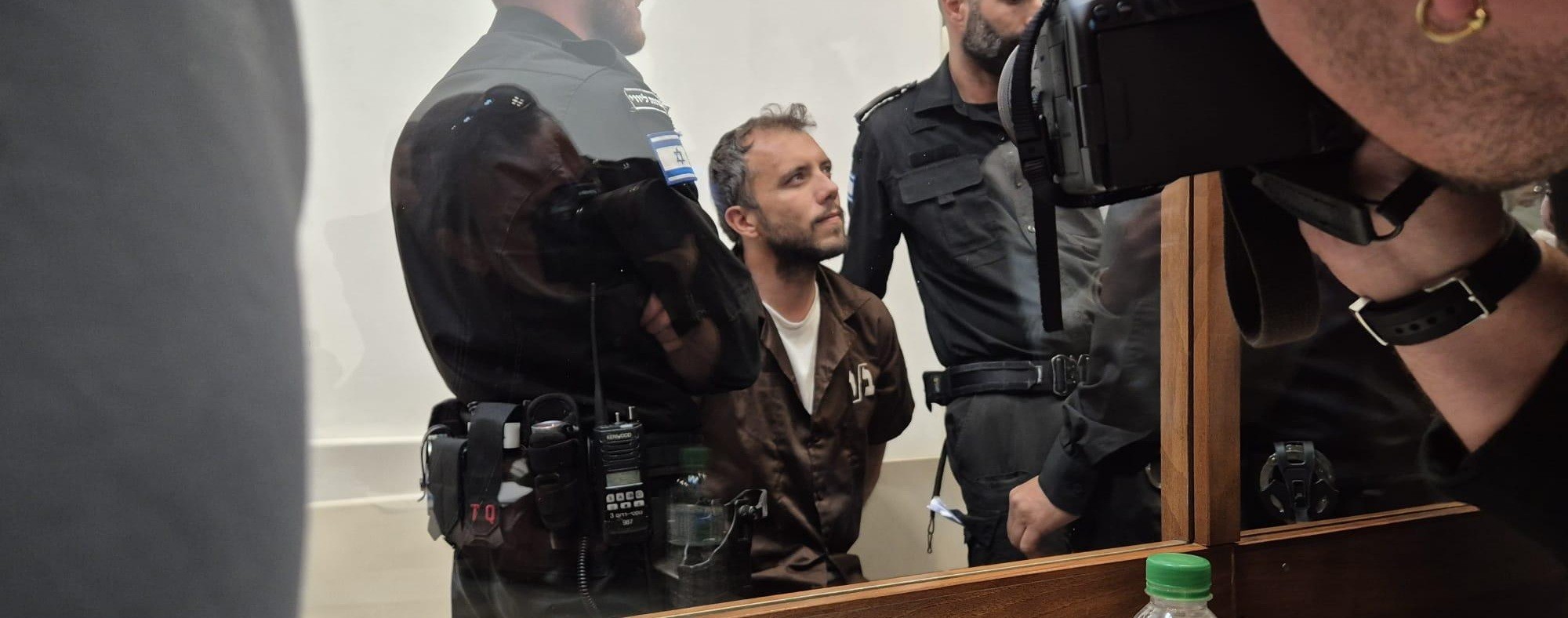
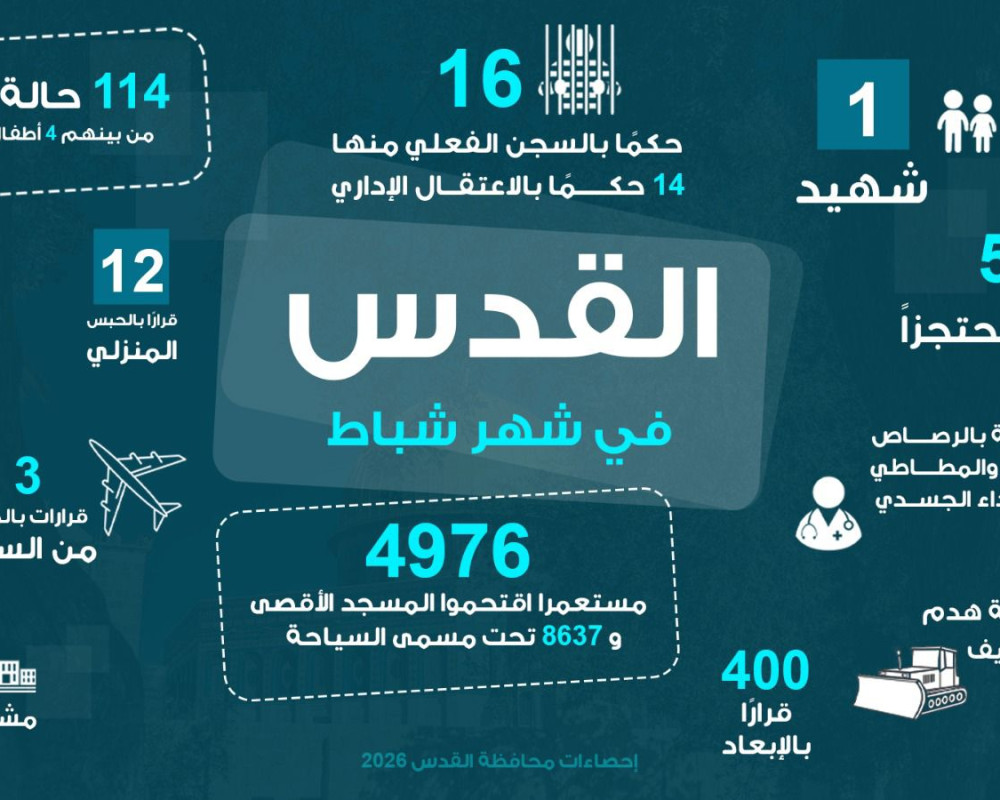
Jerusalem /PNN/The Jerusalem Governorate monitored the systematic crimes of the Israeli occupation in the governorate during the month of February 2026, as the occupation continued its measures aimed at imposing more restrictions on the city and its people. These crimes were topped by the ongoing attacks on the blessed Al-Aqsa Mosque, and the accompanying massive incursions of colonists under the protection of the occupation forces, and attempts to establish a new reality that affects the existing historical and legal situation. This was followed by the continuation of demolition and bulldozing operations in multiple neighborhoods of the city, the notification of dozens of facilities, the death of a martyr, and the recording of injuries among citizens as a result of direct attacks or field repression. Arbitrary detention campaigns also continued, and decisions of actual imprisonment and house arrest were issued against Jerusalemites, in addition to hundreds of decisions of forced deportation from the Blessed Al-Aqsa Mosque and the city of Jerusalem, in addition to moving forward in submitting and approving new colonial plans aimed at Judaizing the city and changing its demographic and geographic character. Martyrs: The young martyr Nasrallah Muhammad Jamal Abu Siam died from the town of Mikhmas, northeast of Jerusalem, as a result of his wounds sustained by colonialists’ bullets during an attack. On February 18, 2026, in a crime that falls within the escalation of terrorism by colonialist militias organized under the protection of the occupation. The colonists targeted the young man in his residential area, in the context of attacks that included shooting and burning homes and property. The town is subjected to repeated attacks to impose colonial facts. The people held his funeral the next day amid widespread condemnation. Crimes and violations in the Blessed Al-Aqsa Mosque: The month of February 2026 witnessed a qualitative and systematic escalation in Israeli violations against the Blessed Al-Aqsa Mosque, coinciding with the advent of the month of Ramadan, as the Jerusalem Governorate monitored the intrusion of (4,976) settlers into the courtyards of the mosque, along with (8,637) others who entered under the guise of so-called “tourism.” These raids were accompanied by dangerous steps, which included extending the morning raid hours during the holy month of Ramadan, allowing the performance of public and collective Talmudic prayers, implementing the so-called epic prostration, and distributing prayer sheets for Hebrew occasions, in addition to inciting the “Temple” groups to open Al-Aqsa to the colonizers throughout the holy month, including the last ten days, leading to the occupation closing the entire Al-Aqsa Mosque under the pretext of the “emergency law” against the backdrop of escalation. Regional.Injuries: During the month of February 2026, the Jerusalem Governorate recorded a total of (33) injuries, distributed among injuries with live and rubber bullets, cases of severe beatings, injuries with tear gas, in addition to injuries sprayed with pepper gas by the colonists. The injuries were concentrated around the apartheid wall, the Qalandiya checkpoint, and the towns of Al-Ram and Abu Dis, where (7) injuries were recorded among workers and young men as they attempted to cross or near the wall. These violations confirm that the extreme right-wing occupation government continues to unleash its forces and colonists to carry out its attacks against Jerusalemites with legal cover and military protection, in a scene that reflects official complicity and a deliberate policy of impunity. Colonists’ attacks: During the month of February 2026, the Jerusalem Governorate monitored the colonists carrying out (47) attacks, including (9) attacks with physical harm, one of which led to the martyrdom of the young man Nasr. Allah Abu Siam from the town of Mikhmas, north of Jerusalem, in the context of an organized, multi-level escalation that targeted the blessed Al-Aqsa Mosque, Bedouin communities, private property, and Islamic and Christian sanctities. The attacks included shooting, burning property, blocking roads, persecuting shepherds, storming and vandalizing homes, and attacks on churches, under the direct protection of the occupation forces, reflecting the complementarity of roles between colonial groups and the extreme right-wing government to impose new realities on the ground and undermine the existing situation. Cases of arrests: During the month of February 2026, the Jerusalem Governorate observed a remarkable escalation in the policy of repression and arrest pursued by the Israeli occupation authorities against Jerusalemites, as It documented the arrest of (114) citizens, including (3) women and (4) children, as part of a systematic campaign targeting various areas of the occupied city of Jerusalem. These arrests were accompanied by widespread raids into homes and neighborhoods, and field arrests at checkpoints and roads, with the use of excessive force, beatings, intimidation, and insults. The arrests were distributed across multiple areas, most notably: the town of Hizma, Shuafat Camp, Anata, Silwan, Al-Issawiya, Qalandia Camp, Kafr Aqab, Beit Daqu, Bab Al-Amoud neighborhood, in addition to the vicinity of the blessed Al-Aqsa Mosque. They also included a number of freed prisoners, activists, and journalists. Decisions of the occupation courts against detainees: The Israeli occupation courts continue to issue arbitrary decisions against Jerusalemites, including imposing strict restrictions on movement, in addition to financial fines. The high costs that burden families, the imposition of forced home confinement, deportation decisions, and travel bans. These courts also continued to extend arbitrary administrative detention without bringing specific charges, in some cases for long periods, which is a flagrant violation of human rights and the basic principles of legal justice. Actual imprisonment: During the month of February 2026, the Jerusalem Governorate monitored the continuation of the Israeli occupation’s repressive policy against Jerusalemite prisoners, as it documented the issuance of (16) rulings and decisions, including (14) administrative detention, within the framework of the escalation of the use of this arbitrary measure against marabouts, civil servants, and minors. And journalists, through repeated renewals and transfers to actual prison without clear charges. Actual imprisonment sentences and financial fines were also issued, in a clear continuation of the policy of repression and legal terrorism directed against Jerusalemites. Home detention: During the month of February 2026, the Israeli occupation authorities continued the policy of forced deprivation of liberty through home detention against Jerusalemites, targeting in particular young people and journalists, as a punitive tool alternative to direct arrest. During this month, the Jerusalem Governorate monitored (12) house arrest decisions, accompanied by strict conditions that included temporary deportation and a ban on the use of telephones and social media, in a step aimed at restricting their civil and media activity and silencing their voices. Deportation Decisions: During the month of February 2026, the Israeli occupation authorities continued the policy of arbitrary forced deportation against Jerusalemites, using this measure as a punitive means targeting those stationed in the service of Al-Aqsa Mosque, journalists, activists, and freed prisoners, And the students, as part of systematic efforts to empty the city of its religious and national symbols. During this month, the Jerusalem Governorate monitored (400) deportation decisions from the blessed Al-Aqsa Mosque and the Old City, noting that the actual number may be higher, in light of the severe restrictions and the threat of those deported to renew the decisions in the event of making any media statements, in addition to informing some of them via text messages on the “WhatsApp” application. Travel ban decisions: During the month of February 2026, the Israeli occupation authorities continued to use the travel ban as an arbitrary punitive tool against Jerusalemites, targeting religious figures. Patriotism and young Jerusalemites, in the context of a policy aimed at restricting freedom of movement and tightening control over the city. During this month, the Jerusalem Governorate monitored (3) travel ban decisions, which included renewing the travel ban against Hanadi Al-Halawani, in addition to preventing the two young men, Subeih Abu Subaih and Mahmoud Al-Taryaki, from traveling and confiscating their passports. Demolition, bulldozing, and property confiscation operations: The Jerusalem Governorate monitored (49) demolition and bulldozing operations, divided into (15) forced self-demolition operations in which Jerusalemite citizens were forced to demolish their homes with their own hands, and (27) A demolition operation carried out by the occupation mechanisms and its municipalities, in addition to (7) bulldozing operations targeting Palestinian lands and property. Data indicate that the demolition operations were distributed among several towns and neighborhoods in Jerusalem, including Silwan, Beit Hanina, Sur Baher, Al-Issawiya, Jabal Al-Mukaber, Shuafat, and other neighborhoods, within the framework of a systematic policy aimed at imposing forced displacement and destroying the sources of livelihood of Jerusalemites. Demolition decisions, forced evictions, and land confiscation: during the month of February In 2026, the Israeli occupation authorities continued the policy of notifications, demolitions, evictions, and confiscations against Palestinians in the Jerusalem Governorate, which reflects a dangerous escalation that threatens the city’s residents, its sanctities, and the livelihoods of Jerusalemite families. During this month, the Jerusalem Governorate documented the issuance of (143) notices, divided into (125) demolition decisions, (16) eviction decisions, and (2) confiscation decisions, which reflects a remarkable escalation in the pace of violations, especially in Waar Al-Bik in the town of Anata, the Batn Al-Hawa neighborhood in the town of Silwan, the Wadi Saab and Wadi Al-Awaj neighborhoods east of Al-Eizariya, and the Al-Bustan and Umm Al-Shakhalib neighborhoods east of Abu Dis. Which constituted major targeting hotspots for the benefit of settlement associations and occupation measures. Targeting of national and religious figures: During February 2026, the Jerusalem Governorate witnessed the continuation of the occupation’s systematic policy of targeting Palestinian religious and national leaders, in an attempt to stifle Jerusalemite discourse and isolate influential figures, through arbitrary ban, deportation and restriction decisions and judicial and administrative prosecutions. On February 5, 2026: The occupation authorities banned the Minister of Jerusalem Affairs, Ashraf Al-Aawar, from entering the West Bank, as confirmed by lawyer Khaldoun Najm, which prevents him from exercising his official duties within the Palestinian government. On February 16, 2026: The occupation police arrested the Imam of Al-Aqsa Mosque, Sheikh Muhammad Ali Al-Abbasi, and handed him a deportation order from Al-Aqsa. On February 17, 2026: The occupation authorities renewed the deportation of Jerusalem Chief Justice Sheikh Iyad Al-Abbasi for a period of 6 months via “WhatsApp”. Crimes and violations against Jerusalem institutions and monuments. During the month of February 2026, the Jerusalem Governorate witnessed a series of systematic Israeli violations targeting Jerusalem institutions and monuments, including preventing the occupation forces from holding an honorary meeting in the Al-Qibli prayer hall in Al-Aqsa for male and female students of the Supreme Islamic Council after passing the fasting fatwa exam. And zakat, and carrying out a continuous attack through repeated spitting by settlers at the entrance to the Armenian Church in the Old City, storming the house of the head of the National Conservatory of Music and the Yabous Cultural Center and handing him a summons for investigation in conjunction with the storming of the center, and closing the headquarters of the Burj Al-Luqluq Foundation in the Old City by a decision of the Minister of National Security that included all of its facilities except kindergartens after storming it and besieging those present and smashing its doors, preventing the entry of breakfast meals for those who are fasting and imposing restrictions on the employees of the Endowments Department, and demanding the Deputy Mayor The occupation evacuated an UNRWA institute in Qalandiya as part of a policy of restricting the work of the educational agency, and targeted the Visitation Church in the displaced Ein Karem with racist slogans written on the walls and surrounding vehicles, and stormed Al-Rahman Mosque in Beit Safafa and imposed a violation under the pretext of raising the call to prayer as part of a series of restrictions on Islamic sanctities, and classified five Palestinian media platforms as “terrorist,” in an attempt to limit independent media work. Colonial projects: Monitored Jerusalem Governorate during January 2026, a continuation of Israeli colonial policies aimed at strengthening control over the Jerusalem Governorate, through extensive settlement plans that included construction, land seizure, and colonial expansion. The governorate documented, based on the daily follow-up of official announcements issued by the so-called “Civil Administration” and the occupation municipality in Jerusalem, in addition to what was documented by the Orient House Center, a total of (20) colonial plans during the month. The data showed that among these plans, (7) plans were deposited, and include the construction of (613) colonial units on a total area of (960,188) dunams, while the approval was made for (5) Settlement plans that include the construction of (51) colonial units on an area of 40,168 dunums, in addition to offering a plan for tender that includes the construction of (231) colonial units.