
اخبار البحرين – وطن نيوز
W6nnews.com ==== وطن === تاريخ النشر – 2026-04-26 15:25:00
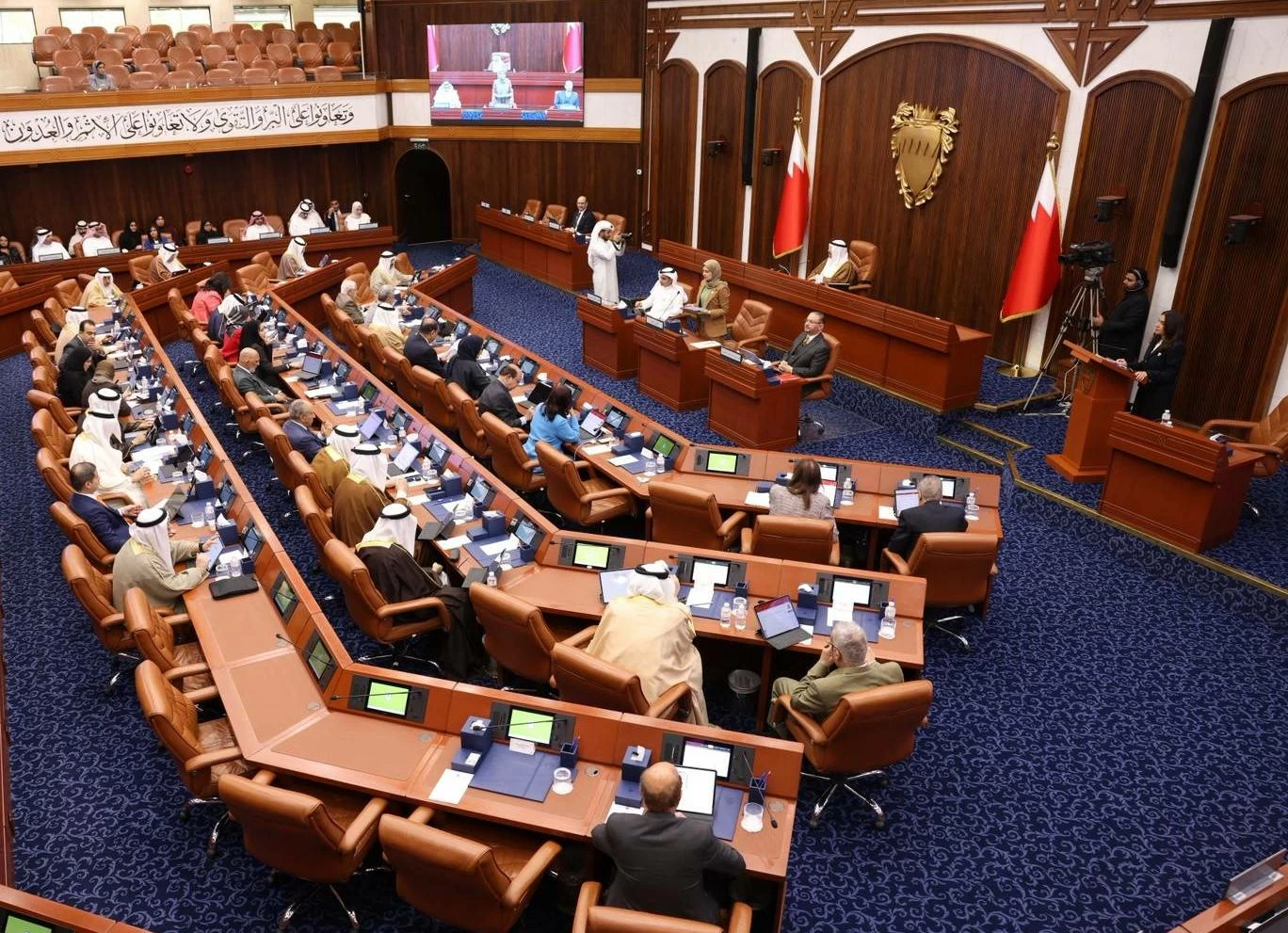
His Excellency Mr. Ali bin Saleh Al-Saleh, Speaker of the Shura Council, chaired this morning (Sunday) the twenty-eighth session of the Council in the fourth session of the sixth legislative term, in the presence of His Excellency Mr. Ghanem bin Fadl Al-Buainain, Minister of Shura and Representatives Council Affairs, His Excellency Eng. Wael bin Nasser Al-Mubarak, Minister of Municipal Affairs and Agriculture, His Excellency Dr. Muhammad bin Mubarak bin Dinah, His Excellency Mr. Yousef bin Abdul Hussein Khalaf, Minister of Labor and Minister of Legal Affairs, and His Excellency Mr. Nawaf bin Muhammad. The Minister of Justice, Islamic Affairs and Endowments, and His Excellency Mr. Abdullah bin Adel Fakhro, Minister of Industry and Trade. The session began its work by ratifying the minutes of the previous session, before Her Excellency Ms. Karima Mohammed Al-Abbasi, Secretary-General of the Shura Council, presented the messages received from His Excellency Mr. Ahmed bin Salman Al-Musallam, Speaker of the House of Representatives, regarding what the House of Representatives concluded regarding a draft law approving the accession of the Kingdom of Bahrain to the Locarno Agreement regarding establishing an international classification for industrial designs, signed in Locarno on 8 October 1968 AD and amended on September 28, 1979 AD, accompanying Decree No. (77) of 2025 AD, and notifying the Council of referring it to the Foreign Affairs, Defense and National Security Committee with notification of the Legislative and Legal Affairs Committee, as well as a draft law to ratify amending some provisions of the Organization of Arab Petroleum Exporting Countries Agreement, accompanying Decree No. (6) of 2026 AD, and notifying the Council of referring it to the Committee of Foreign Affairs, Defense and National Security with notification of the Legislative Affairs Committee The Council was also notified of a draft law adding a new clause No. (8) to Paragraph (C) of Article (8) of Decree Law No. (78) of 2006 regarding unemployment insurance, attached to Decree No. (24) of 2026 AD, and notifying the Council of referring it to the Services Committee with notification of the Legislative and Legal Affairs Committee, as well as a draft law amending some provisions of Decree Law No. (54) of 2002 AD regarding the internal regulations of the House of Representatives. (Prepared based on the proposal for a law submitted by the House of Representatives, and notifying the Council of referring it to the Legislative and Legal Affairs Committee). While the Council was notified of a draft law adding a new article No. (19 bis) to the Traffic Law promulgated by Law No. (23) of 2014 AD (prepared based on the proposed law – as amended – submitted by the House of Representatives, and notifying the Council of referring it to the Foreign Affairs, Defense and National Security Committee with notification of the Legislative and Legal Affairs Committee, as well as a draft law amending Article (19) of The Traffic Law promulgated by Law No. (23) of 2014 AD (prepared based on the proposal for a law submitted by the House of Representatives, and notifying the Council of referring it to the Foreign Affairs, Defense and National Security Committee with notification of the Legislative and Legal Affairs Committee. The Council then moved to discuss the report of the Foreign Affairs, Defense and National Security Committee on a draft law ratifying the amendment of some provisions of the Organization of Arab Petroleum Exporting Countries Agreement, attached to Decree No. (6) of 2026 AD. The committee’s rapporteur, His Excellency Dr. Bassam Ismail Al-Bin Mohammed, confirmed that The amendments made to the Organization of Arab Petroleum Exporting Countries agreement came in response to the rapid transformations in the energy sector, as the organization’s competencies expanded to include various energy fields, thus enhancing its ability to keep pace with regional and international developments and serve joint Arab action, noting that the amendments included abolishing the organization’s previous judicial body and replacing it with modern mechanisms for settling disputes, starting with amicable settlement and ending with arbitration, which is consistent with modern international trends in managing disputes within international organizations, and enhances the organization’s flexibility in Addressing controversial issues. The Council decided to agree to take the final opinion approving the draft law as a matter of urgency, and send it to the Speaker of the House of Representatives to refer it to His Highness the Prime Minister in preparation for submitting it to His Majesty the King. The Council discussed the report of the Legislative and Legal Affairs Committee on a draft law promulgating the Law on the Legal Profession, attached to Decree No. (16) of 2025 AD. The Committee’s rapporteur, His Excellency Dr. Adel Abdul Rahman Al-Muawadah, confirmed that the draft law aims to establish a legislative framework. An advanced regulation of the legal profession that contributes to achieving the goals of the comprehensive development process consistent with the Kingdom’s Economic Vision 2030, and keeps pace with the requirements of sustainable development, which requires issuing a new law to regulate the legal profession that keeps pace with these developments, and contributes to achieving that vision by developing the legal profession and its professional standards in the Kingdom, and raising the efficiency of the profession’s practitioners by enhancing professional competitiveness in the legal field in order to provide legal services to its beneficiaries in accordance with the best modern international practices, which also contributes to strengthening the investment environment through a justice system. It is developed and considered one of the most important factors for attracting and stabilizing foreign investments. Al-Mawada pointed out that the legal profession – in its origin and the essence of its rules – is a free profession practiced independently by lawyers, and represents a fundamental pillar in assisting the judicial authority in establishing the rule of law and achieving justice as a desired final goal. She explained that she had completed a careful study of the draft law and examined all of its articles, and looked closely at the decision of the esteemed House of Representatives regarding it, and was firmly certain that it was free of any It conflicts with the provisions of the Constitution and the established constitutional principles, and therefore it concludes that it is sound from a constitutional standpoint. Al-Mawada explained that the draft legal profession law has met the requirements for its soundness, and that it comes to be an integrated alternative to the existing legislation, through a more developed legal system that keeps pace with the rapid developments that have occurred in the legal profession locally and internationally, and works to reformulate the legal frameworks established therein in a way that ensures updating the provisions and ensuring the efficiency of professional performance, indicating that it has influenced In order to clarify the features of the draft law, highlighting the new texts and amended provisions contained in the draft law, as they are the fundamental reason for the change and the axis of the desired development. The Council decided to agree to take the final opinion approving the draft law as a matter of urgency, and send it to the Speaker of the House of Representatives to refer it to His Highness the Prime Minister in preparation for submitting it to His Majesty the King. The Council discussed the report of the Foreign Affairs, Defense and National Security Committee on a draft law approving the Kingdom of Bahrain’s accession to the Locarno Agreement on Establishing an international classification for industrial designs, signed in Locarno on October 8, 1968 AD, and amended on September 28, 1979 AD, accompanying Decree No. (77) of 2025 AD. The Committee’s Rapporteur, Her Excellency Mrs. Nancy Dina Elie Khaduri, indicated that the accession of the Kingdom of Bahrain to the Locarno Agreement contributes to strengthening the protection of industrial innovation by establishing an integrated system compatible with international standards, ensuring the preservation of the rights of designers and rights holders, and creating an environment It supports creativity and development, and enhances the efficiency of the intellectual property system in the Kingdom. The agreement aims to unify the technical and regulatory procedures related to the registration and examination of industrial designs, in order to establish unified standards that enhance transparency, raise the efficiency of institutional performance, and reduce disparity between countries, leading to a more disciplined and reliable system at the local and international levels. The Council decided to agree to take the final opinion to approve the draft law as a matter of urgency, and send it to the Speaker of the House of Representatives to refer it to His Highness the Prime Minister in preparation for submitting it to His Majesty the King. While the Council discussed the report of the Services Committee on a draft law adding a new clause No. (8) to Paragraph (C) of Article (8) of Decree Law No. (78) of 2006 AD regarding unemployment insurance, accompanying Decree No. (24) of 2026 AD, which aims to introduce an exceptional and temporary provision within cases of disbursement from the unemployment insurance account, by adding a new clause that allows the use of the resources of this system in Paying the wages of insured Bahraini workers for a specific month, which is April 2026, with a maximum that does not exceed the insured wage, while adhering to the general controls mentioned in Paragraph (e) of the same article. The Committee’s Rapporteur, Mrs. Lina Habib Qasim, indicated that the draft law reveals a legislative expansion from the traditional function of the unemployment insurance system, which is limited to compensating the unemployed, to a proactive protective mission aimed at preserving the stability of existing labor relations and preventing their transformation into cases of actual unemployment, in In light of the exceptional economic conditions imposed by the regional situation, Qasim explained that the draft law represents a direct tool for dealing with the economic repercussions in a way that contributes to stabilizing income, maintaining levels of demand, and avoiding the cascading effects that may result from a decline in purchasing power. This intervention also reflects a legislative awareness that dealing with crises extends to protecting its economic and social structure from gradual erosion. The Council decided to agree to take the final opinion to approve the draft law as a matter of urgency, and send it to the Speaker of the House of Representatives to refer it to His Highness the Prime Minister. In preparation for submitting it to His Majesty the King. The Council also discussed the report of the Services Committee on a draft law amending Article (144) of the Social Insurance Law promulgated by Decree Law No. (24) of 1976 AD, prepared based on the proposal for a law submitted by the esteemed House of Representatives. The Committee Rapporteur, His Excellency Dr. Ibtisam Muhammad Saleh Al-Dallal, indicated that the draft law aims to make private sector retirees equal to public sector retirees (government sector) with regard to pension replacement loans, as they are implemented in Law No. (13) of 1975 regarding the organization of retirement pensions and benefits for government employees every two years from the last replacement, which is an appropriate period, while the private sector retiree cannot renew the replacement loan until two years after paying the last installment of the last replacement, which is a long period. The draft law came to make the second category equal to the first category in the interim period necessary to obtain a new replacement loan. Al-Dallal indicated that reorganizing the time periods regulated for benefiting from these loans, and unifying them between the two sectors, would contribute to expanding the scope of Utilizing it, which is reflected in increasing the volume of transactions related to it in an orderly manner, which results in enhancing the financial returns achieved by the Authority, and supporting its ability to generate more regular and stable financial flows, which contributes to strengthening its financial position. The Council decided to agree to take the final opinion on the final approval of the draft law as a matter of urgency, and send it to the Speaker of the House of Representatives to refer it to His Highness the Prime Minister in preparation for submitting it to His Majesty the King. The Council also discussed the report of the Public Utilities and Environment Committee on the draft law. A law regulating the possession and circulation of dangerous animals, attached to Decree No. (15) of 2025 AD. The committee’s rapporteur, His Excellency Mr. Reda Ibrahim Monfaridi, confirmed that the draft law aims to regulate legal responsibility in the possession, circulation and care of dangerous animals, as it is one of the pieces of legislation through which the legislator seeks to balance the protection of dangerous animals by legalizing and regulating the acquisition of this type of animal, and the protection of humans whose safety may be threatened by the presence of dangerous animals without any restrictions on the acquisition Defining dangerous animals, and so that it would not be difficult for those addressed by the provisions of this law to identify these animals, the minister was entrusted with the task of defining them by decision after the approval of the Council of Ministers. Monfardi pointed out that the draft law prohibited the possession and circulation of dangerous animals without a license and restricted it to specific entities such as zoos, animal parks, circuses, centers and research institutions, and obliged these entities to register dangerous animals in a register with the competent administration, provide care for them, including veterinary care, vaccinate them against diseases, and provide places Safe and appropriate housing for them, feeding them with appropriate food, not leaving them unattended while taking the necessary precautions and measures to ensure that they do not lose or escape, not transferring their possession to another facility or not moving them from one place to another within the Kingdom or transporting them by way of transit except after obtaining the approval of the competent administration, are all controls that lead to achieving the objectives of the draft law and enhancing protection in society from the dangers of these types of animals. The Council decided to agree to take the final opinion by approving the draft law as a matter of urgency and sending it to the Speaker of the House of Representatives. To refer it to His Highness the Prime Minister in preparation for submitting it to His Majesty the King. The Council also discussed another report of the Legislative and Legal Affairs Committee regarding a draft law amending some provisions of Decree Law No. (54) of 2002 regarding the internal regulations of the House of Representatives, which aims to develop the oversight performance entrusted to the House of Representatives, represented by the request to interrogate ministers, and the optimal use of interrogation tools. The committee’s rapporteur, Her Excellency Mrs. Sabeeka Khalifa Al-Fadala, confirmed that the draft law leads to the removal of what The progress of the interrogation may be hindered by obstacles that may be due to the two-thirds majority quorum stipulated in the effective text, which would enhance the supervisory role of that tool. Al-Fadhala indicated that adding a third paragraph to Article (146) takes into account the circumstances of some interrogations if the Council’s will is to discuss the interrogation in the Council directly without referring it to the relevant committee, as the proposed paragraph allows the interrogation to be discussed in a secret session at the request of the government, the President of the Council, or ten members of the Council. At least from its members. If two-thirds of the Council members reject this request, the interrogation will be discussed in a public session. The Council decided to agree to take the final opinion for final approval of the draft law as a matter of urgency, and send it to the Speaker of the House of Representatives to refer it to His Highness the Prime Minister in preparation for submitting it to His Majesty the King.