

اخبار تونس- وطن نيوز
اخر اخبار تونس اليوم – اخبار تونس العاجلة
W6nnews.com ==== وطن === تاريخ النشر – 2026-03-13 09:11:00
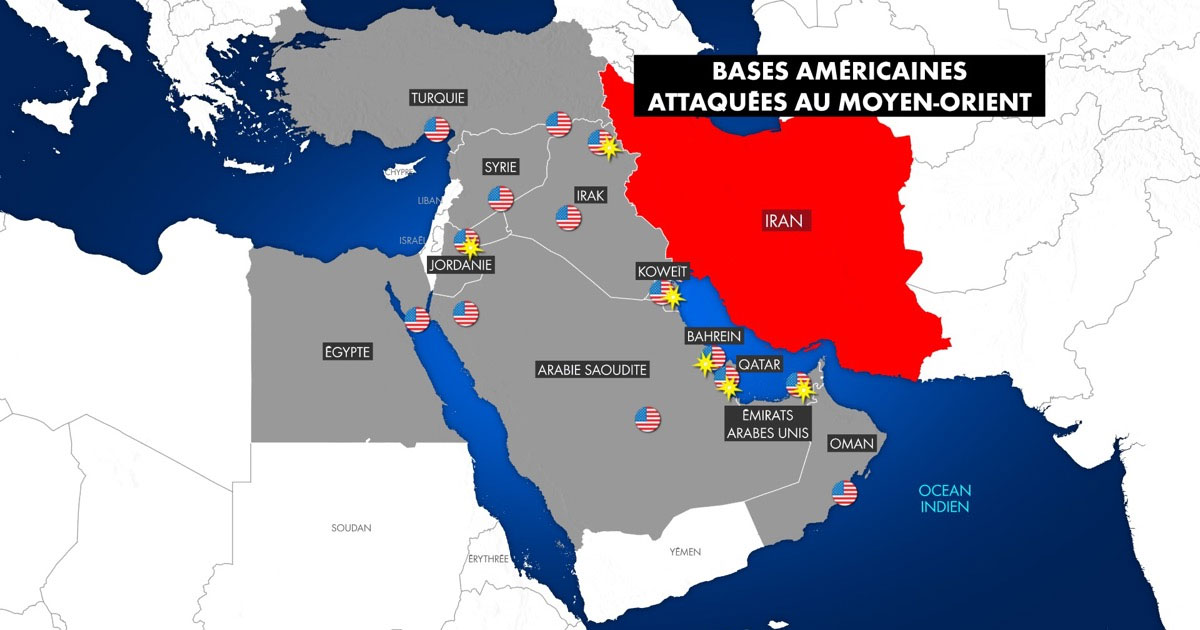
In light of the current conflicts, countries hosting foreign military bases are turning into a “response arena” or potential military targets, which puts their national security at risk of conflicts in which they are not a direct party. These bases are used as launching pads for offensive military operations, embarrassing the host countries in front of their neighbors or the international community. The war currently taking place in the Middle East and the Gulf states has proven that betting on foreign military bases for protection is a failed bet, and more than that, it brings aggression. (US military bases in the Middle East that were subjected to attacks from Iran.) Reda Ben Salama * The war raging in the Middle East is likely to result in “splitting repercussions,” and will represent a very important turning point in the geopolitical balances in the region and in the world. These current events are no longer just a traditional round of escalation, but have turned into a geopolitical earthquake that strikes the foundations of balances that have been stable for decades. The current conflict has broken the old rules of engagement and demonstrated that military technological superiority alone is no longer sufficient to resolve conflicts in long wars of attrition. The Middle East remains a major arena for international competition (America, Russia, China), the dangers of which have worsened under the weight of Israeli tyranny in exterminating the Palestinian people and making their rights dependent on the President of the United States of America taking this dangerous risk. Any new security arrangements will be closely linked to the shape of the next world order. Major economic and political projects have complicated their paths, awaiting the outcome of the war. This is with the emergence of new “axes” and the crystallization of two fronts, one seeking stability through more reliable international alliances, and the other adopting an approach of resistance and changing the balance by force, which makes the “central region” gradually narrow and expand to create a rift in international legal and human rights concepts, which will affect how future crises are managed globally. The birth of a world with a new security and political structure. The “day after” this war will not be a return to the past, but rather the birth of a world with a completely new security and political structure. The repercussions of the current conflict in the Middle East, which Israel continues to ignite, go beyond to touch vital joints in the global system. These effects can be summarized on several levels. On the economic and financial level, global markets are witnessing sharp jumps, as the price of a barrel of Brent exceeded $84 (March 2026) as a result of fears of disruption to supplies through the Strait of Hormuz, through which about 20% of global oil consumption and 20% of liquefied gas pass. This would lead to higher shipping costs, disruption of supply chains (especially in the Red Sea), and additional inflationary pressures, which could push central banks to postpone reducing or raising interest rates again. The insane rise in sea freight costs (an increase of 260% according to some indicators in 2024) will directly affect the prices of consumer goods globally. On the geopolitical and security level, direct confrontations between regional powers (such as Iran and Israel) have led to a redrawing of the map of alliances, with an increase in the direct military involvement of major powers such as the United States. The conflict demonstrated the decline in the ability of traditional powers to impose their presence by force, which opened the way for greater roles for other regional and international actors such as China and Russia. When saying “the fragmentation of the repercussions,” the meaning indicates that the prominent repercussions resulting from an adventure that did not, from its inception, have a clear declared path and goals, but rather divided and branched out randomly (fragmentation), which made controlling the situation or understanding its dimensions a very complicated matter, in which Israel plays the role of the arsonist. In the midst of all this, the dilemma of foreign military bases is at the forefront of the constant tension between the gains of “security and alliance” and the costs of “sovereignty and security risks.” As host countries seek to strengthen their defenses and geopolitical position, major legal and political problems are emerging that make these rules a double-edged sword. There is always a question about whether the military base is an “occupied territory” or a hosted facility. Immunity is known as the Status of Forces Agreement (SOFA), which is a legal framework that defines the rights and duties of foreign forces stationed in a host country with their consent. The issue of immunity from local courts in these agreements revolves around protecting foreign soldiers from legal procedures that may be considered unfair or politicized, and to ensure the continuity of military control and discipline of the sending state over its forces, which raises popular anger when violations occur. Doubts are growing about Washington’s reliability towards its “allies.” In light of the current conflicts, host countries are turning into a “response arena” or potential military targets, putting their national security at risk of conflicts in which they are not a direct party. These bases are used as launching pads for offensive military operations, embarrassing the host countries in front of their neighbors or the international community. On the other hand, reliance on foreign bases weakens the host country’s self-defense capacity building. With the change of administrations in major powers (such as the current US administration’s tendencies), fears arise of sudden withdrawal or the use of the rules as political and economic pressure cards. It is noted that the events of the war sparked widespread debate about the legitimacy of the Iranian response that affected American bases in Arab countries, and the distinction between “ownership” and “territorial jurisdiction” over those lands. At the same time, doubts increased about Washington’s reliability towards its “allies.” Foreign military bases remain surrounded by a “security dilemma” that puts the host country in a constant state of worry about losing control over its sovereign decision or being drawn into others’ wars. These military bases are often seen as a sign of power imbalances because they are the result of “pressure” or “mismanagement.” In many cases, the rule is not an option but a “price” for certain guarantees or to avoid the worst protection in exchange for sovereignty, where militarily “weak” states accept the existence of rules to protect their political system or borders from a strong neighbor, making them at the mercy of the permanent “bargain” from the superpower. Sometimes the rules are used as a means to relieve financial pressures or as part of major deals that include economic aid, which some see as “depending” on the state’s decision. Management error and short-sightedness (legitimacy crises) This point is considered the most controversial, as Al-Qaeda is seen as a failure in strategic management. An authority suffering from weak popular legitimacy may resort to bringing in foreign forces as an undeclared “private guard,” which is a grave management error because it leads to a deep gap with society. Failure to build a strong and capable national army pushes the state to fall into the “dependence trap,” where the presence of foreigners becomes a technical necessity and not a political option. The mistake in management here lies in miscalculation and bringing the danger of wars to the state’s territory without having any say in those conflicts. Some realists believe that there is a third type, which is “equal partnership” (such as American bases in Japan or Germany), but even these models face massive popular protests in which they see a “management error” that dates back to the Cold War era and is no longer appropriate. Any foreign military presence is a derogation of the state’s dignity and the independence of its decisions, regardless of the justifications. Countries that adopt “principled rejection” often seek to achieve independent, sovereign decision-making to ensure that state lands are not used as a launching pad for attacks or as pressure cards in conflicts that do not belong to them, and to avoid internal tension caused by the presence of foreign soldiers who enjoy legal immunities above the local judiciary. Refusal often pushes the state towards a policy of “neutrality”, which is a difficult path that requires great diplomatic skill to avoid the hostility of the great powers, which may see refusal as “hostility” or “throwing into the arms of the opponent.” Historically, countries that allowed foreign bases “under pressure” found it extremely difficult to remove them later, as these rules turn into a fait accompli that are difficult to change except through political upheavals or wars, which confirms that prohibition from the beginning is the safest option for long-term sovereignty. However, there are deep security agreements that may be more dangerous and more subtle than the actual base, for several reasons that make it a “hidden military base.” These agreements grant the foreign country the right to use airports, ports, airspace, and store equipment. In this case, the territory is not permanently “militarily occupied,” but is “ready for use” at any moment. The danger here remains that the host country becomes a military target for adversaries without even having the right to daily oversight of what happens inside those facilities. These deep agreements often include technical and information dependency and reliance on foreign intelligence and communication systems that leave national secrets completely exposed. When officers and commanders are trained according to a foreign country’s doctrine, the national army becomes a strategic “extension” of that country, even without a single foreign soldier on the ground. Security agreements are often concluded in closed rooms and under “secret” terms. It also grants privileges (such as the right of passage or eavesdropping) that the average citizen does not see, which makes it easy for the authority to pass them on without noise, and here they fall within the category of “mismanagement.” The trap of “coercive association” creates a state of dependency, as the state cannot change its political compass because its entire defense system (spare parts, radars, software) is in the hands of the other party. This “technical occupation” takes away the will of the state without the need to deploy a single soldier. The actual base is “apparent occupation,” while the deeper agreements are “structural occupation.” The first provokes national sentiment and pushes for resistance, while the second silently undermines state sovereignty and makes independence a mere outer cover. Complete abolition is the only requirement that achieves sovereignty, while “transparency” may turn into just a tool to legislate the existence of these rules. If the existence of the rule or agreement is the result of “pressure” or “mismanagement,” then transparency will not change the fact of the deprivation of sovereignty. Abolition here means restoring the decision and getting rid of dependence on external agendas. End the “military target” status imposed by foreign forces. Forcing the great powers to deal with the state as a political partner, not as a geographical arena. Transparency is a good step in stable democracies, but in the case of military bases it can be a political anesthetic. Publishing the details of the agreement may aim to make the foreign presence “legal” and acceptable under technical or economic justifications. The agreements may be presented to mock parliaments for approval, thus turning the “management error” into a “legal obligation” that is difficult to reverse internationally. Although abolition is the ultimate goal, realists believe that transparency is the weapon that reveals the extent of concessions. Once the people know the details of “immunities” and “privileges,” popular pressure arises that makes “abolition” inevitable and supported by a national will. The principle that rejects the establishment of rules cannot be satisfied with knowing the terms of the “lease,” but rather seeks to end the “contract” from its foundations. Adopting this position places sovereignty as a supreme value that is not negotiable, going beyond the logic of “immediate interest” that the authorities invoke. In the current geopolitical reality, the application of this principle faces major challenges. “The price of sovereignty,” despite its highness, is much lighter than “the price of subordination.” Rejecting the rules is an act of liberation, and the greatest burden falls on the national elites to formulate a security and economic alternative that convinces the street that “the price of sovereignty,” despite its highness, is much lighter than “the price of subordination.” The current war has proven that betting on foreign military bases for protection is a failed bet, and more than that, it brings aggression. This proposal touches on the heart of the current geopolitical transformations, as contemporary experiences have shown that foreign bases often serve the agenda of the country that owns the base, not the host country. In major crises, great powers adhere to “red lines” related to their national security only, and they may leave the ally to face his fate if protecting him conflicts with their highest interests or they fear sliding into direct confrontation. The host country becomes a legitimate target for the foreign power’s opponents, making its territory an arena for settling scores and retaliatory strikes (as we see in the targeting of bases in several regions of the Middle East). In light of the ongoing military escalation and the targeting of American bases in the region, new strategic features are emerging through which the Gulf states may deal with this radical change by reconsidering their defense doctrine. The current attacks are pushing the countries of the region towards gradual disengagement from total dependence on the “perforated” American security umbrella. The new trend seems to focus on strengthening self-defenses by investing heavily in national air defense systems and local deterrent weapons, and diversifying security partners by searching for new alliances (Eastern and Western) to avoid dependence on one pole. Foreigner bases have proven to be “attack magnets” rather than a protective shield. Host countries may be forced to impose strict restrictions on the launch of any US offensive operations from their territories to avoid retaliatory strikes, and to strengthen internal and logistical cohesion by dealing with the state of popular shock from the “fall of the myth of protection” by strengthening national discourse and self-reliance, and securing alternative trade routes away from threatening straits to ensure the continued flow of basic needs in the event of the conflict expanding. The Gulf states are currently facing an existential challenge and are in the stage of a major “strategic review” that aims to transform from being an “arena for settling scores” to an “independent actor” that builds its security on complex political balances instead of foreign military bases only. There are strong indications that some rules may not return to what they were before, and may even be gradually changed or abandoned. Iranian strikes have destroyed billions of dollars worth of radars and defense systems ($2.7 billion for radars alone), putting financial pressure on the US defense budget. The attacks created a “huge gap of trust” between the Gulf states and Washington, as these countries began to see the bases as a source of danger (a magnet for attacks) rather than a means of protection. The current trend tends towards temporary rehabilitation of the most vital sites to support ongoing military operations, with a long-term strategic direction towards reducing the number of these bases or transferring their management to the national forces to avoid future targeting. * Politician and writer.