

اخبار سلطنة عُمان – وطن نيوز
اخر اخبار سلطنة عُمان اليوم – اخبار سلطنة عُمان العاجلة
W6nnews.com ==== وطن === تاريخ النشر – 2026-05-06 15:39:00
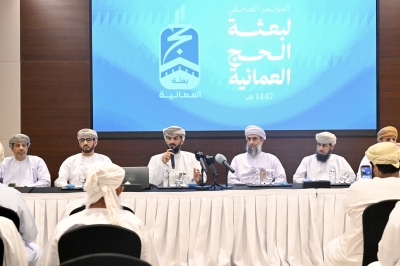
14 thousand pilgrims, new facilities, and development of camps in Mina and Arafat. Written by – Abdulaziz Al Abri. “Photo by: Hussein Al-Muqbali.” Today, during its press conference for the 1447 AH Hajj season, the Omani Hajj Mission reviewed the most prominent preparations, organizational plans, development initiatives, and services provided to the pilgrims of the Sultanate of Oman, in addition to developments in transportation and packing, and general indicators for the current season, within the framework of an institutional approach that focuses on governance. And digitization and improving the experience of the Omani pilgrim. His Excellency Ahmed bin Saleh Al Rashidi, Under-Secretary of the Ministry of Endowments and Religious Affairs and Head of the Omani Hajj Mission, confirmed that the Ministry’s management of the Hajj sector is based on a philosophy based on enabling pilgrims to perform this great ritual in accordance with the guidance of the Prophet, and in a way that achieves the purposes of Sharia in facilitating and removing hardship, while making the pilgrim a basic priority in all services provided, and applying the highest standards of governance, quality, efficiency and transparency, in integration with various partners locally. Internationally, led by the Ministry of Hajj and Umrah in the sisterly Kingdom of Saudi Arabia. His Excellency explained that the Ministry continued to develop the system for managing Hajj affairs through the electronic system for registering pilgrims of the Sultanate of Oman, which manages the registration, sorting, and selection of companies and services 100 percent electronically. He pointed out that the system won the “Libitum” award as the best digital service for pilgrims globally, and also achieved a satisfaction rate of 99 percent in the last Hajj season 1446 AH, and contributed to enhancing justice. Transparency and providing opportunities for pilgrims according to precise and organized eligibility criteria. He also pointed out that this system has contributed, over the past ten years, to registering more than 300,000 applications, providing an accurate national database that supports eligibility mechanisms and prioritization. Requests for Hajj pilgrims His Excellency said that the number of Hajj applications submitted for the 1447 AH season exceeded 42,000 applications, of which 14,000 applications were accepted according to the approved eligibility criteria, while those accepted completed the procedures and requirements for traveling to the Holy Land by 100 percent, explaining that among them were 13,560 Omani pilgrims and 440 Omani pilgrims. A resident pilgrim. He also pointed out that the general satisfaction rate for the last Hajj season reached 97 percent, with the mission looking forward to enhancing this percentage during the current season, stressing that using the entire quota allocated to pilgrims by 100 percent represents one of the important indicators of the efficiency of the organization. Eligibility Sorting Mechanism And age, in addition to allocating certain percentages for carrying out Hajj wills and on behalf of the deceased, and taking into account cases related to the mahram and companions; Muscat Governorate topped the number of pilgrims eligible for the 1447 AH Hajj season with 21 percent of the total quota, followed by North Al Batinah Governorate with 20 percent, while the rest of the quotas were distributed among the other governorates according to the approved standards. His Excellency stressed that this mechanism is announced transparently every year, and that modification to it remains limited and within the framework of what is required by the need for improvement and development. Season Indicators The mission reviewed the timetable for the work plan for the Hajj season 1447 AH, which included the dates for opening the system to register those wishing to perform Hajj, informing those eligible within the various stages of eligibility, the dates of the second Hajj and Umrah Conference and Exhibition, the latest dates for contracts and issuing permits, in addition to the deadlines for pilgrims to enter the Kingdom of Saudi Arabia by land. And in the atmosphere. His Excellency explained that the mission proceeded to implement the established time plan according to what was scheduled in most of its stages, noting that the permit aspect took longer than expected as a result of some challenges, but the mission was able to overcome them and had already begun issuing permits. He pointed out that more than 11 thousand permits had been printed and were ready for delivery, with the mission looking forward to completing the distribution of permits within the Sultanate of Oman before the pilgrims travel, which would contribute to facilitating procedures and ensuring readiness. Hajj before departure. He also indicated that the age distribution of those eligible showed that the largest percentage was concentrated in the age group from 45 to 60 years, while the Hajj route by air reached 78 percent compared to 22 percent for the land route, explaining that this distribution reflects indicators described as healthy that do not require major intervention. Direct coordination with the Saudi Ministry of Hajj and Umrah; With the aim of mitigating the operational and financial impacts on companies and pilgrims, and working to find alternative solutions that ensure the smoothness of services. His Excellency also explained the results of negotiations with the competent authorities in the Kingdom of Saudi Arabia, which resulted in allowing Omani buses to enter Saudi territory, provided that the transportation of pilgrims within Mecca and the Holy Sites would be organized via licensed Saudi buses, in addition to granting a grace period of 48 hours for the entry of pilgrims coming directly from the Sultanate of Oman or via Medina to Mecca. His Excellency stressed that the Ministry views the air route as safer and smoother than The land route, but it does not tend to oblige switching to it, but rather works to encourage and facilitate it through initiatives that reduce the gap and push towards a natural transition in pilgrims’ choices. He explained that this trend contributed to significantly reducing the number of land pilgrims, which the mission considers one of the important positive indicators, noting that the cost of Hajj is approximately 1,647 Omani riyals by land and about 2,013 riyals by air, and that the mission is working to reduce the price gap between the two routes while maintaining the level of service. Qualitative initiatives The conference reviewed a number of qualitative initiatives for the 1447 AH Hajj season, the most prominent of which is the “Second Hajj and Umrah Conference and Exhibition.” And the “Hajj Lab Initiative,” which included holding more than 32 consultative meetings with government and private agencies, and involving more than 133 Hajj companies through an extensive electronic questionnaire. With the aim of developing the Omani pilgrim experience and setting a road map for future priorities. His Excellency explained that these outputs received great attention from the mission, and were presented to the Permanent Committee for Hajj to consider the mechanisms for implementing them and benefiting from them in the coming seasons. Within the framework of developing air transport services, the mission referred to the implementation of an “airline initiative” that contributed to reducing air ticket prices by about 40 Omani riyals compared to the last season, adding Taif Airport as an available destination for pilgrims of the Sultanate of Oman, and allowing the operation of flights departing through Sohar Airport for interested companies, as well as providing additional facilities to companies. Hajj to improve your travel experience. The initiative also indicated a decrease in the share of land pilgrims from 5,122 pilgrims in the 1446 AH season to 3,034 pilgrims in the 1447 AH season, which the mission considered one of the most prominent positive results of the initiative. The initiatives also included the “Beit Al-Rabat Endowments Initiative” with more than 200 thousand Omani riyals for eligible groups, and the “Initiative to enhance the readiness of Hajj companies” to ensure raising the efficiency of performance and improving the quality of services, in addition to the “Initiative to enhance the expansion of the Hajj companies’ plan.” Delivering pilgrims through land ports, which introduced a smart mechanism to directly monitor the movement of buses and respond quickly to emergency situations and crises, and contributed to reducing the waiting time for buses from about four hours to approximately half an hour or 45 minutes for each bus. Field Services With regard to field services, the mission announced the move of the headquarters of the Omani Hajj Mission to a new location characterized by its proximity to the holy sites, the availability of modern logistical services, and low traffic density, which contributes to facilitating the arrival of pilgrims through land ports. pilgrims and completing operational work more efficiently. She also indicated that she had informed the Hajj companies and other partners of this move earlier, in order to ensure readiness and early coordination. On the health side, His Excellency the Head of the Omani Hajj Mission confirmed that the mission pays great attention to medical capacity in cooperation with the Ministry of Health and the health delegation, noting that the Sultanate of Oman achieved an achievement last season by obtaining the award for medical capacity at the world level among only three countries. He explained that the mission decided this season to provide permits to 17 doctors within the Hajj companies, so that the doctor in the Hajj company would be the first point of contact with the pilgrim, while full coordination remained in place between these doctors and the medical delegation, and to provide them with the support and treatments they needed according to the available capabilities, in a new experiment that the mission intends to measure its impact at the end of the season. Camp Development During the conference, the mission touched on developments in the development of the camps in Mina and Arafat, explaining that feedback The information received from pilgrims and companies during the last season, in which more than 7,800 pilgrims participated, led to the identification of a number of improvement priorities, the most important of which is the rise in temperatures inside the Mina camps. She pointed out that all of the tents in the Mona camp were roofed with modern material, with an area exceeding 22 thousand square metres. With the aim of improving cooling distribution, reducing heat loss, and reducing the health effects associated with high temperatures. The development work also included integrated lighting, improved flooring, and comprehensive development of facilities, with expectations that there will be no need to use evaporative air conditioners except as a precaution, which will also contribute to reducing some of the health effects associated with the respiratory system and the transmission of viruses. The mission indicated that the readiness in the Mina and Arafat camps exceeded 90 percent at the time of the last evaluation visit. Responses to interventions In his responses to media questions during the conference, His Excellency explained that the mission annually reviews the service packages imposed by the service providers in the Kingdom of Saudi Arabia, and balances the level of public satisfaction with the cost of Hajj; In order to ensure the selection of the most appropriate for pilgrims without disrupting the quality of service, he pointed out that some packages are mandatory for all missions, while space remains available for the mission to choose non-mandatory services according to what is provided by cumulative experiences and the results of measuring public satisfaction. With regard to the land route, His Excellency described the air route as safer, which does not mean canceling the land route, but rather reflects a strategic direction towards encouraging the gradual transition to air through facilities and initiatives, without imposing this on the pilgrims. He also explained that the mission is following up on the observations related to the land route and the services related to it, and will transfer any observations it receives to the competent authorities in the Kingdom of Saudi Arabia, especially since this route is still relatively new compared to other routes. He explained that apologies and replacements for accepted pilgrims are accepted whenever they are justified by health, social, financial, or other considered conditions, and they are dealt with according to an organized mechanism that takes into account the use of the full quota, in addition to being linked to the procedures approved by the Saudi side, indicating that all A justified apology is considered, and then a replacement is searched for from the list of those registered in the system until reaching the stages in which the replacement stops due to the expiration of the approved periods. In response to a question related to the period of permission specified for buses, His Excellency stated that the announced period does not represent a problem from experience, explaining that buses usually arrive within 24 hours, and that any violation of this framework means the existence of a problem that requires follow-up. He pointed out that the mission launched this year for the first time a real-time tracking system for all buses departing from the Sultanate of Oman, allowing knowledge of their locations, speed, and data of the drivers and pilgrims present on them, and helps in providing support and backup when needed. With regard to bus drivers’ permits, he explained that the problem that appeared last season had been dealt with, and that the mission had developed a solution for this season, which was to provide Hajj cards for at least two drivers on each bus, so that the two drivers would be treated like a pilgrim during the trip, and this is what was achieved. He reached it after coordination with the competent authorities in the Kingdom of Saudi Arabia, expressing his hope that this solution would contribute to avoiding a recurrence of the problem during the current season. With regard to the “Rabat House” endowments, His Excellency indicated that the endowments have a role in supporting Omani pilgrims and Umrah performers, explaining that there are endowments existing on the ground, but they are far from the Haram compared to what was the situation previously. He added: Among the currently proposed options is renting a building close to the Haram for the benefit of Omani pilgrims and Umrah pilgrims, within the framework of a possible partnership between the Rabat House Endowments and the Omani Hajj Mission, so that the building is used during the Hajj season to serve the mission, and during the Umrah season to serve Umrah pilgrims, stressing that this option is still under study.


