
اخبار فلسطين – وطن نيوز
فلسطين اليوم – اخبار فلسطين اليوم
W6nnews.com ==== وطن === تاريخ النشر – 2026-05-23 12:42:00
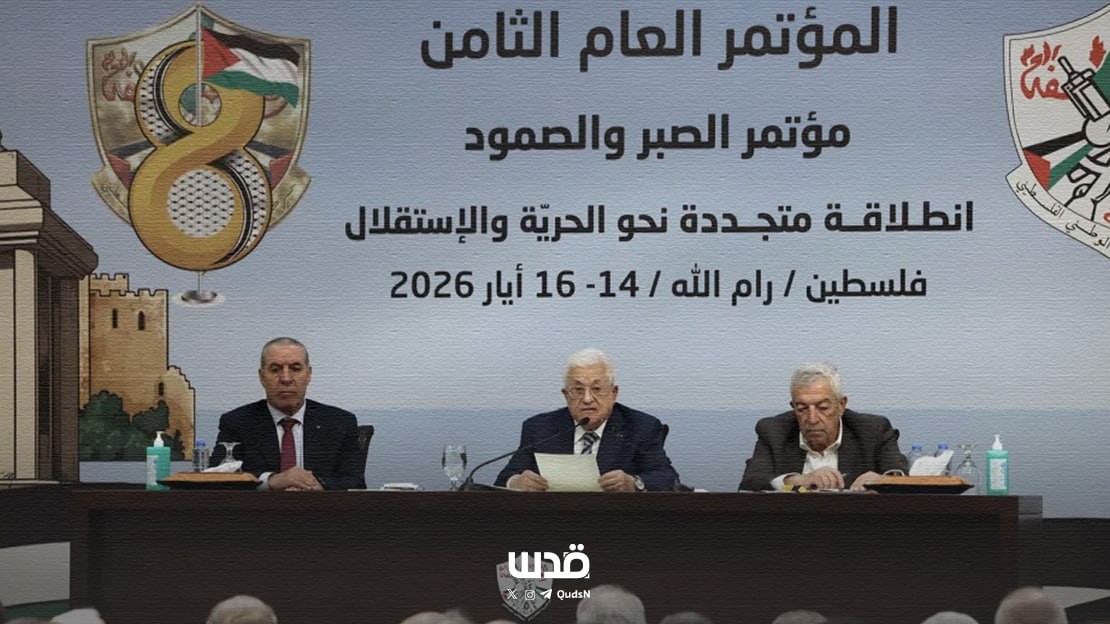
Quds News Special: Historical leaders from the Fatah movement expressed their dissatisfaction with the outcomes of the movement’s eighth conference, as they considered that “it did not bring anything new, and will not exceed the permissible political ceiling, and it has produced a new leadership that will not go towards conflict with the occupation, in addition to the fact that part of it held positions in the Revolutionary Council, or the Central Committee, and they never had a history of struggle within the movement.” On the sixteenth of this month, the Fatah movement completed its internal elections, within the movement’s eighth conference, where it produced a new leadership for the Revolutionary Council, in which the rate of change exceeded 80 percent, while the new central committee was carefully detailed, according to the president’s directives and the balance of power within the movement. The outcomes of the Fatah movement conference, according to the estimates of leaders and cadres within the movement, reflected a state of widespread controversy regarding the mechanisms of representation and election, amid accusations of the absence of historical figures and effective cadres from the organizational scene. In this context, Musa Abu Sobha, a former member of the Legislative Council for the movement, said in his interview with the Quds Network that “the conference’s outcomes were similar to its inputs, as well as its results, as they were not correct after the absence of the movement’s historical and basic staff,” considering that the nature of the management of the organizational process directly affected the final results. In a direct criticism of the mechanism for forming lists and internal elections, Abu Sobha considered that the conference’s preparatory committee should not have run in the elections, explaining that “whoever chooses the names does not have the right to run at the same time,” because that opens the way, according to his description, for “pre-engineering the names to serve the purpose of voting for him, and determining the members of the Revolutionary Council, the Central Committee, and even the political program.” According to his estimate, the conference was not limited to the exclusion of historical figures within the movement, but also included figures who could have brought about a shift in its organizational and political path and gained broad popular acceptance. In this context, he referred to names including Qaddoura Fares, who he said “worked hard on the prisoners’ file and had to be excluded,” in addition to Abbas Zaki, who he believed “took positive positions after October 7,” as well as Hossam Zomlot, who “presented a bright diplomatic image in the European arena.” The criticism extended to include the results of the Revolutionary Council and Central Committee elections, as Abu Sobha considered that they “do not live up to the greatness of the movement at all,” adding that personalities “without a history of struggle” reached leadership positions within the movement, while others won advanced positions “despite the membership conditions not being applied to them, even if they were affiliated with Fatah.” Regarding the “popular resistance” option that the movement adopted in its previous conferences, Abu Sobha saw that this file did not receive any justice within the last conference, but was “completely ignored,” as he put it. He added that the movement raised this slogan during the seventh conference, “but it never activated it, but rather placed many obstacles in front of it,” despite the escalation of field challenges in the West Bank. Abu Sobha linked this to the escalation of settlement expansion in areas of the southern West Bank, noting that the Bethlehem and Hebron governorates are witnessing accelerating settlement expansion, “without real support for the popular resistance or representation of its cadres within the conference,” he said. On the other hand, he called for the movement to deal with the national reconciliation file during the next stage as “the most prominent Palestinian priority,” stressing the need to choose a person to handle this file who has good relations with the various political forces and enjoys wide acceptance among them, considering that this could constitute one of the few positive aspects that may emerge from the conference. He also pointed out that a state of “regionalism” emerged in the discussions of the movement’s cadres during the conference, as a result of the approach followed by the preparatory committee, even though the discussion was supposed to take place within the framework of a “universal revolutionary movement.” He pointed out that the areas of Hebron, Bethlehem, and Jerusalem were marginalized in the results, in contrast to a large presence of cadres from the northern West Bank. Abu Sobha pointed out that the outcomes of the conference related to the Hebron region “are not commensurate with the greatness of this region, nor with the size of its cadres and their role within the movement,” in reference to the continuing internal debate regarding the nature of representation and organizational balances within Fatah. In contrast to the voices that criticized the conference’s outcomes from the perspective of organizational representation, other readings emerged that considered the crisis to be deeper and related to the structure of the political movement and its performance over the past years. In this context, the former member of the Revolutionary Council in the Fatah movement, Louay Abdo, revealed that he boycotted participation in the eighth conference despite his membership in it, explaining in his conversation with the Quds Network that his position came “from a firm conviction,” because he believed in advance that “the outcomes will not be successful.” Abdo believed that the conference was marred by a number of fundamental problems, which he identified in three main observations, the first of which was the absence of a clear political goal, considering that the ceiling of the conference’s goals “remained limited within the framework of the previous Central Committee.” He also described the content of the conference as weak, noting that it was “not prepared in accordance with the required organizational and temporal progression in order for the elite of the movement to be represented,” before adding that the timing of its holding was “a failure in the first place” because it came, according to his assessment, in response to Western pressure or from some Arab countries. According to his reading, the head of the Authority and the head of Fatah, Mahmoud Abbas, remained the primary controller of the movement’s details and decisions, despite the fact that Fatah, from the seventh conference until today, “was inactive, weak, and not present,” in addition to its inability, as he put it, to provide near or distant solutions to the issues of division, settlement, the city of Jerusalem, and the Gaza Strip. Abdo pointed out that the process of preparing for the eighth conference and rearranging the movement’s organizational structure actually began years ago, in a way that serves the survival of the current leadership that emerged after the conference, considering that the leadership today is moving towards a “policy of dissociation,” in light of a clear desire, according to him, not to enter into any clash with the Israeli occupation. In describing the nature of the transformations within the movement, Abdo considered that Fatah “has become in the service of the president’s mandate, and the president is no longer in the service of the movement’s mandate,” adding that the movement’s internal system has become closer to “the presidential system, and the path of settlement has become the only path approved politically and organizationally.” He also reduced the possibility of bringing about actual change through the composition of the Revolutionary Council and the new Central Committee, explaining that the powers of the Revolutionary Council are “specific and known, and do not go beyond being a council for discussion and deliberation.” He denied that it was a “Fatah parliament” as some of the movement’s cadres described it. His criticism extended to the nature of the results produced by the conference, as he saw that it established “absolute centralization” within the movement, which does not allow for any change in decisions or even the presence of internal opposition capable of influencing, considering that the current leadership has the ability to “absorb reactions and contain any organizational bloc.” In the same context, Abdo expected that the new members of the Revolutionary Council and Central Committee would not have an actual influence inside or outside the movement, whether at the organizational or leadership level or in decision-making, adding that “individual struggle is of no benefit in Palestinian action,” even if some members have a history of struggle on the personal level. Abdo stopped at the issue of Qaddoura Fares’ exclusion, considering that what happened with him is not an exception, but rather an extension of a repeated approach that affected “dozens of people previously within the Revolutionary Council and the Central Committee, where disputes were often managed through compromise and settlement of differences.” On the other hand, he believed that whoever participated in the conference must accept its results, even if he was convinced of the presence of “fraud or exclusion,” because his participation in itself means his acceptance of the rules of the existing organizational process. Abdo went further in describing the reality of the movement, asking: “I say to the angry people within Fatah: What can you do? Do you want to reform Fatah? There is no such thing as reforming Fatah. How do you want to develop organizational work when everything is under the complete control of the occupation, and every small and large matter in the Authority and in Fatah is subject to Israeli surveillance.” He added: “It is not possible to change the name of a person in a leadership position if the occupation objects to it,” and therefore, the Palestinian Authority will not slide into a battle with the occupation. In turn, the leader of the movement, Abu Ali Yatta, in an interview with the Quds Network, considered that the recent conferences, from the sixth to the eighth conference, established a pattern based on personal relationships more than on organizational standards and struggle history. He explained that the winners of membership in the Revolutionary Council and the Central Committee “are those who have personal relationships with each other,” adding that some of those who reached these positions “They were employees in the offices and not a movement cadre that met the organizational standards.” According to his vision, the eighth conference did not bear any indications of an actual change in the movement’s political path, but rather remained within the same traditional framework, including the file of “popular resistance,” which he said “remains limited to what the occupation allows, in light of the continued daily incursions into the Palestinian areas, the expansion of settlements, and the demolition of homes.” In his evaluation of the results of the conference, Abu Ali Yatta saw the new faces it produced The elections “will not renew anything in Fatah,” and the political program will not witness any fundamental change, adding that some of the winners may believe that they are able to present a different proposal, “but the international community does not allow them to do more than what is existing.” He also considered that the discussion that took place during the conference about developing the political program was nothing but a “media speech” aimed at suggesting the existence of a reform path within the movement, explaining that all previous conferences began with a state of enthusiasm and promises, “and then ended as they began without any real change.” Abu Ali Yatta said that the basic message was directed abroad, specifically to the international community and the Arab countries, by trying to present an image of the movement as “democratic and seeking transparency and reform within the functioning of power through the party that runs it.” He added that the conference came, in large part, “as a form of satisfaction for the countries of the world and the Arab countries,” stressing in return that “the reality on the ground will not change much and warning that the repercussions of the conference may be more negative than positive, especially in light of the state of organizational tension that preceded its holding and continued.” Afterwards, he pointed out that the differences that existed due to the marginalization of some leaders deepened after the announcement of the results, which, according to him, added “more angry and disaffected people who felt excluded,” while “a small group was satisfied at the expense of a large segment within the movement.” In criticizing the nature of the organizational rise within the movement, Abu Ali Yatta said that a number of those who had reached the Central Committee since the sixth conference “had no actual connection to Fatah, but rather were busy in the fields of trade, economics, and travel, before.” They later reach leadership positions as if nothing had happened.” He considered that the same applies to some members of the Revolutionary Council, in contravention of the principle of “organizational progression within the movement.” He also expected that none of the new members would deviate from the existing political line, explaining that the composition of the Central Committee and the Revolutionary Council is still subject to the same approach, which prevents the emergence of voices calling for escalation, uprising, or any radical change, whether publicly or unannounced. Abu Ali Yatta concluded by emphasizing that all of those produced produced outcomes. The conference will adhere to the same political program, which is based on seeking to establish a Palestinian state through a peaceful approach and calling on the international community to support this path. And anyone who thinks about escalating his tone and rhetoric, if he is spared the occupation, will not be spared from the movement’s leadership, which does not want escalation.”