
اخبار فلسطين – وطن نيوز
فلسطين اليوم – اخبار فلسطين اليوم
W6nnews.com ==== وطن === تاريخ النشر – 2026-03-30 12:50:00
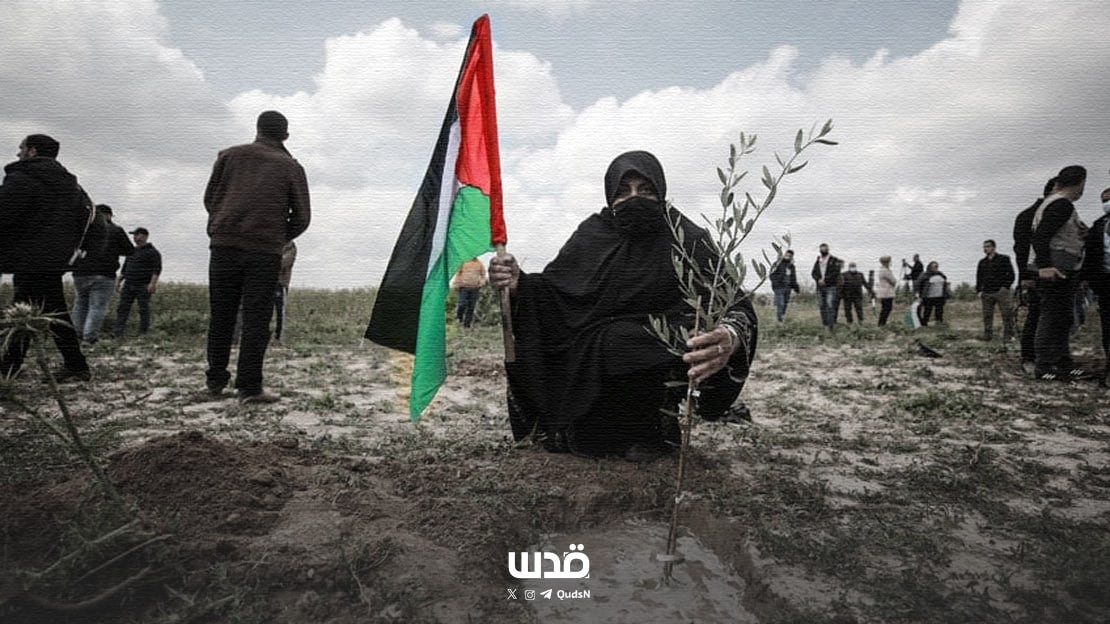
Exclusive – Quds Network: The anniversary of the Palestinian “Land Day” this year coincides with the fiercest Zionist campaign to confiscate geography and fragment demographics. While the settlement monsters are devouring what remains of the hills of the West Bank, Gaza is being crushed under the weight of an aggression that seeks to impose “buffer zones” at the expense of the remains of its people, at a time when the Palestinians in the occupied interior are facing systematic “Israelization” policies and non-stop uprooting, whose fangs are concentrated in the Negev by seizing lands and bulldozing villages. The past two years have witnessed an unprecedented leap in the pace of Israeli replacement policies, as the West Bank turned into cantons isolated by barriers and confiscations, and Gaza turned into an arena of extermination, displacement, and changing the features of the land, which led to the undermining of any realistic horizon for Palestinian geographical connectivity. This field blockage has today become organically linked to the open arenas of “regional war” between the countries of the Iranian-led axis of resistance, and between the Israeli occupation and its Western allies, led by the United States. If this major confrontation ends with the “defeat” of the occupying state and the decline of its military and geopolitical influence, the direct repercussions on Palestinian land will be a historic turning point. According to observers during an interview with the Quds Network, the wall of hegemony that protects the settlement project will collapse, and the occupation’s ability to impose facts in the same way as the current one will decline. The West Bank: The hat of settlement. The West Bank is experiencing an unprecedented stage of land loss due to accelerating settlement expansion, according to what is confirmed by the researcher at the Palestinian Center for Human Rights, Imad Abu Hawash, who said in an interview with the “Quds Network” that “the areas classified as C, which have an area of more than 3,500 dunums out of the West Bank, which has an area of more than 5,800 dunums, have practically become under the complete control of the occupation, while military orders are used as a tool to perpetuate this reality.” On the anniversary of Land Day, this control is most clearly evident in the tightening grip on all areas classified as “C” according to the Oslo Accords, which represent more than 60% of the area of the West Bank, and were considered the last breathing space for the Palestinians over the past three decades, before they turned into an open field for organized settlement expansion. In this context, “Israel,” as Abu Hawash explains, imposed a broad system of military orders that provide protection for settlers and facilitate the spread of settlement outposts, the number of which has increased since 2020 to more than 300 outposts, most of which were established on Palestinian land that has been classified as “state land” since the 1980s, based on legal pretexts related to the absence of proof of ownership. These developments coincide with the escalation of threats to demolish Palestinian homes, as data from the Civil Administration of the occupation army indicate that more than 10,000 homes in Area C are threatened with demolition, in light of periodic meetings being held to discuss plans to expand settlements and approve new construction projects, according to Abu Hawash. This stage also reveals, on this anniversary, the loss of large areas of land by the Palestinians, estimated at approximately 167 thousand dunams, within what was known as the contractual reserve in the Wye River Agreement in 1998, in the context of continuing measures to strip them of their property, in parallel with the imposition of additional restrictions on the lands of the Hebron Governorate, especially in the vicinity of the Ibrahimi Mosque. At the level of movement, Abu Hawash says that the West Bank has a dense spread of military checkpoints and gates, the number of which has exceeded a thousand obstacles, which leads to the dismemberment of cities and villages, and imposes a reality of geographical isolation and daily restrictions on the lives of Palestinians. In a dangerous development since this anniversary, Abu Hawash points out that the occupation authorities had previously announced their intention to reveal the names of land owners in the West Bank, in a move that is feared to be used to facilitate manipulation and falsification of ownership records, especially in light of a complex legal environment within the Israeli courts, in which the roles of settlers overlap at various levels of litigation and implementation. In this context, Abu Hawash explains that during the past two years, the implementation of large-scale settlement plans has been accelerated, even though they were planned for many years to come, with the direct support of extremist Minister Bezalel Smotrich, and with the active participation of the “Regavim” settlement association, which has strengthened its presence as a partner in formulating policies related to the Palestinian territories. This expansion is not limited to areas classified as “C”, but is gradually extending to areas “A” and “B”, through the imposition of civil administration interventions, as happened in the “protected” natural areas in Bethlehem, in addition to the escalation of settler attacks on lands and facilities in areas “B” without significant restrictions, especially in Ramallah, Bethlehem and Hebron. Human rights data recorded by the Palestinian Center for Human Rights indicates that seven new settlement outposts were registered in Area B during the past two years, some of which were established in adjacent areas classified as “A,” which reflects a dangerous field transformation that may lead to the erosion of what remains of these areas in the coming years. The occupation authorities also issued a series of military orders in the north, south and west of the West Bank, allowing the leveling of lands and the uprooting of hundreds of thousands of trees in Areas C and B under the pretext of security considerations, in parallel with the issuance of demolition decisions that also affected Area B under the same justifications. In parallel, the anniversary of Land Day takes place in light of the harsh field reality experienced by the Palestinian camps, especially in the northern West Bank, where the Jenin and Tulkarm camps have been subjected to continuous military operations for more than a year, resulting in the forced displacement of residents and the widespread destruction of homes and infrastructure, according to Abu Hawash. The occupied interior: Israelization plans and attempts at revival. The condition of the land is no different worse in the occupied interior than in the West Bank, as Louay al-Khatib, a member of the political bureau of the Abnaa al-Balad movement, said in an interview with the Quds Network. He points out that the lands of Palestinian villages and towns in the interior lack the elements for future development, as a result of their deprivation of agricultural and industrial lands, which has made the Palestinians there prisoners of the occupation policies, at a time when plans to seize large areas are escalating, especially in the Negev region. In the same context, he points out that the national movement at home has been subjected, during the past two years, to a systematic process of deterrence, which has limited its ability to act and influence, to the point where freedom of expression itself has become restricted, in light of campaigns of repression and arrests of Palestinian activists under false pretexts, which has been reflected in the decline in the role of this movement in confronting Israeli policies. He confirms that the land inside Palestine is now in dire need of restoring the momentum of national action, but this path faces great challenges, in light of what he describes as government support for the growth of crime within Arab society, which contributes to weakening its internal structure. Al-Khatib points out that the Palestinians inside, although they constitute about 22% of the population, own only approximately 2% of the land, as a result of economic and legal policies pursued by successive Israeli governments, which reflects the size of the structural gap in the distribution of resources and control over the land. He also points out that Land Day is no longer the only national occasion whose activities have declined, as national activities in general have become subject to severe restrictions by the Israeli occupation police, going so far as to impose conditions on organizing events and preventing the raising of the Palestinian flag, despite the special symbolism that this day carries in the national consciousness. In light of this reality, according to Al-Khatib, the necessity of rearranging the ranks of the national movement at home and activating the popular incubator to commemorate Land Day emerges within a truly national action that restores respect to this occasion and its connotations, especially in light of what he described as an unprecedented state of repression since the outbreak of the war on Gaza. He adds that the extent of the current persecution and restrictions raises questions about the outcome of the national situation, pointing out that what happened in Gaza did not move the international community, nor even the Arab world, in the desired manner, which, in his opinion, reflects the weakness of interaction with what is happening inside Palestine. Despite this, Al-Khatib points out indications of a gradual return to some forms of movement, through the recent revival of events and gatherings, considering that these movements, in light of the repercussions of the war, reflect a growing awareness that the balance of power is not fixed, and that reality is subject to change. He believes that “Israel” sought to consolidate the image of an invincible state, but regional developments, including the ongoing military confrontations with Iran, may open the door to shifts in the balance of power, which in turn will be reflected in the Palestinian situation at home and in the rest of the occupied territories. He points out that these transformations may contribute to restoring hope to the Palestinians, and give the national forces an opportunity to reorganize their ranks and restore their role, at a time when the Palestinians at home feel as if they are living under a system closer to direct military rule. Al-Khatib concludes that any decline in Israel’s ability to impose its conditions in the region would reflect positively on the Palestinian situation and enhance the chances of regaining the initiative, in light of the growing spirit of confrontation after years of the occupation’s supremacy and its imposition of new realities on the ground. Gaza: The Window of the Conflict on the Land As for the Gaza Strip, since the beginning of the Al-Aqsa Flood Battle (October 7, 2023), which resonated and affected the entire region, the land has been the focus of the strategy and the essence of the confrontation with the occupation, as the conflict over it has remained the main title that has governed the various forms of Palestinian action, whether organized or popular, throughout history. In this context, the director of the Orouba Center for Research and Strategic Thinking in Gaza, Ahmed Tanani, confirmed in an interview with the Quds Network that historical experience clearly shows that raising the cost of the Israeli presence on the ground often leads to the occupation retreating from it, citing what happened in the Gaza Strip in 2005, when the occupation was forced to withdraw from it. In a reading of the current reality, Tanani explains that the extreme right-wing Israeli government came carrying what he calls “decisive lines,” under the headings of ethnic cleansing, the expulsion of the Palestinian people, and the reoccupation of the land. He pointed out that this vision intersects with the statements of Israeli Finance Minister Bezalel Smotrich, who talks about “correcting the historical mistake during the Nakba, after leaving a portion of the Palestinians on the land and enabling them to control some areas.” He adds that this approach places among its priorities the expulsion of the Palestinians from their land and the dismantling of their political entity, which explains the rush towards a war of extermination against Gaza, which included among its goals the restoration of control over the land of the Gaza Strip. Tanani continues that this war was not isolated, but was accompanied by a large settlement push in the West Bank, by annexing the largest possible area of land, even without an official political declaration, explaining that this took place under political cover and legislation issued by the Knesset. He points out that what is happening in Gaza goes beyond military operations, and includes the cleansing of land and people, the blowing up of infrastructure, and attempts to institutionalize the Israeli presence in large areas of the Strip, amounting to an actual occupation led by the decisive Israeli government. Regarding ways of confrontation, Tanani believes that the occupation’s plans require the formulation of a comprehensive Palestinian policy, based on adopting various forms of resistance, most notably popular resistance, in addition to raising the cost of the occupation on the ground. At the same time, he stresses the importance of supporting the steadfastness of the Palestinians, in light of persistent Israeli efforts to transform the Palestinian territories into an unlivable environment, whether through the restrictions imposed in the West Bank, which have now affected the details of the residents’ daily lives, or through reducing public space, intensifying barriers, and turning the West Bank into isolated “cantons.” He adds that what is happening in the Gaza Strip represents a more severe example, as the occupation policies are embodied in perpetuating the reality of genocide, by perpetuating starvation and disrupting relief work, which makes life unbearable and pushes the Palestinians towards coercive options that serve their displacement from their land. Tanani stresses that confronting these policies must take place within an inclusive Palestinian national framework. On the diplomatic level, Tanani calls for activating the various paths, popular and official, to prosecute the occupation in international judicial forums, and to exert pressure on Western governments that have moved towards recognizing the Palestinian state, in order to oblige the occupation to withdraw from the lands in which it is expanding. He also stresses the need to transform “timid” international positions into real tools of pressure on the Israeli occupation government. In the context of commemorating Land Day, Tanani links this occasion to Israeli expansion in the region, considering that current policies reflect ambitions that go beyond Palestine towards implementing the “Greater Israel” project, in light of the occupation of lands in Arab countries, including Lebanon and Syria, which indicates a broader expansionist tendency that reaches the Arab surroundings. He believes that breaking this Israeli push, coinciding with regional tensions, would mark the failure of the decisive government project, and open an internal debate in “Israel” about the feasibility of these policies. Tanani concludes by emphasizing that the steadfastness of the Palestinians remains the decisive factor at this stage, as it is the guarantor of the preservation of the Palestinian presence on the land, which represents the “origin” from which the tools of confrontation are launched. He points out that remaining on the ground, strengthening steadfastness, and raising the cost of occupation, together constitute the strategy that should be adhered to on this historical anniversary.