
اخبار موريتانيا – وطن نيوز
اخر اخبار موريتانيا اليوم – اخبار موريتانيا العاجلة
W6nnews.com ==== وطن === تاريخ النشر – 2026-06-02 12:18:00
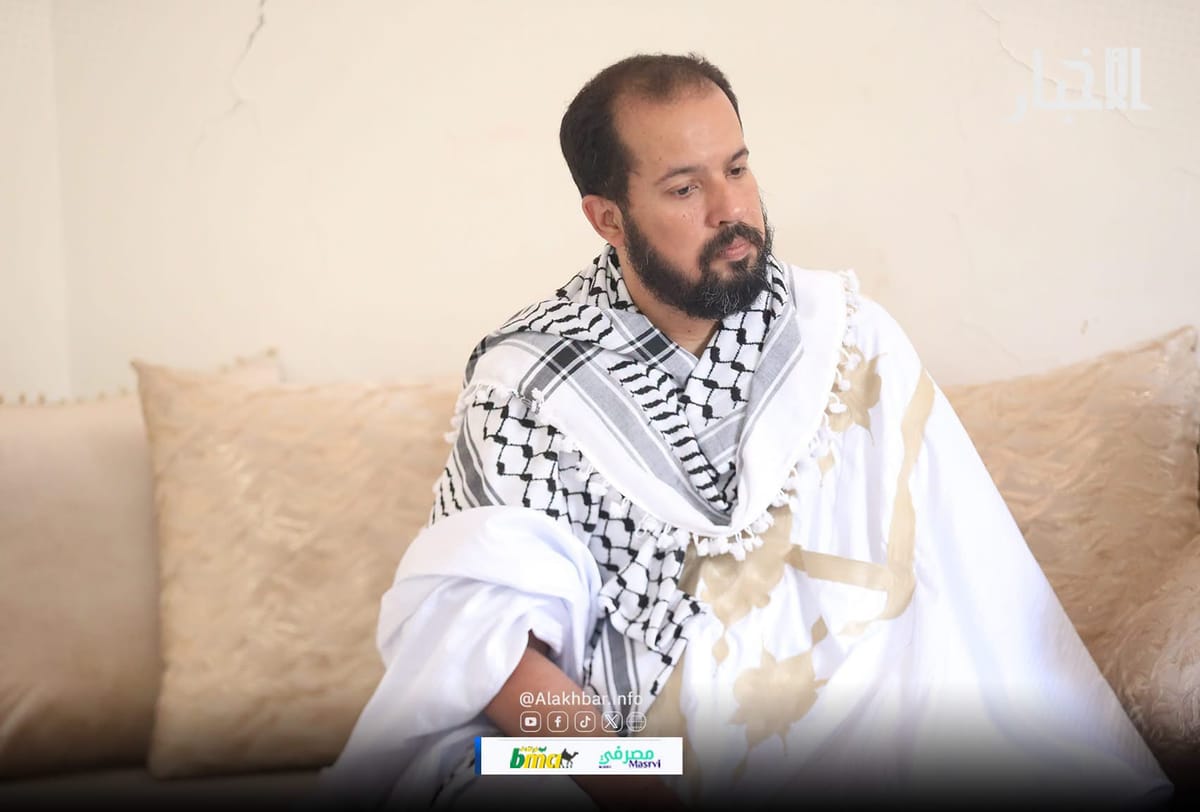
News (Nouakchott) – Ahmed Ould Jeddou, a journalist and member of the Mauritanian delegation participating in the Second Resilience Fleet, describes his participation in the fleet as the fulfillment of a dream. When he tried to join the previous version of the fleet, he did not succeed in that, and when he was given the opportunity to participate in the second version, participation was no longer an option for him that could be hesitated. Ould Jeddou said in an interview with the Independent News Agency that his motives were “very simple: a person sees a part of humanity being annihilated before his eyes, and he is tortured and killed.” With weapons, starvation, and siege, he has no choice but to move, or at least try to do something.” Ould Jeddou adds that everyone who maintains feelings through which he feels human suffering “is supposed to find himself involved in initiatives of this kind, because the fleet was a human gathering that included ideas, patterns, and patterns of people with the aim of breaking the siege imposed on the Gaza Strip.” Ould Jeddou tells Al-Akhbar that he did not expect a different end to the journey. From the first moment he knew that he was heading toward an occupying authority, not toward “A natural reality or a space governed by the usual laws,” so what happened next was not a surprise to him as much as it was a logical extension of what he had expected from the beginning. After the completion of the arrival of the participating activists, the fleet left the Turkish port of Marmaris on the fourteenth of May, and the first days passed with relative calm, before that calm dissipated at the dawn of the fifth day of sailing. Information and the activists saw the occupation boats until they began implementing protocols for preparing for the interception. The participants sat waiting for the moment of the storming; They discussed how to deal with the soldiers, put on life jackets, then threw their phones into the sea after the boats approached the ship. After that, the forces boarded the ship’s deck and issued their first orders to the participants to go to the front of the ship and lie down on their stomachs on the ground. Then the instructions continued – Ould Jeddou continues – and the activists were forced to move on their knees to another part of the ship, before they began being transferred one by one to the detention ships, in a stage that “was not smooth, but it seemed normal compared to what was to come.” Later.” Ould Jeddou believes that the ship he was on was the fifth among the ships seized by the occupation, and he says that he was Detainee No. 47, as he was transferred with the rest of the activists to the initial prison, which consisted of “metal trucks” in which they were detained for two days. The trucks, according to his description, were closer to “closed iron boxes, with no mattresses or barriers separating the detainees’ bodies from their metal walls.” If the heat increased, they turned into “heat tanks,” and if the temperatures dropped, they turned into “an additional source.” “For the cold.” The activists spent two days in those conditions, before the operations to control the rest of the ships were completed and all the detainees were gathered in preparation for their transfer to the port of Ashdod. Ould Jeddo talks about that stage of the kidnapping and the effects of abuse are still visible on his body. Dark circles left by the shackles on his wrists and right arm, with his left arm broken. The Fleet’s Message Despite the conditions of detention, Ould Jeddou mentions that collective activities inside the courtyards of the first prison did not stop. Slogans were chanted from time to time, along with Arabic chants, along with collective prayers. But the scene that remained stuck in Ould Jeddou’s mind and which he remembers with pride, is the guarding of prayer; While the Muslims were performing their prayers, non-Muslim activists were forming a human cordon around them to protect them from the harassment of the occupation forces. Ould Jeddou believes that this image alone was enough to summarize the entire story of the fleet; Muslims are praying, and non-Muslim activists guard them during prayer, and on the other side the occupation stands “isolated from everyone.” The moment the arms were broken, when the detainees began to be transported towards the port of Ashdod, the occupation forces began to take them out one by one. Ould Jeddo confirms that everyone was subjected to different forms of assault and violence, and that the difference was in the size and nature of the damage. When it was his turn to get out of the truck, two soldiers grabbed his left arm and raised it with extreme violence to the top. At first, he did not understand What happened, but the sound he heard clearly was enough to remove any doubt that his injury was a broken arm. Immediately after that, the broken arm was turned back, and tied with the other arm behind his back, stressing that he did not find any justification for what he was exposed to, and did not notice a reason that distinguished him from the rest of the detainees other than the way the two soldiers chose to deal with him. He added that one of them put his passport in his good hand before throwing it away, while he was forced to continue moving in a difficult position. Their hands were tied behind their backs. They had no choice but to lean on their foreheads while lying down and moving, while the position of those whose hands were tied in front of them was relatively less harsh. Despite the broken arm, Ould Jeddo confirms that he did not feel the pain he expected, and describes this as “a kindness from God Almighty,” which enabled him to endure the following hours, during which the detainees were forced to listen for long hours to the occupation anthem, before they were ordered to lie on their stomachs. Checkpoint After the inspection procedures were over, the plastic restraints were replaced. With iron ones, the shackle position was also changed so that the hands were in front of the body instead of behind it. Later, the detainees were transferred to closed transport vehicles, with their hands and feet shackled, on a journey that lasted approximately 6 hours towards the Negev Desert Prison. Upon arriving at the prison, he was informed that he was taken to a private office, where he was examined by a doctor who confirmed categorically that his arm was indeed broken, and promised him treatment. The shackles were also removed from him and he spent his first night without restraint. He says that the investigations were limited. Extremely, and that he refrained from answering the investigators’ questions after consulting his lawyer and adhering to her advice, before the occupation took his detainees out again in closed vehicles without informing them of their destination. An unknown scenario. In the absence of any information, Ould Jeddo adds, everyone was busy guessing what awaited them. Some of them suggested that deportation to Jordan, and others talked about Egypt, while a third group believed that they were still in the litigation stage and no final decision had been issued regarding them. During the long trip, some of those sitting near the windows The narrow vehicles were trying to peek outside. The names of areas appeared on the signs, including Rafah, before the vehicles finally stopped after hours of driving. Then one of the detainees assured them that they had arrived at an airport. The picture became clear, the restrictions were removed, and it was decided to transfer the detainees to Turkey, so that the journey could begin. The Italian doctor participating in the fleet recommended to the organizers that an ambulance should be prepared for Ould Gedo upon arrival, due to his broken arm. Before entering the operating room, Ould Gedo tried to communicate with his family, which was not possible. This is done, so that he forgets the matter due to the effect of anesthesia in preparation for the start of the surgical operation. When he opened his eyes again, the first face he saw next to him was the face of the scholar Sheikh Muhammad Al-Hassan Al-Dado, who said that he had made a call to his mother, and that that call represented for him a “special moment” during which he felt that “the mission had been completed.” As for the injury and the abuse that accompanied it, Ould Jeddo sees them only as fleeting details in front of the goal for which he went out, because what happened – he adds – is part of a long accumulation of Forms of solidarity with Gaza, starting with statements, then vigils, marches, convoys, and all the way to fleets, in a continuous path that aims to “keep the issue present in the global consciousness.” The mother’s flogging and permission. Despite the risks that accompanied the experience, what was most preoccupying for Ould Jeddo during the period of detention was checking on his mother, adding that imprisonment and detention are not new things to the family, and that his mother lived a similar experience in the 1980s when his father was imprisoned for a year. Kamel and was subjected to torture. She was young at the time, and she knew firsthand the meaning of waiting for a prisoner and anticipating his news, but the difference this time – he continues – was great, as “my father was imprisoned inside his homeland and among his people, while I was detained by the Zionists, in completely different conditions, and at a different age stage compared to my mother, who is a mother.” Ould Jeddou is keen to point out that he did not participate in the fleet except after her knowledge and explicit approval, stressing that she cannot prevent him from doing what she considers “an effort.” “Nabila” aims to contribute to breaking the siege on Gaza, despite the risks that accompany it. The Sindhi citizen. During the first stage of detention, the prison brought together Ould Gedo and engineer Islam Ould Maaloum, where the occupation forces were giving the detainees bread and bottles of water without cups or drinking utensils, which forced them to invent primitive means of sharing water among themselves, which Ould Maaloum helped him with due to his incapacity due to his broken arm. After the end of the prison term, and his arrival at the hospital in Türkiye, With medical recommendations preventing him from using his hand, his compatriot, the student activist Sheikh Mohammed, helped him in his various daily affairs, and remained by his side throughout the treatment period. Ould Jeddou adds that his companion was able to return to Mauritania after the end of his mission, but he preferred to remain in Turkey until he was discharged from the hospital, before accompanying him to Istanbul and then returning together to the homeland. The Prison Miracle Despite the fractures and injuries he suffered, Ould Jeddou says that what surprises him most when recalling the experience is that he He did not feel pain throughout the period of detention, because after his arm was broken, he was subjected to a series of harsh procedures and continuous movements. However, he did not feel the pain that he expected. Ould Jeddou describes that what happened was “the kindness of God Almighty” that accompanied him throughout the journey. It was not limited to the broken arm, as he already suffers from asthma, and he spent the period of detention inside metal trucks in harsh conditions, without feeling it, even though the conditions he lived in were sufficient – under normal circumstances – to cause anxiety. Asthma. At the end of his speech, he stresses that the experience did not change his convictions. The fracture was treated, and the surgical operation was performed, but what he saw was not surprising, as they were sailing “towards a usurping entity that kills children and uses prohibited weapons,” so there was nothing in the treatment that “astonishes” or prompts a “review” of positions. Ould Jeddou believes that the entire world owes Gaza an apology, but what he and his companions did, he sees as nothing more than an “effort of the eye” and an attempt to join in every action that reminds of what the residents are subjected to. The Strip, and apologizes to the people of Gaza for any negligence, stressing that it will continue to seek to disturb those who cause their suffering by all available peaceful means. “The entity’s isolation is expanding.” One of the aspects that was imprinted on Ould Jeddou’s mind and that he kept and changed his mentality and his view of the fleet, is the vision of elderly Europeans in various positions participating in the fleet, such as an elderly Frenchwoman carrying with her medicines for her chronic diseases, heading towards “Ben Ghafir, who does not fear God in doing anything.” Among the scenes that affected His participation in the flotilla also meant that he felt cold, so he turned around and found an 87-year-old Italian doctor sharing the same situation with him. He felt pain in himself at the sight, and blamed her for feeling cold. The conclusion that Ould Jeddou came out of the flotilla’s experience is that “Israel has become popularly isolated” because the elderly participants from Europe, Latin and South America are heading towards Gaza, realizing “that the entity no longer distinguishes between the south and the north of the globe, nor Arab or other.” Ould Jeddou confirms that The activists were convinced that the entity would “hurt everyone” and that the perception that everyone had that a European national was protected “is a lie,” because while he was kneeling on his knees and on his forehead, in front of him was an Englishman, the captain of the ship, in the same position, and that if the entity had a better state, it would be for Britain. The entity equated the treatment of prisoners with their different nationalities and characteristics, according to Ould Jeddou, adding that each had his own individual story, and that each one had his share of abuse, and it did not No one is spared from it in general: “neither brown, nor blond, nor wheat, nor from the south or north of the world,” while the effect remains “individual incidents, whether at your level or at the level of the intention of those who handle your affairs in prison.”