
اخبار سوريا اليوم – وطن نيوز
سوريا اليوم – اخبار سوريا عاجل
W6nnews.com ==== وطن === تاريخ النشر – 2022-11-18 18:48:00
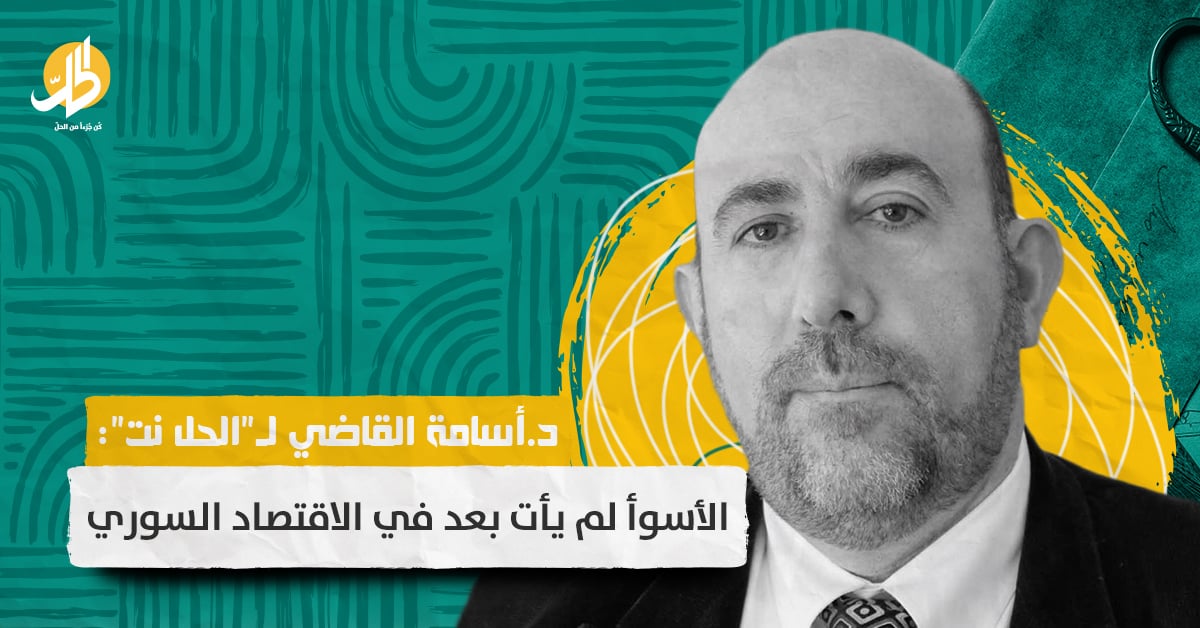
Before 2010, the government in Damascus was talking about the country reaching self-sufficiency, in addition to making promises related to developing the economy and improving per capita income, despite the spread of government corruption in all state institutions. However, the economic storms that have emerged in recent years have shown unprecedented government inability, at a time when Damascus justifies these storms with the protests that took place in 2011 against the ruling authority. Were these protests really the most prominent reasons for the collapse of the Syrian economy? The “Al-Hal Net” website discussed many issues related to the stages and causes of the collapse of the Syrian economy, in a special dialogue with the Syrian economic researcher, Dr. Osama Al-Qadi, who believes that the economic renaissance that the government talked about before 2011 is not possible due to widespread corruption. A dangerous stage. It is also believed that Syria today faces a very dangerous stage due to the government’s economic policies and the division of the country into several economic geographies, as well as the handing over of the remainder of the economy to both Russia and Iran. Regarding the Damascus government’s announcements related to reaching self-sufficiency more than 11 years ago, Al-Qadi indicated during the special dialogue that Syria had a minimum level of food, medicine, and oil self-sufficiency, as it was producing 340,000 barrels of oil, and 240,000 of them were being consumed. Wheat production was also 4 million tons annually, with a consumption rate not exceeding 75 percent. The judge also described self-sufficiency related to medicines as “acceptable,” given the percentage of production of pharmaceutical factories in Syria. Al-Qadi said in his speech, “Syria was equipped to advance much more than it was already. The problem was the level of widespread corruption and the absence of the rule of law, and this was hindering all investments, even national ones from expatriates, as well as Arab and foreign ones.” The judge also saw that the holding companies “have had a stranglehold on the Syrian economy since that period,” and instead of Syria benefiting before 2011 from more than 1,200 legislative decrees in order to truly liberalize and govern the economy, there was very large corruption in managing the economy on the one hand, and a problem in redistributing income on the other hand. The decline in economic growth is not new to Syria. In 2004, more than 30 percent of Syrians were below the poverty line, and there were a million unemployed in the country. “This could have been easily overcome if there was a framework of good governance prevailing in the economy, but unfortunately there was a preference for the interests of the corrupt class over society.” During the past two decades, the heads of the ruling authority in Syria have been controlling the joints of the Syrian economy, a policy that, according to the judge, has led to the poverty rate in Syria reaching about 50 percent, even before the start of popular protests against the authorities in Damascus in March 2011. As evidence for this, the judge pointed out that the percentage of random buildings in Syria has reached approximately half, in addition to somewhat organized buildings, but they are of course unregistered and illegal. Indeed, the judge believed that the economic situation before 2011 was one of the most prominent reasons for the outbreak of protests and not the opposite, as the suppression of freedoms and widespread corruption in the first decade of the current century, of course, led to the emergence of a class of wealthy people, which was the reason for the Syrians to come out to demand greater justice. The economic tension surrounding this issue, he explained, saying, “Of course, the spark was related to wasting the dignity of one or two people, or the families of a group of children, but the issue had a deep economic root, more than 50 years old. This popular economic tension was one of the causes of the revolution.” Al-Qadi described the geography of the Syrian economy as being divided into many economic regions “terrifyingly.” This means that each region of influence is trying to make its economy independent of the other. Transporting a shipment of tomatoes from Idlib to Homs, for example, may be an accusation punishable by “Hay’at Tahrir al-Sham,” which rules the northwestern governorate. He explained in this regard, saying, “The problem within this terrifying economic fragmentation is that we have dealings in more than one currency on this land over a geography of 186 thousand square kilometers, and this is also terrifying. Likewise, the wealth has been shared by areas of influence, and of course it is not properly used so that it is distributed throughout all of Syria.” Oil, for example, is not invested properly and is not distributed to the Syrians. Rather, it is invested in a primitive manner and harms the environment in a primitive way. This will have an impact for years and perhaps decades, in addition to smuggling and corruption, in light of the absence of oversight in the regions of the north and northwest, which are witnessing the spread of many factions without the slightest presence of oversight bodies, which allows smuggling operations to be carried out in huge quantities and may even amount to the smuggling of contraband. The judge spoke about the economic situation in northern and northwestern Syria, and said, “The northwestern regions have administrative problems and corruption, and there is militia administration and no real administration. The interim government, which is part of the coalition, is powerless and has no budgets at all and is not practically ruling on this land. The actual ruler is the existing Turkish governor and the existing Turkish mayor, and the factions deal with him, and this may mean corruption may reach the point of spreading to everyone.” As for “Hay’at Tahrir al-Sham” in Idlib and its environs, it is classified on terrorist lists and cannot be dealt with, and of course there is no transparency, neither in its management of the crossings nor in how the crossings are managed and the volume of goods that enter and exit those areas, nor how the money is spent. Returning to the areas controlled by the central government in Damascus, they are certainly suffering from their worst financial and economic conditions, and if we talk about the crossings, the “Nasib” crossing in the south with Jordan has turned into a major corridor for drug smuggling. The judge explained in the context of the economic conditions there, “The Nassib crossing has become the Captagon crossing. Unfortunately, Syria has transformed from the capital of the Umayyads to the Captagon capital of the world, and Jordan seeks help from the world through the Nassib crossing and the huge amount of millions of Captagon pills and contraband that enter through the crossing and go to the Gulf and sometimes to Greece. The problem is very large and there is poverty that may exceed 90 percent.” The role of the government in the collapse of the judge also saw that the government contributed to the collapse of the Syrian economy, by mortgaging various sectors, not the most prominent of which are oil and underground resources, to both Iran and Russia, through contracts it signed with both sides, in addition to Iranian and Russian debts, which will cause the collapse of the economy for many decades to come. There has been a recent prominent trend to reduce government support, as it has been withdrawn from multiple segments of Syrians. Does this step actually reduce the economic burden on state institutions, and is Damascus’ move towards liberalizing and privatizing the Syrian economy an appropriate solution in the coming period, and in light of the current conditions, should Syria transform into a social market economy? During the dialogue with the judge, he talked about attempts to privatize the Syrian economy and transform Syria into a social market, as he stressed that the problem is not the market economy, as this market is based on a basic pillar, which is non-monopoly, but in Syria the monopoly has existed since the first moment the “Baath” Party took power, especially during the time of the current president, Bashar al-Assad, so there was a monopoly of Rami Makhlouf and the Republican Palace, in the joints of the economy, through holding companies. From society, as part of efforts to reduce the economic burdens on state institutions, but the judge pointed out that this trend is not new, as the government has had a plan for more than 10 years to abandon the government support provided to citizens. The judge explained that one of the most prominent economic problems of government support is not related to the lifting of the support itself, but rather to the inflation rate, which rises periodically. He explained this, saying, “Raising support is not always bad. Sometimes, every time the support was withdrawn by the economic governments in the Syrian regime, prices fell. The problem is that there is a distributed Syria. “The distribution of ports was, for example, the port of Tartous was from Jamil al-Assad’s share, and iron was from so-and-so’s share, and so-and-so’s share of cement, and this material is not permissible to be imported because it is from so-and-so’s share.” Therefore, the withdrawal of government support was something that had been planned for a long time, as the distribution of wealth was taking place at the heights of corruption in the country, so the budget situation collapsed in recent years, and there were no longer even any resources for these budgets, so the government became dependent on drug trade and smuggling. The judge reduced the standards. The impact of government decisions to confront economic crises, as he considered the decision to ban dealing in currencies other than the Syrian pound tantamount to “economic suicide,” especially since the exchange companies that were closed were bringing in large amounts of foreign currencies via remittances, especially from Syrians residing outside Syria, which further disrupted the wheel of economic growth. Regarding decisions to increase periodic salaries, Al-Qadi explained that these decisions have almost no effect, especially since they coincide with a rise in the inflation rate, and therefore any increase in salaries will necessarily mean a higher increase in the prices of goods and services, because there is no volume of goods. And adequate services for Syrians at home. The Syrian government recently resorted to selling treasury bonds, in an attempt to cover the financial deficit in the budgets, so the government put bonds and treasury bills for trading on the Damascus Stock Exchange, months ago, with a value that reached 300 billion pounds. Al-Qadi commented on these measures by saying, “Treasury bonds do not solve the crisis at all in the Syrian issue, because treasury bonds with inflation are worthless. There is no investor on the face of the planet who has the mind to invest in treasury bonds, as inflation in them reaches.” 1000 percent, if an investor bought treasury bonds in 2020 for one billion Syrian pounds, he would lose $200,000 after a year, due to inflation, and never make a profit.” Conclusion and conclusion about the government’s claims that the rise in prices is directly and directly linked to the rise in prices in the world, the economic researcher pointed out that the Syrian situation is different, and is not directly linked to global crises. He explained this by saying, “The global situation is certain that there is inflation, in the event of large imports from abroad, we import until prices rise, or what is called The inflation of imports from the world, but in the Syrian issue at all, there are no foreign exchange until you import a lot of raw materials. The situation will be worse, and worse means that the meaning of unemployment no longer has any meaning in Syria in the first place. The Prime Minister’s salary, according to the legislative decree, is approximately 240 thousand Syrian pounds, which is less than fifty dollars, and by international standards he is below the poverty line. “As for the middle class in Syria, it began to disappear since 2007, when we began to lose 9 percent of it, and the dissolution increased. This class has now disappeared, with the existence of two classes in Syria, a poor class and a very poor class, while there is less than 3 percent, which is the wealthy class. Al-Qadi concluded his speech by stressing that the Syrian economy is on the way to further collapse, for many reasons, most notably the dozens of contracts signed between the Damascus government and both Russia and Iran. He added, “We know of the projects that were announced and that were leaked. There are memorandums of understanding and contracts with Iran and Russia, the size of which no expert knows yet.” Therefore, the scale of the losses and the plundering of the Syrian economy is large and astonishing, and its scale may astonish the Syrians after the disaster has passed.”