
اخبار تونس- وطن نيوز
اخر اخبار تونس اليوم – اخبار تونس العاجلة
W6nnews.com ==== وطن === تاريخ النشر – 2026-05-16 20:57:00
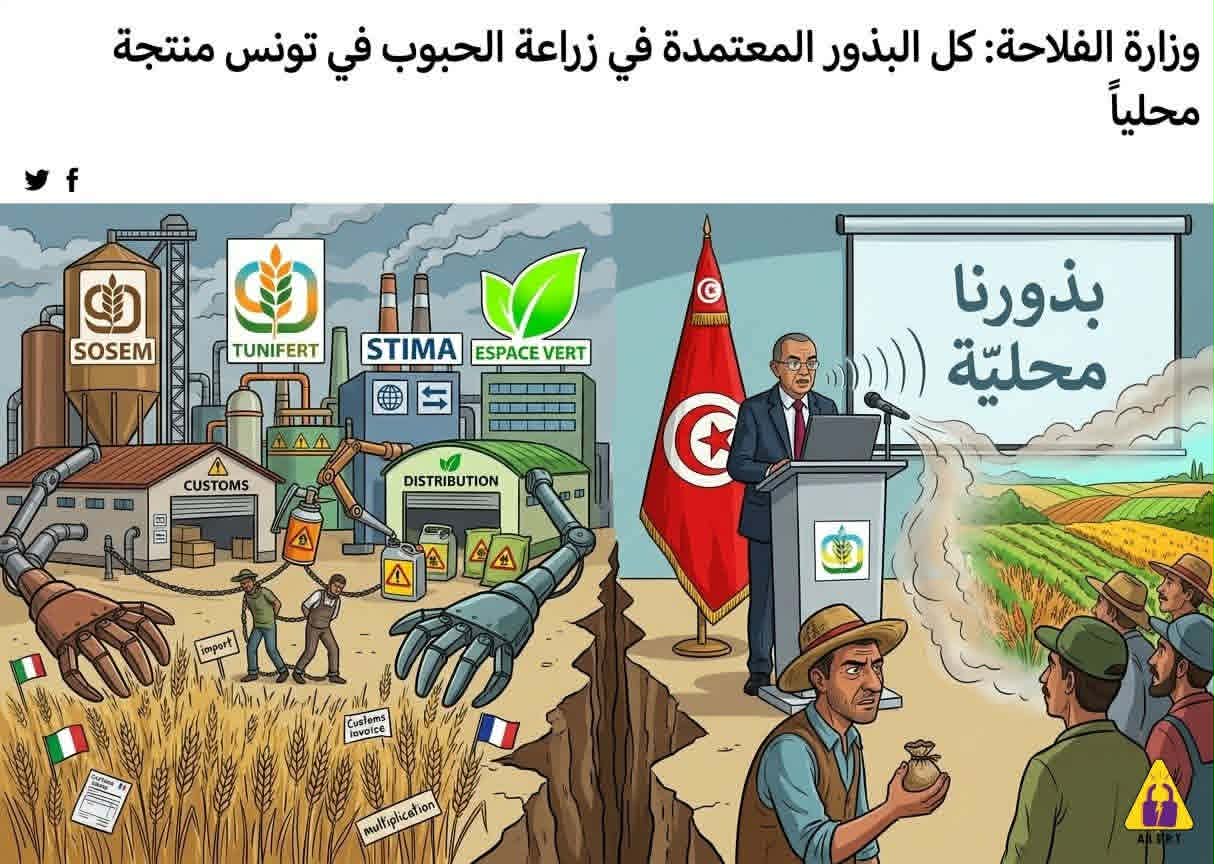
The existing regime today is moving on two fronts simultaneously. With a tightening grip on civil society voices, it freezes the structures and organizations that undertake the mission of enlightening public opinion and exposing the failures of public policies, seeking to silence every rational voice that dares to be held accountable. On the other hand, it drowns the media it monopolizes in a continuous wave of misleading information and delusional statements, in an attempt to falsify reality and divert attention from the facts. The latest chapter of this deception is the statement issued by the Ministry of Agriculture claiming that “all seeds approved for grain cultivation in Tunisia are produced locally.” We at the ALART organization see in this statement a deliberate confusion between concepts, and we place before public opinion the complete facts, in numbers and names. *First: “Produced locally” does not mean “Tunisian origin.” There is a fundamental difference that the ministerial statement deliberately ignores. The seed imported from Italy or France, which was multiplied on Tunisian soil for three years, remains a foreign-generated seed, even if it was born in a Tunisian field. Saying that they are “locally produced” is like saying that cars installed in Tunisia are Tunisian-made cars. The place where the seed is multiplied does not change its genetic composition, its origin, or the technical dependency it imposes. Only a quintal. What is more dangerous is that a growing portion of this approved 15% comes from European varieties, the mother seeds of which are imported by private companies under customs exemptions granted by the state. *Third: In fifty years, we have lost 95% of our seed heritage. Numbers alone tell the whole story. In 1975, 65% of the seeds used in Tunisia were of Tunisian origin. This percentage collapsed to 25% in 2004. Today, only 5% of our agricultural genetic heritage remains. This is what remains after decades of policies that gradually and silently paved the way for comprehensive external hegemony over the heart of our food system. *Fourth: Four groups control the certified seed market. This market is not divided among multiple competitors, but rather is dominated by four specific parties. The first is the SOSEM group, affiliated with the White Rose Group, led by Kamal Belkhairia, which is at the same time the first grain collector in the country, the first seed producer, and the first converter, in an integrated chain that extends from the grain in the field to the box in the consumer’s kitchen. The second is the TUNIFERT company, affiliated with the SEPCM group, led by Al-Daghari, which sells the farmer the seed, fertilizer, and pesticide at the same time, thus combining the sale of the problem and the sale of the solution together. The third is the STIMA company, owned by Al-Khulaifi, the exclusive importer of the two Italian wheat varieties Saragolla and Iride, which are registered in the Tunisian official catalog of plant varieties in his personal name. The fourth is Gharyani’s company, Espace Vert, which provides the farmer with a comprehensive package of seeds, irrigation, and fertilizers, in a model that reduces his margin of choice to its lowest levels. *Fifth: Privileges that combine public money and private influence. These four groups enjoy an integrated system of privileges. It benefits from customs exemptions on its imports of mother seeds, and from Grain Bureau guarantees that allow it to access bank financing, in addition to public support extended since 2020, which now includes its foreign varieties. That is, public money finances the settlement of seeds that are neither owned by the state nor by the farmer. *Sixth: From seed to debt – a closed circle of dependency. Importing a seed does not mean importing the seed alone, but rather it means importing the entire technical path associated with it: specific fertilizers, specific pesticides, and specific technologies that no other seed is useful for. The closed loop is that these supplies are sold by the same companies that sell the seed. What does this mean for the Tunisian farmer in a tangible way? He no longer controls his seed, he no longer controls his requirements, and he buys on credit from private individuals supported by public money. When the harvest is bad, the grain office bears the shock, that is, the burden returns again to public funds and to the citizen.* Food sovereignty is not reduced to knowing where the grain grew. True food sovereignty means that the farmer owns his seed, and that the people have their say in who controls their agriculture. What is being promoted today is not sovereignty, but rather deception wrapped in the rhetoric of sovereignty. As a reminder: The following is the report of the Ministry of Agriculture, Water Resources and Fisheries: Closing of the first national workshop on biological diseases and pests: The Minister of Agriculture stresses the importance of transforming scientific research into field solutions to protect productive systems. Today, Friday, May 15, 2026, Minister of Agriculture, Water Resources and Fisheries, Mr. Ezzedine Ben Sheikh, supervised the conclusion of the first national workshop on “Biological diseases and pests in Tunisia: from research to field solutions,” which continued over the course of On May 14 and 15, in the presence of the Mrs. President of the Institution of Higher Agricultural Research and Education, the Mrs. General Director of Phytosanitary and Agricultural Input Control, and ladies and gentlemen, representatives of central and regional structures, researchers, experts, and representatives of professional organizations. In his speech, he stressed that this workshop represented an important milestone for unifying the efforts of various stakeholders in order to combat biological diseases and pests that threaten agricultural production systems in Tunisia, appreciating the scientific discussions and constructive dialogue that the workshop witnessed, which contributed to the development of practical proposals that can be implemented. He explained that the selection of the workshop topics, related to the Tristeza virus in rodents, pesticide-resistant weeds in grain systems, Xylella fastidiosa bacteria, and the cochineal insect of the prickly pear, reflects the danger of these pests on a number of vital sectors such as oils, grains, and rodents, pointing out the significant economic and environmental losses caused by the cochineal insect in recent years. The Minister also stressed the importance of joint work between the Institution of Higher Agricultural Research and Education and the General Administration of Plant Health and Monitoring of Agricultural Inputs, with the participation of development and extension structures and professionals, which contributes to developing mechanisms for monitoring, diagnosis, early warning, and rapid intervention when such pests appear. In this context, the Minister announced a number of practical measures emerging from the workshop’s recommendations, including the creation of a national network for monitoring and exchanging data on pests, developing training programs for the technical staff of the regional delegations for agricultural development, in addition to strengthening phytosanitary monitoring at crossing points and intensifying awareness and sensitization campaigns. Regarding resistance to the cochineal insect, the Minister stressed the move towards rehabilitating the prickly pear production system by adopting resistant varieties and optimal agricultural practices, while supporting Mexican ladybird breeding units and encouraging young entrepreneurs and the private sector to invest in this field. As for the prevention of Xylella fastidiosa bacteria, it was announced that the national committee charged with following up on the national program to prevent the entry of this bacteria into Tunisia has been updated, in addition to preparing scientific research programs to draw a map of the spread of vector insects and study the extent of resistance to local varieties of olives. It also recommended intensifying efforts to combat pesticide-resistant weeds in cereal systems by updating the weed distribution map and creating a data platform for good practices in the field of integrated control. In the rodent sector, the Minister stressed the need to accelerate the generalization of the use of proven seedlings that are resistant to the “Tristesa” virus, while granting a five-year period for the full production of proven seedlings, in addition to allocating a financing line to support uprooting and replanting operations in the affected areas. At the end of his speech, Al-Sadd called on the Minister to increase coordination between the various intervening structures and to establish a participatory approach in which agricultural scientific research is an essential pillar for anticipation and foresight, in a way that enhances the agricultural sector’s ability to adapt to climate and health challenges and ensures the sustainability of production systems and national food sovereignty. As a reminder also of another report by the Ministry: On the National Day of Agriculture, the Minister of Agriculture confirms: “Food sovereignty is a decision, not a choice.” Announcing a package of measures to support agricultural production and enhance food security On the occasion of the celebration of the National Day of Agriculture, Mr. Ezzedine Ben Sheikh, Minister of Agriculture, Water Resources and Marine Fisheries, today, Tuesday, May 12, 2026, supervised an official procession organized at the National Institute of Marine Sciences in Salambo, under the slogan: “Food Sovereignty.” A decision, not a choice,” in the presence of Messrs. Governor Ben Arous and Manouba, ministry officials, researchers, sector professionals, farmers, sailors, representatives of national organizations, and the media. In his speech, the Minister stressed that achieving food sovereignty has become a “strategic and sovereign decision” in light of climate change and global economic transformations, stressing that the food security battle today represents an extension of the national liberation battle, by supporting national production and enhancing the independence of national decision-making. He pointed out that the agriculture and fishing sector has demonstrated in recent years a great ability to withstand despite the challenges, highlighting that the food trade balance in 2025 maintained a surplus worth 1,280 million dinars with a coverage rate of 119.8 percent, while the first quarter of 2026 recorded a surplus worth 798.3 million dinars and a coverage rate of approximately 139.6 percent. Regarding the strategic productive sectors, the Minister announced a number of new measures to support various agricultural systems. In the olive oil sector, emphasis was placed on continuing to support storage and export and providing financing lines for small farmers, in addition to encouraging the export of canned and organic olive oil and opening new markets. As for the dates sector, the Minister announced a review of the interventions of the Date Quality Promotion Fund within the framework of a vision based on comprehensive quality and improving the competitiveness of Tunisian exports. With regard to the grain system, the Minister revealed the launch of a national strategy to achieve self-sufficiency in durum wheat, based on providing excellent Tunisian seeds and expanding the cultivation of irrigated grains. He also touched on the situation of the livestock breeding sector, which has witnessed a decline due to water scarcity and high feed prices, announcing the activation of the full role of the National Feed Office to confront monopoly and speculation, in addition to assigning the Livestock Breeding and Pasture Provision Office to reconstitute the national herd of cows and sheep. This year’s celebration coincided with World Plant Health Day, where the Minister stressed the importance of biosecurity for plants and animals as it is an essential pillar for achieving food security. In this context, he announced the launch of a national campaign to combat the red palm weevil, in addition to launching the annual national campaign to vaccinate animals to protect livestock from epidemic diseases. Regarding the water file, the Minister stressed that the state will not leave the citizen and the farmer to face the challenges of water supply alone, noting that exceptional allocations have been allocated during the year 2026 to dig new wells, strengthen desalination plants, and juice the irrigation areas and distribution networks, while moving towards encouraging smart irrigation techniques and valuing the use of treated water. He also announced the launch of an electronic platform for managing public water ownership, in addition to developing an authoritative information system to assist in decision-making and provide real-time indicators on the water situation, within the framework of supporting the administration’s digital transformation path. On the scientific research side, the Minister highlighted the importance of innovation and technology in building smart and sustainable agriculture, pointing to the continued development of scientific solutions for the benefit of farmers, students and professionals, in addition to modernizing the academic and administrative system and digitizing services. He also revealed a program to reclaim more than 6,000 hectares of degraded forest and pastoral systems, distribute millions of seedlings, and enhance firefighting efforts and environmental awareness. In the marine fishing and aquaculture sector, the Minister stressed the continuation of improving port infrastructure and enhancing the sustainability of marine resources. As for the investment level, more than 6,500 investment operations were approved with a total value of 548 million dinars, with support allocated to young entrepreneurs, women and private companies, in addition to continuing to provide seasonal loans for the benefit of farmers in various production systems. The Minister of Agriculture concluded his speech by emphasizing that food sovereignty is a “collective national project” that requires continuing reforms, modernizing production systems, rationalizing the exploitation of natural resources, and promoting investment and innovation, reiterating the Ministry’s commitment to continuing to work for a more resilient, competitive and sustainable agricultural sector.