

اخبار الجزائر – وطن نيوز
اخر اخبار الجزائر اليوم – اخبار الجزائر العاجلة
W6nnews.com ==== وطن === تاريخ النشر – 2026-04-22 22:01:00
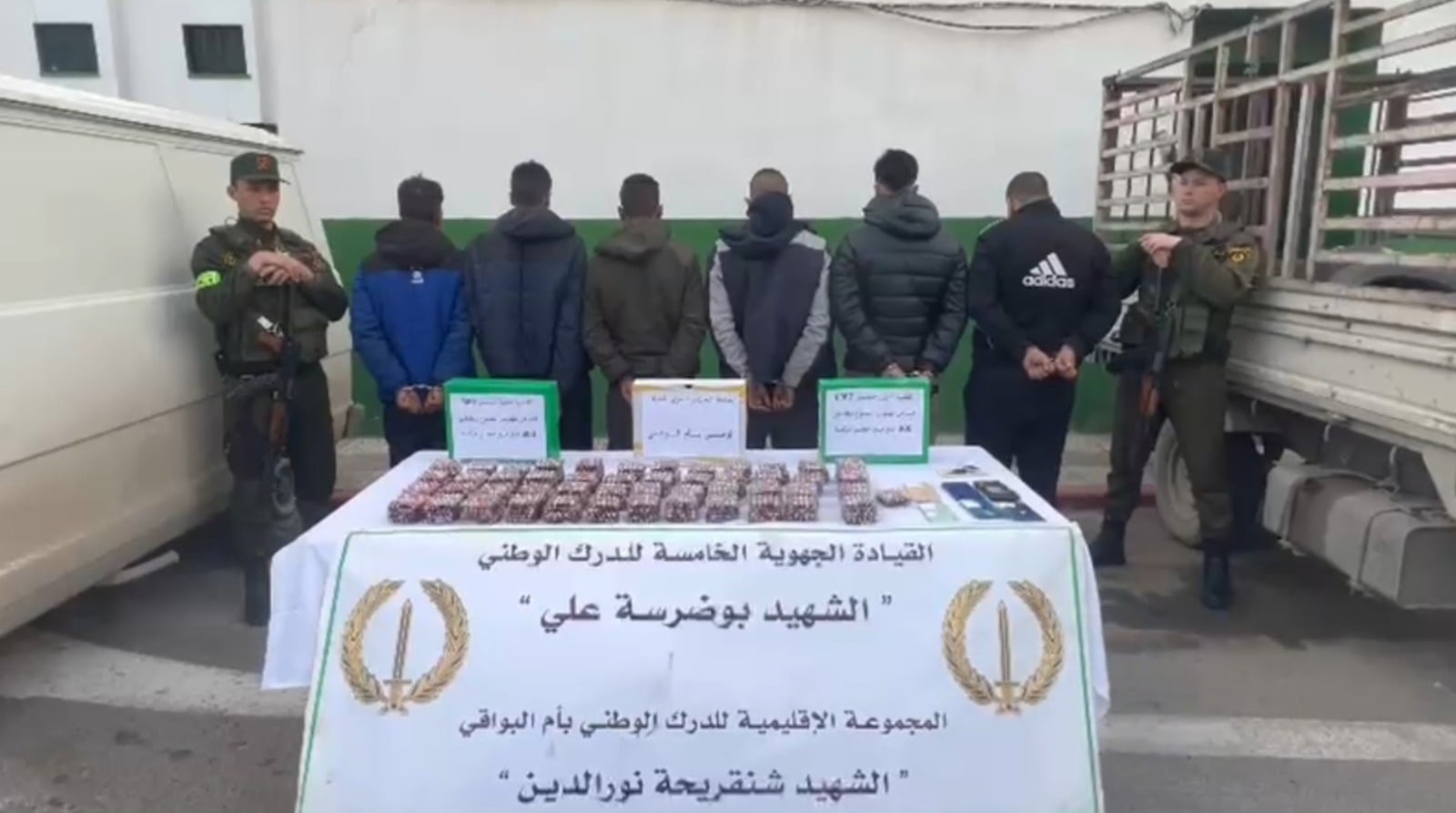
In recent years, Algeria has witnessed a large spread of neighborhood gangs that commit daily attacks, various crimes, and thefts, terrorizing residents and disrupting their daily lives. This transformation means moving from a casual crime that is planned and carried out by one individual to achieve a personal interest, to organized crime, which is a group consisting of two or more people, active within residential neighborhoods with the aim of imposing control over the area, spreading social deviance and intimidating the population, and attacking the safety and freedoms of citizens or their property using violence or cold weapons. Its members harass people and threaten their lives in order to spread an atmosphere of terror and panic among the people, with the aim of destabilizing the security of residential neighborhoods. Shocking statistics: The outcome of the activities of the National Gendarmerie units for the year (2025-2026) showed a firm escalation against organized crime, as 162 neighborhood gangs were dismantled across various states, a significant increase that reflects an intense field deployment, and the arrest of 861 people involved in these crimes, (with 436 people arrested during the summer season only). This reflects the widespread spread of this phenomenon during the summer season, where the area of spread expands. Neighborhood gangs are taking advantage of the vacuum and lack of supervision, which turns some neighborhoods into hotbeds of tension that threaten the security and tranquility of citizens. In addition, 1,395 evil associations were dismantled, 1,174 people were arrested for vehicle theft, and 2,342 people were arrested for stealing livestock. 21,222 tons of processed kif and 13 million hallucinogenic tablets were seized. These efforts come in the context of combating the spread of white weapons, assault on the population, and security threats in urban areas. By installing the National Committee for the Prevention and Combating of Neighborhood Gangs for the period 2026-2029, the government emphasizes the necessity of adopting legal measures to protect the various security services charged with confronting these gangs, with the aim of eliminating the phenomenon and protecting citizens, as the measures include strengthening security, implementing the deterrent Law 20-03, and emphasizing the application of the penalties contained therein, which amount to up to 20 years in prison for gang leaders, while excluding them from any amnesty procedures. The establishment of this committee came for the sake of launching a new comprehensive strategy, focusing on prevention, vigilance, and early warning in neighborhoods and schools, and continuing to prevent the import, manufacture, or sale of bladed weapons directed at these gangs, such as swords and daggers, and fighting them, and sensitization work in spreading awareness and activating the role of the family, civil society, and the media in establishing a culture of peace and non-violence, and enhancing the spirit of citizenship and responsibility among the youth, which contributes to protecting them from various forms of deviance and crime, in addition to supporting local initiatives aimed at Social and professional inclusion, and intensifying coordination between various security, educational and social bodies, to ensure a safe and stable environment within neighborhoods and educational institutions. Implementation tools: In implementing its strategy (2026-2029), the National Committee for the Prevention and Control of Neighborhood Gangs relies on a combination of legal, preventive, field, and awareness-raising tools, including an accurate diagnosis of the phenomenon, where interactive maps are prepared for the neighborhoods most vulnerable to criminal activity. The committee also relies on activating early monitoring systems for the emergence of groups, social and educational intervention in the school environment and youth homes, and coordinating efforts between the ministerial sectors (interior, education, solidarity), civil society, and the family. The committee focuses its strategy on field work and the digital system and deploying field teams to secure neighborhoods and enhance the security presence, with a focus on the digital space to limit electronic recruitment, and the application of deterrent law based on Order No. 20-03 related to the prevention of neighborhood gangs. And combating it, which specifies strict penalties for those involved (10 to 20 years imprisonment for gang leaders). The committee also has the tool to submit an annual report to the President of the Republic that includes an evaluation of the implementation of the national strategy, recommendations to strengthen prevention and deterrence mechanisms, and spread awareness by developing a preventive discourse targeting youth and exploiting social media and mosques to spread awareness. Preventive Discourse The National Committee for the Prevention and Combat of Neighborhood Gangs is betting on establishing a new preventive discourse directed at young people, based on simplicity, interactivity and realism, far from traditional preaching and alienating paternalistic style, by adopting a direct and understandable language for all. In implementing its strategy, it also relies on presenting real-life stories and experiences of models that have succeeded in overcoming challenges, and using “podcasts” to raise issues in depth and transparency, as well as enhancing digitalization by designing educational games and launching interactive competitions. The committee pays special attention to emotional intelligence by addressing young people’s psychological needs and offering practical alternatives, stressing that young people do not reject advice as much as they reject the method of providing it, which requires shifting the discourse from the logic of commands to the logic of “smart choices.” Somaya Salehi, a counselor in school psychological guidance and counseling. Neighborhood gangs rely on violence as a means of self-assertion and dominance. Somaya Salehi, a counselor in school psychological guidance and counseling, says, “In light of the rapid social transformations that Algerian society has witnessed in recent years, and the accompanying emergence of deviant behavioral manifestations among a group of adolescents, violence within educational institutions – in its various verbal, physical, and destructive forms – has become a phenomenon that calls for an in-depth scientific reading that goes beyond a superficial interpretation based on the violation.” And discipline, to touch upon the psychological, educational, and social dimensions that produce this behavior.” Somaya Salehi explained in a statement to the “Algeria Mubasher” website, “School violence is no longer just a passing behavior or a circumstantial reaction. Rather, in many cases, it has become an expression of disturbances in the psychological and emotional structure of the adolescent, and a defect in the mechanisms of self-control, in addition to his being influenced by deviant social models in which he finds a kind of belonging and appreciation.” She pointed out that “in the absence of early and effective institutional intervention, this behavior may gradually turn into a pattern of collective deviance, embodied in the phenomenon of neighborhood gangs, which are mainly based on violence as a means of self-affirmation and dominance.” She continued, “The educational reality today requires a radical reconsideration of the roles of the listening and psychological follow-up cell within educational institutions, and moving it from a procedural function with limited impact to an effective strategic device, based on early monitoring, preventive intervention, and continuous psychological accompaniment,” noting that “effectively activating this cell requires adopting a practical, multi-dimensional scientific approach, based on modern models in educational psychology, such as school prevention programs, social-emotional learning, and positive behavioral support systems, which are based on the development of psychological and social competencies.” For the student, instead of limiting himself to controlling his behavior through punishments.” The spokeswoman adds, “These models have proven that building self-awareness, teaching emotion management skills, conflict resolution, and responsible decision-making are essential factors in preventing aggressive behavior.” “In this context – the specialist says – the transition from the logic of punishment to the logic of positive reinforcement and the reformist approach represents a fundamental shift in the philosophy of dealing with school behavior, where the focus is on valuing positive behavior, teaching the student to take responsibility for his actions, and working to repair the damage instead of just punishing him, which contributes to rebuilding the student’s relationship with the institution on the basis of trust and belonging. The pivotal role of the educational staff, especially the professors, cannot be overlooked as they are the daily actor in controlling the classroom climate and monitoring behavioral shifts. For students, this requires supporting them through continuous training programs in educational communication skills, behavior management, and emotional intelligence, enabling them to provide early and effective intervention.” Our speaker concluded by saying that “involving the family as an essential partner in the educational process remains a decisive factor in the success of any preventive strategy, as the psychological balance of the student cannot be achieved in light of the separation between what is built within the school and what is lived within the family,” noting that the school today is no longer just an institution for transmitting knowledge, but rather has become a space for rebuilding the psychological and social balance of the individual, and a vital field for the prevention of delinquency. Every aggressive behavior that is contained and treated within the institution represents a proactive intervention that limits the development of more dangerous paths, and contributes to protecting society from complex phenomena such as neighborhood gangs, which find in the psychological and social vacuum a fertile ground for growth.” Lawyer and legal advisor, Farida Ibri Strict criminal deterrence limits some behaviors but does not address the deep roots. For her part, lawyer and legal advisor, Farida Ibri, says that “tightening penalties, in principle, represents a necessary tool in confronting the phenomenon of neighborhood gangs, but it It remains insufficient if isolated from the rest of the preventive and social dimensions.” Farida Ibri explained to the “Algeria Mubasher” website that “comparative experience, and even daily judicial practice, shows that strict criminal deterrence may limit some behaviors in the short term, but it does not address the deep roots that produce this phenomenon, such as social fragility, unemployment, family disintegration, and weak educational and cultural framework. Therefore, the effective approach cannot be punitive only, but must be comprehensive, combining deterrence, Prevention and reintegration.” The lawyer explained, “With regard to the current legal framework, despite the remarkable development it has witnessed, especially with the introduction of texts that criminalize belonging to neighborhood gangs and tighten the penalties associated with them, the need for additional amendments remains. These amendments should focus on clarifying some legal concepts, such as defining a gang more strongly and the limits of belonging to it, strengthening mechanisms to protect witnesses and whistleblowers, and expanding the powers of the judicial police within the framework of respect for rights and freedoms, as well as incorporating modern tools to combat organized crime, especially in its digital dimension, which has become a means of coordinating these gangs and promoting their activities. “Through pleading in similar cases – says specialist Farida Ibri – several challenges and gaps emerge that hinder the actual application of legal texts. The most prominent of which is the difficulty of proof, especially when it comes to proving the element of “belonging” or “organization,” in addition to the hesitation of some victims and witnesses to report for fear of retaliation, which empties the texts of their effectiveness. Sometimes social pressure and the lack of complete confidence in legal protection contribute to a climate of impunity. The disparity in the logistical and human capabilities of law enforcement agencies cannot be overlooked, which affects the speed and effectiveness of intervention.” She added, “In this context, the role of the citizen emerges as an essential partner in the security equation. The culture of reporting is not just a legal duty, but rather a civil act that reflects society’s awareness of its collective responsibility to protect itself. Breaking the silence and strengthening trust between citizens and state institutions represent the cornerstone of containing this phenomenon. Here, the committee currently dedicated to combating neighborhood gang crimes of a mafia nature is of particular importance, which came as an institutional response to the spread of these crimes in a disturbing and horrific manner, as they have begun to affect the security and tranquility of citizens in shocking scenes that contradict moral and social values.” She stressed that “the success of this committee, regardless of the extent of its powers, remains dependent on the extent of the involvement of society as a whole in supporting its efforts, through reporting, awareness, and cooperation.” The battle against neighborhood gangs is not just a battle of agencies, but rather a battle of an entire society, seeking to restore public space as a safe space, in which human dignity is preserved and values are protected, away from manifestations of violence and chaos that only produce fear and brokenness.” She concluded by saying that “the bet today is not only on enacting tougher laws, but rather on building a collective awareness that rejects these phenomena, dries up their sources, and restores respect to the idea of coexistence based on security, respect, and the rule of law.” Jalloul Hajimi, Secretary-General of the National Federation of Imams and Employees of Religious Affairs and Endowments. Such mechanisms strengthen and empower decisions that maintain the cohesion of society and the cohesion of the nation. Thamn Jalloul Hajimi, Secretary-General of the National Federation of Imams and Employees of Religious Affairs and Endowments, makes decisions related to the gangs present in the neighborhoods and the injustice, aggression, and attacks that citizens are exposed to by neighborhood gangs, especially by those who take drugs and hallucinogenic pills, which creates terror among citizens. Hajimi said in an interview with the website “Algeria Live” said, “The state must ensure the protection, security, and tranquility of citizens, and the provision of such mechanisms strengthens and strengthens these decisions that preserve the cohesion of society, the cohesion of the nation and the individual, and the preservation of our institutions and property.” He pointed out that “the mosque, the Qur’anic school, and the zawiyas are doing a tremendous job in raising awareness, raising awareness, explaining the truth to people, and advising, guiding, and directing, and this is at the core of their work, and there is no doubt that the size of the mosques in this country, which exceeds 26 thousand mosques, is corresponding.” 23 million people arrived there on Friday, which will have a strong and effective impact in influencing such behaviour.” Hajimi added, “It is necessary to adopt a method of deterrence that puts an end to those who attack others and to take the necessary measures. We all cooperate as imams, scholars, virtuous people, preachers, educators, guides, teachers, and mentors with the security authorities to clarify to the people and distinguish truth from falsehood, although it is necessary to tighten control and tighten such measures, so that a society He was safe and in peace, and God Almighty said, “Let them worship the Lord of this House, who has fed them against hunger and made them safe from fear.” He concluded by saying, “We are all cooperating, and God willing, the calls of the Minister of the Interior and Local Communities, Saeed Saeed, will find decisions that provide the opportunity to maintain the security of society.”