
اخبار فلسطين – وطن نيوز
فلسطين اليوم – اخبار فلسطين اليوم
W6nnews.com ==== وطن === تاريخ النشر – 2026-05-05 00:40:00
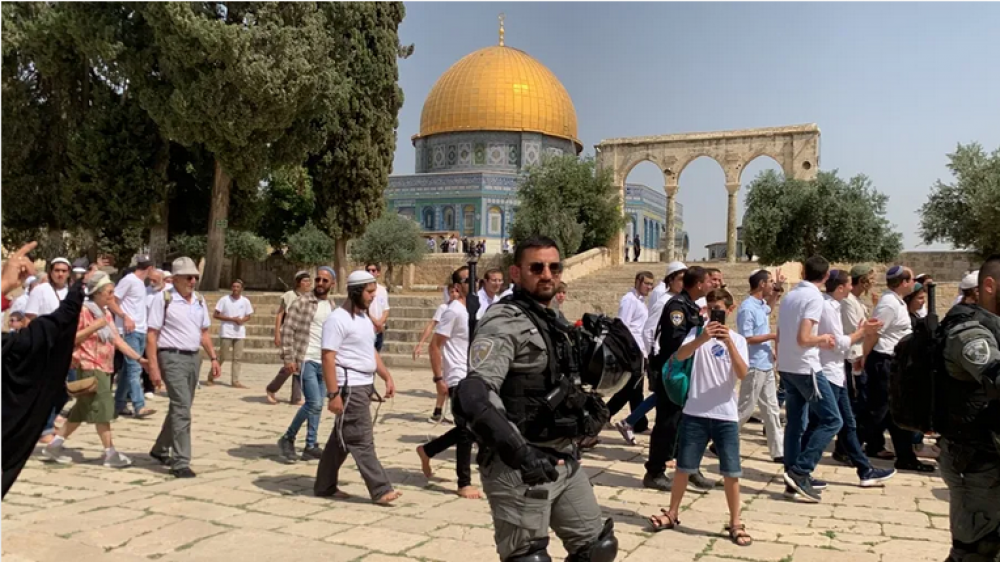
The Jerusalem Governorate monitored the systematic crimes of the Israeli occupation in the governorate during the month of April 2026, as the occupation continued its measures aimed at imposing more restrictions on the city and its people. These crimes were topped by the ongoing attacks on the blessed Al-Aqsa Mosque, and the accompanying massive incursions of colonists under the protection of the occupation forces, and attempts to establish a new reality that affects the existing historical and legal situation. This was followed by the continuation of demolition and bulldozing operations in multiple neighborhoods of the city, the notification of dozens of facilities, the death of a martyr, and the recording of injuries among citizens as a result of direct attacks or field repression. Arbitrary detention campaigns also continued, and decisions of actual imprisonment and house arrest were issued against Jerusalemites, in addition to hundreds of decisions of forced deportation from the Blessed Al-Aqsa Mosque and the city of Jerusalem, in addition to moving forward with the filing and approval of new colonial plans aimed at Judaizing the city and changing its demographic and geographic character. The following is a summary of the violations committed by the occupation and colonizers during April: Martyrs: The child, Muhammad Murad Rayan (17 years old), from the town of Beit Daqu, northwest of Jerusalem, was martyred by bullets from the Israeli occupation forces, who seized his body after shooting him. Another citizen was also injured during confrontations that broke out in the town, coinciding with the storming of the occupation forces, which carried out a massive raid and search campaign that affected a number of citizens’ homes. Crimes and violations in the Blessed Al-Aqsa Mosque: The month of April 2026 witnessed a qualitative and systematic escalation in Israeli violations against the Blessed Al-Aqsa Mosque, as the occupation forces completely closed the mosque from February 28 until dawn on April 9, 2026, under the pretext of imposing a state of emergency, which prevented worshipers from entering it and emptying it for a long period. During April, it was recorded that (4,112) settlers stormed, and (1,216) others entered under the guise of “tourism,” in light of the escalation of incitement from “Temple” groups, which called for intensifying the raids, introducing sacrifices, and imposing Talmudic rituals, especially during Israeli holidays. The mosque witnessed public and provocative practices, such as prostrating, blowing the trumpet, dancing, and raising flags, in addition to performing public collective prayers under heavy protection from the occupation forces. The month included a series of prominent violations, the most prominent of which were repeated attempts to introduce the “Passover offering,” the storming of the mosque by the Minister of National Security in the extremist occupation government, Itamar Ben Gvir, and the expansion of the daily storming hours to six and a half hours. Collective rituals were also recorded in the vicinity of the Dome of the Rock, the seizure of children’s toys, and the prevention of the call to prayer for the evening prayer on April 20, in addition to widespread raids on “Independence Day” accompanied by arrests and restrictions on worshipers. The end of the month witnessed an increase in the use of printed prayer texts and the performance of public rituals inside the courtyards of the mosque, an indication of the establishment of a new reality inside Al-Aqsa. Injuries: During the month of April 2026, the Jerusalem Governorate recorded a total of (49) injuries, distributed among injuries with live and rubber bullets, cases of severe beatings, and injuries with tear gas, in addition to injuries as a result of settlers spraying pepper gas. The injuries were concentrated in the vicinity of the apartheid wall, the Qalandiya checkpoint, the towns of Al-Ram and Abu Dis, and the towns northwest of Jerusalem, including Beit Daqo, Beit Anan, and Qatana. Among them, (9) injuries were recorded among workers and young men while they were trying to cross the wall or stand near it. These violations indicate that the extreme right-wing occupation government continues to unleash its forces and colonialists to carry out its attacks against Jerusalemites, with legal cover and military protection, in a scene that reflects official complicity and a deliberate policy of impunity. Settlers’ attacks: During the month of April 2026, the Jerusalem Governorate monitored the settlers carrying out (35) attacks, including (4) physical abuse attacks, in the context of a continuous, organized, multi-level escalation that targeted the Blessed Al-Aqsa Mosque, Bedouin communities, private property, and Islamic and Christian sanctities. The attacks included shooting, burning property, blocking roads, pursuing shepherds, storming and vandalizing homes, and assaulting churches, under the direct protection of the occupation forces, reflecting a complementarity of roles between colonial groups and the extreme right-wing government, to impose new facts on the ground and undermine the status quo. Among the most prominent of these attacks was what happened on April 7, when colonists burned a tent in a Bedouin community near Mikhmas and tried to steal livestock. The April 11 attack also emerged, as a large-scale attack was carried out on the town of Mikhmas, during which citizens’ vehicles were targeted, in a dangerous mass escalation. On April 29, a colonialist attacked and injured a Christian nun in Jerusalem, in an incident that reflects the targeting of even religious symbols. Cases of arrest: During the month of April 2026, the Jerusalem Governorate monitored a remarkable escalation in the policies of repression and arrest pursued by the Israeli occupation authorities against Jerusalemites, as it documented the arrest of (138) citizens, including (9) women and one child, as part of a systematic campaign targeting various areas of the occupied city of Jerusalem. These arrests were accompanied by widespread raids into homes and neighborhoods, and field arrests at checkpoints and roads, with the use of excessive force, beatings, intimidation, and insults. The arrests were distributed across multiple areas, most notably: Qalandiya camp, the town of Al-Ram, the Shuafat refugee camp, the town of Anata, the town of Silwan, the town of Al-Issawiya, the Wadi Al-Joz neighborhood, the town of Kafr Aqab, Beit Daqo, the town of Al-Eizariya, the town of Abu Dis, and the Bab Al-Amud neighborhood, in addition to the vicinity of the blessed Al-Aqsa Mosque. It also included a number of freed prisoners, activists and journalists. Decisions of the occupation courts against detainees: The Israeli occupation courts continue to issue arbitrary decisions against Jerusalemites, including imposing strict restrictions on movement, including imposing heavy financial fines that burden families, forced home detention, deportation decisions, and travel bans. The occupation courts also continued to extend arbitrary administrative detention without bringing specific charges, in some cases for long periods, which represents a flagrant violation of human rights and the basic principles of legal justice. Actual prison: During the month of April 2026, the Jerusalem Governorate monitored the continuation of the Israeli occupation’s repressive policy against Jerusalemite prisoners, as it documented the issuance of (20) rulings and decisions, including (13) administrative detention, as part of the escalation of the use of this arbitrary measure against marabouts, civil servants, minors, and journalists, through repeated renewals and transfers to the actual prison without clear charges. Actual imprisonment sentences and financial fines were also issued, in a clear continuation of the policy of repression and legal terrorism directed against Jerusalemites. Home detention: During the month of April 2026, the Israeli occupation authorities continued the policy of forced home detention against Jerusalemites, particularly targeting youth and journalists, as a punitive tool alternative to direct arrest. During this month, the Jerusalem Governorate documented two house arrest decisions, which were accompanied by strict conditions, including temporary deportation and a ban on the use of the phone and social media, in a move aimed at restricting their civil and media activity and silencing their voices. Deportation decisions: During the month of April 2026, the Israeli occupation authorities continued the policy of forced and arbitrary deportation against Jerusalemites, and used this measure as a punitive means targeting those stationed in Al-Aqsa Mosque, journalists, activists, freed prisoners, and students, as part of systematic efforts to empty the city of its religious and national symbols. During this month, the Jerusalem Governorate monitored a total of (95) deportation decisions from the Blessed Al-Aqsa Mosque and the Old City, noting that the actual number may be higher, in light of the severe restrictions and the threat of the deportees to renew the decisions in the event of making any media statements, in addition to informing some of them via text messages on the “WhatsApp” application. Demolition, bulldozing, and property confiscation operations: During the month of April 2026, the Jerusalem Governorate monitored (33) demolition and bulldozing operations, divided into (17) forced self-demolition operations in which Jerusalemite citizens were forced to demolish their homes with their own hands, and (13) demolition operations carried out by the occupation mechanisms and its municipalities, in addition to (3) bulldozing operations that targeted Palestinian lands and property. Data indicate that the demolition operations The bulldozing was distributed among several towns and neighborhoods in Jerusalem, most notably: Silwan (especially the Al-Bustan neighborhood, Kroum Al-Qamar, Ras Al-Amoud, and Wadi Hilweh), Al-Issawiya, Jabal Al-Mukaber, Sur Baher, Shuafat, Hizma, Al-Ram, and Al-Sawwanah, in addition to agricultural lands in northeastern Jerusalem. Demolition decisions, forced evictions, and land seizures: During the month of April 2026, the Israeli occupation authorities continued the policy of notifications, demolition, eviction, and construction cessation against Palestinians in the Jerusalem Governorate, within the framework of an ongoing escalation targeting the Palestinian presence in the city and threatening the residents, their sanctities, and their sources of livelihood. During this month, the Jerusalem Governorate documented the issuance of (65) notices, divided into (50) decisions to stop construction, (8) demolition decisions, and (7) eviction decisions, without registering any seizure orders, which reflects the continuation of the policy of gradual pressure that leads to forced displacement. These measures were concentrated in a number of areas that constituted major targeting hotspots, most notably Silwan, Shuafat Camp, and Issawiya, in addition to towns north of Jerusalem such as Al-Ram, Kafr Aqab, and Qalandia Camp, where notifications and large-scale field campaigns intensified. Crimes and violations against Jerusalem institutions and landmarks. During April 2026, the Jerusalem Governorate witnessed a widespread Israeli escalation targeting religious, educational, cultural and media institutions, in addition to press and diplomatic crews and public facilities, as part of a policy aimed at imposing control and undermining the Palestinian presence. The violations were characterized by the complementary roles of the occupation forces, its municipality, and the settlement associations, by restricting freedom of worship, movement, and journalistic work, and disrupting educational and religious life. The violations varied between militarizing the Old City during Holy Saturday, preventing worshipers from arriving, closing streets to provide Judaization events, obstructing students’ access to their schools, restricting journalists and diplomats, and leading to attacks on medical and media personnel. This reflects the continuation of a systematic policy targeting the societal and institutional structure in Jerusalem and imposing new realities on the ground. Colonial projects: During April 2026, the Jerusalem Governorate observed a continuation of Israeli colonial policies aimed at strengthening control over the Jerusalem Governorate, through extensive settlement plans that included construction, land seizure, and colonial expansion. The governorate documented, based on daily follow-up of official announcements issued by the so-called “Civil Administration” and the occupation municipality in Jerusalem, in addition to what was documented by the Orient House Center, a total of (7) colonial plans during the month. The data showed that among these plans, three plans were submitted, and include the construction of (965) colonial units on a total area of (172) dunums, while three settlement plans were approved, including the construction of (412) colonial units and a religious school on an area of (52.4) dunums, in addition to putting up a plan for tender that includes the construction of (263) colonial units.