
اخبار سلطنة عُمان – وطن نيوز
اخر اخبار سلطنة عُمان اليوم – اخبار سلطنة عُمان العاجلة
W6nnews.com ==== وطن === تاريخ النشر – 2026-03-07 19:41:00
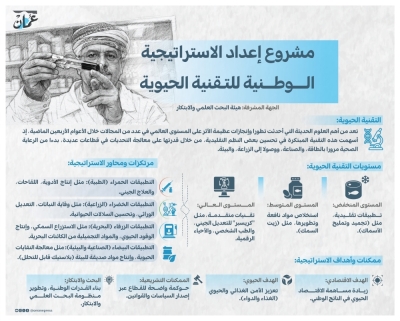
Poll – Yousef bin Salem Al Habsi – In a step that reflects the ambition of the Sultanate of Oman to create a future based on knowledge and scientific research, the project to prepare the “National Biotechnology Strategy” at the Scientific Research and Innovation Authority in partnership with many governmental and academic agencies, stands out as a bridge towards keeping pace with the emerging global economic developments, as this strategy is not limited to scientific aspects only, but rather is a comprehensive national vision that aims to employ vital resources and systems for the sustainable achievement of economic, food, health, and environmental goals, through concerted efforts between various sectors. Concerned, as the Sultanate of Oman seeks to transform its unique vital resources into investment opportunities that place it on the map of international competitiveness, in line with the objectives of Oman Vision 2040. International Competitiveness Map Dr. Kawthar bint Ibrahim Al Balushi, from the Scientific Research and Innovation Authority and project manager for preparing the national strategy for biotechnology, said: The project for preparing the national strategy for biotechnology aims to place the Sultanate of Oman on the map of international competitiveness in this vital sector… stressing that biotechnology is a fundamental driver of innovation. She explained that biotechnology is a technical application that uses living organisms and biological systems to produce goods and services that achieve maximum industrial and economic benefit, as the world is witnessing the emergence of the “bioeconomy”, as its annual global revenues are expected to reach between (2-4) trillion US dollars in the period from 2030-2040. She pointed out that the strategy directly intersects with the priorities of Oman Vision 2040, especially in the axes of economy and development, sustainable environment, and people and society. In the eleventh five-year plan through programs and initiatives related to the manufacturing, bio-manufacturing and food industries… Noting that the project began in August 2023 with an analysis of the current situation, and is currently in the fourth stage of developing and preparing the strategy and its governance mechanism… Stressing that the Sultanate of Oman possesses unique strengths, including: biodiversity and a distinct geographical location, which makes investment in biotechnology a golden opportunity to strengthen the knowledge-based economy and achieve environmental sustainability. Academic Investment Dr. Fahd bin Mahmoud Al-Zadjali, Dean of the Amman College of Health Sciences, and a researcher in medical sciences: Biotechnology is one of the most important engines of modern development, and it is a national necessity that affects multiple aspects, and is not limited to education and scientific research only, but extends to include health security, food security, and diversification of sources of income, in addition to supporting industrialization, enhancing partnership with the private sector, and transferring and localizing technology. He explained that many countries have worked to align their national strategies according to their data, capabilities, and status in the field of biotechnology, out of awareness of the importance of this sector. Hence, the importance of governance of the national strategy for biotechnology emerges, ensuring the integration of efforts between the various sectors and institutions concerned, and maximizing the use of national resources, to build a strong and sustainable economy for the future. He pointed out that academic investment in scientific research and innovation in the field of biotechnology contributes to building specialized national cadres, developing advanced analytical and applied laboratories, supports the establishment of emerging small and medium-sized pioneering companies, enhances local content, and reduces dependence on imported products. Accordingly, the activation and governance of the national strategy is within a clear system. It defines priorities and draws a practical road map, ensuring that resources are directed efficiently and that a tangible and sustainable impact is achieved. A sustainable knowledge economy. Dr. Adel bin Salem Al Hinai, Supervisor of Red Applications in the National Biotechnology Strategy Project, said: Red biotechnology represents (medical and health applications, including the development of medicines, vaccines, medical diagnostics, and advanced treatments) and is a strategic pillar for achieving Oman Vision 2040, by contributing to economic diversification, building a sustainable knowledge economy, and providing highly skilled job opportunities. For young people. He stressed that this technology is linked to the Sultanate of Oman through its endeavor to localize the pharmaceutical industry, enhance health and drug security, and benefit from Omani natural resources in research and development. Its importance lies in improving the quality of health care, reducing dependence on imports, and adding an industrial sector with high added value. He explained that scientific research and innovation are the basis of the development of this sector, through research centers in academic institutions (such as Sultan Qaboos University), encouraging the registration of patents, and strengthening partnerships between the public and private sectors to develop products. And innovative treatments, and we look forward with a future vision to make the Sultanate of Oman a leading regional center, through establishing integrated pharmaceutical complexes, qualifying national cadres, and adopting advanced technologies such as personalized medicine and genetic therapies. We also look forward to benefiting from Omani biodiversity to discover new medicines, integrating artificial intelligence into research, and developing supportive legislative systems, and these combined efforts contribute to achieving sustainable and long-term economic development for the Sultanate of Oman. Adopting modern technologies, said Dr. Ghalia Bint Humaid. Al Maamriya, Director of the Textile Agriculture and Biotechnology Research Center at the Ministry of Agricultural Wealth, Fisheries and Water Resources, and Supervisor of the Green Applications Center in the technical team of the project to prepare the National Strategy for Biotechnology: While the countries of the world are accelerating in adopting modern technologies to achieve food security and environmental sustainability, the Sultanate of Oman is moving at a steady pace towards benefiting from biotechnology in strengthening the agricultural sector, as it is a major tool for creating a qualitative shift in agricultural production and achieving sustainable development. She added: Under the supervision of the Scientific Research and Innovation Authority, and in cooperation with many stakeholders, the Sultanate of Oman is working To prepare the National Strategy for Biotechnology, of which the Green Biotechnology Applications Foundation is a major part, which aims to employ modern applications of biotechnology in the agricultural sector, where its benefits range from improving productivity, enhancing food security, and achieving environmental sustainability. She added: Biotechnology is not just a tool for improving agricultural production, but rather it is an essential pillar for achieving self-sufficiency, preserving genetic resources, and developing crops capable of facing environmental challenges such as salinity and heat. She added: Biotechnology also opens broad horizons for investment in the security sectors. These investments include the production of hybrid and improved seeds, the development of environmentally friendly biofertilizers, and the production of natural pesticides extracted from local plants such as frankincense, neem, and other local plants. Microorganisms Nadia bint Saeed Al Ameri, supervisor of white applications in the National Biotechnology Strategy Project, said: White biotechnology relies on the use of biological systems such as microorganisms and enzymes in industrial processes to produce environmentally friendly materials, which contributes to reducing emissions, reducing energy consumption, and improving production efficiency, and its applications enter into multiple industries such as Biofuels, green chemicals, biodegradable plastics, pharmaceutical industries, detergents, and advanced biomaterials. In light of the global transformations towards a low-carbon economy, the importance of white biotechnology or biomanufacturing is highlighted as one of the pillars supporting the establishment of green and sustainable manufacturing industries, based on research and innovation, in line with the strategic directions of Oman Vision 2040, which is represented in economic diversification and enhancing the role of knowledge-based industries, in a way that supports the Sultanate of Oman’s achievement of its development goals. Sustainable 2030. She added: With the continued growth of global demand for sustainable products, and the clarity of environmental legislation, especially with regard to zero neutrality, biomanufacturing constitutes an attractive field for local and foreign investment. It also opens promising horizons for attracting qualitative investments and strategic partnerships, localizing advanced technologies, and supporting innovation and emerging companies in biomanufacturing, in line with the directions of the Sultanate of Oman towards a knowledge-based economy and a low-carbon sustainable industry. The role of scientific research and innovation. She added: Scientific research and innovation It plays a pivotal role in the development of biotechnology, by improving production efficiency, reducing costs, and developing sustainable and environmentally friendly products. International experiences confirm that the success of biotechnology is linked to the extent of integration of universities and research centers with the industrial sector, and with the acceleration of global trends towards carbon neutrality and the circular economy, the Sultanate of Oman has components and features that qualify it to be a regional center for sustainable bio-industries, represented by the availability of a favorable business environment represented by the presence of infrastructure and economic and free zones, and legislation, laws and policies that support investment, She stressed that biotechnology represents a practical implementation tool to achieve the goals of Oman Vision 2040 and the strategic objectives of the eleventh five-year plan (2026-2030), by building a clean, innovative, and globally competitive industry, and enhancing the position of the Sultanate of Oman in future industrial value chains. 2040, especially in building an economy based on knowledge and innovation. Biotechnology is not a complementary option, but rather a strategic path that must be at the core of our national priorities. I believe that biotechnology represents a meeting point between the economy, health, environment and food security. It serves the health sector through the development of biomedicines, vaccines and advanced diagnostic techniques. It contributes to agriculture by improving crops and increasing their ability to resist climate conditions. It also provides innovative solutions for treating water and waste and supporting environmental sustainability. This integration makes it a cross-sector sector, capable of creating value. He stressed that the importance of this field does not lie only in its economic returns, but in its strategic impact, as investing in biotechnology means reducing dependence on imports of medicines and medical technologies, enhancing our food and health security, and creating quality jobs for the sons and daughters of the nation in highly skilled specializations. It also places the Sultanate of Oman on the map of advanced industries regionally. Investment in this field must focus on developing the research infrastructure, stimulating partnerships between universities and the private sector, and supporting emerging companies and innovation. He stated that we aspire to see The Sultanate of Oman is a regional center for research related to the bioeconomy and the production of advanced bioproducts, and a platform for innovation in the fields of food security and sustainability. It is possible to think about establishing a “biotechnology valley” that embraces emerging companies and research centers within an integrated system.