
اخبار السودان – وطن نيوز
اخر اخبار السودان اليوم – اخبار السودان العاجلة
W6nnews.com ==== وطن === تاريخ النشر – 2026-04-15 12:28:00
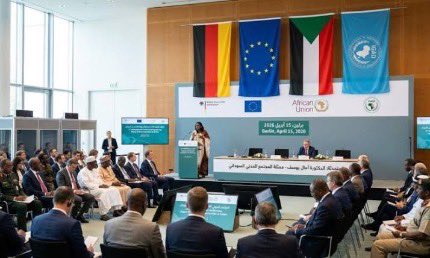
Monday, April 13, 2026 AD: Radio Dabanga Report: Suleiman Serry The activities of the third international conference to discuss the Sudanese issue will be launched in the German capital, Berlin, this Wednesday morning, in order to mobilize international support for efforts to bring peace, provide humanitarian aid, and alleviate the burden of the escalating crisis, with the participation of 40 political and civil figures, excluding parties to the Sudanese conflict. The conference, which lasts for one day, will be held coinciding with the three-year anniversary of the April 15, 2023 war between the Sudanese Armed Forces, the Rapid Support Forces, and the forces supporting both parties, while all attempts at calm have failed to reach solutions to end the war. The announcement of the conference, which was organized by the Federal Republic of Germany, the European Union, the African Union, France, Britain, and the United States, was accompanied by a counter-media campaign and a widespread wave of anger in terms of the invitation and criteria for selecting participants. While political and civil forces welcomed its convening, it faced resistance and harsh criticism from the governments of Port Sudan and Nyala. The “establishment” government did not object to the conference and the issues it would discuss as much as it criticized the invitation of figures it accused of contributing to fueling the war, and considered them representatives of the “Government of Port Sudan,” while the government in Port Sudan had previously sought an invitation from the conference administration, according to the Prime Minister’s statements. When it failed to do so, it announced a boycott and began a diplomatic movement parallel to the conference through its embassies and delegates abroad. This was confirmed, for the first time, by Prime Minister Dr. Speaking to a delegation of foreign journalists visiting Khartoum on Thursday, Kamel Idris said that he warned German Foreign Minister Johann Vadiful not to ignore his government. Idris informed the German official in advance of the failure of the conference results, saying: “If the Berlin conference on April 15 does not include the government of Sudan, I can assure you, with complete confidence and frankness, that it will be a complete failure.” The “absent present” government: But the thinker and academic researcher Dr. Al-Nour Hamad believes otherwise, considering that the media hype accompanying the conference by the “Government of Port Sudan,” under the pretext of its absence from the conference and its exclusion from participation, is incorrect, as evidenced by the fact that it has representatives on its behalf. Al-Nour Hamad told Radio Dabanga that among them are the federal leader Mohamed Sayed Ahmed, known as “Al-Jacomi,” the leader of the Democratic Bloc, Mubarak Ardoul, and the head of the Umma Party, Mubarak Al-Fadil, along with other figures such as lawyer Nabil Adeeb. He believes that the Port Sudan government’s movements through its ambassador to Germany to protest the holding of the conference without the participation of its country are nothing but a “media campaign to mislead.” He also denounced the announcement that the conference represents a broad sector of Sudanese civil forces, and did not rule out political analyst Dr. Al-Nour Hamad said that the “Government of Port Sudan,” as he put it, would have the upper hand and the influential role in forming the membership list of participants, likely with the help of regional powers, which he did not name, that support the Muslim Brotherhood. He linked this to previous experiences that arose in other countries such as Egypt, and continued, saying: “These are the same previous arrangements that arose in Egypt, and they were constantly going against the revolution and aborting the civil democratic transition.” The paradox of the Quartet’s line. Al-Nour Hamad hoped that the conference’s arrangements would follow the line of the Quartet’s mechanism that it announced in September last year, which called for the removal of Islamists, their fronts, the army, and even the military in general, from power and wealth. He expressed his regret that these conditions were not met in reality, pointing out that the Muslim Brotherhood was represented at the Berlin conference, and they were the ones who were standing in all attempts to abort the civil democratic transition. According to these reasons, the academic researcher expected that the conference would not achieve tangible results or lead to the formation of a civil government. Rather, it was likely that it would move towards reconciliation with the Muslim Brotherhood and accepting them as a fait accompli. He also believes that it is impossible for any call to mobilize support and raise funding for humanitarian aid during the conference to succeed, in light of what he described as the Muslim Brotherhood’s control of power, warning that humanitarian aid may not reach those who deserve it. He warned that the “Port Sudan government” would control the organizations and put obstacles in front of them, and he did not rule out the leakage of relief materials to the markets, noting that these methods were tested during the past 37 years of Muslim Brotherhood rule. The thinker and academic researcher Dr. concluded: Al-Nour Hamad pointed out that the Berlin conference will be nothing more than a “media sensation,” ruling out that it will have a real impact on the course of affairs in the coming period in Sudan. Between acceptance and rejection, however, the former Minister of Foreign Affairs, Ambassador Dr. Ibrahim Taha Ayoub, believes that the idea of holding the Berlin conference was a decision of the European Union, which included other international bodies such as the United Nations, the African Union, the League of Arab States, and the Intergovernmental Development Organization (IGAD), in addition to the United Kingdom. Ayoub told Radio Dabanga that this comes in order to intensify diplomatic and international efforts to resolve the crisis afflicting Sudan and its innocent citizens, who have become fuel for this war through no fault of their own. He points out that this gathering of those who reject the war and call for its cessation represents the last opportunity for the return of peace to their country, while the group that calls for its continuation to serve their interests sees it as blatant interference in the affairs of their country. Rather, they consider it a new type of colonialism and Western hegemony in order to return to control power and eliminate the Islamic presence in the country. Ambassador Ayoub pointed out that it is important to call for the efforts of the Berlin Forum to be crowned with agreement on a political settlement acceptable to the parties involved in the conflict, and it must be emphasized that there will be no victor in it, meaning that opinions between the supporters of the Berlin Conference and those against it agree on specific principles based on the sovereignty of Sudan and the preservation of the rights of the masses, and agreement on the form of governance in the transitional period. However, he warned that the risks that the international community is anticipating relate to the spread of the conflict to neighboring countries and the Red Sea region. Humanitarian issues: The former Minister, Ambassador Dr. Ibrahim Taha Ayoub pointed out that one of the necessary and urgent issues, both current and future, is the need to intensify support for humanitarian efforts, deliver food aid, and create a safe environment for displaced persons and refugees living in camps or in the open. It is also believed that the presence of these organizations represents a clear sign of the use of soft and hard diplomacy at the same time, which contributes greatly to the conclusion of the Berlin conference, as wanted by the host country and the friends of Sudan, with positive results that silence the voices of those calling for the war internally and those seeking to sabotage the conference by “demagogic methods” linked to their political and organizational level. He says: “We find in the membership of the five bodies calling for the Berlin gathering the countries that make up the Quartet mechanism, and it can therefore be said that the principles included in the Quartet statement last September serve the agenda of the mechanism, and may even go beyond it.” While the former Sudanese Minister of Foreign Affairs believes that the “de facto government” stands against the Berlin meeting because the countries calling for it deliberately neglected to invite them to participate in it, and he says: “And therefore they oppose it and stand against it. Rather, we hear that members of Islamic groups, at their urging, are carrying out mass campaigns against it.” Ayoub adds: What the advocates of continuing the war ignore is that this gathering is intended for peace advocates. As for the fighting forces that carry weapons and instill terror in the souls of the public, no one was invited, because the conference intended to separate them and remove them from the peace process. Welcome and reservations: For his part, Ambassador Dr. Al-Shafie Ahmed Mohamed welcomed the holding of the Berlin conference, while expressing some reservations. He believes, in principle, that any international move to address any humanitarian issues or armed conflicts deserves to be welcomed by all affected and participating parties, and must be given room for it provided that it is sincere and serious. Ambassador Dr. says: Al-Shafi’i told Radio Dabanga that the Berlin conference may be divided and may lead to confusion in evaluation. He believes that anyone who comments on the conference is necessarily biased towards one of the parties. He explained that these different positions impose the necessity of looking at the conference from an objective perspective that reflects its reality, and indicates that building any hopes must be based on facts. However, he expressed his reservations about the conference, describing the sponsoring countries as not serious about resolving the Sudanese crisis, pointing out that these same countries have been in charge of the Sudanese file since before the change of the previous regime. Ambassador Dr. points out Al-Shafi’i pointed out that countries such as the United States, Britain, France and Germany, whether their movements were through the Quartet mechanism or within the framework of many other activities, were in charge of the Sudanese file. However, as he sees it, the crisis continued to take levels of complexity from one form to another until it reached the stage of war, after which all this suffering occurred, and she is holding this file after the war without achieving tangible progress in the solution, knowing who started the war and who is financing it, and insists that it be presented as part of the treatment. A human tragedy, Dr. pointed out. Al-Shafie pointed out that the human tragedy has reached its peak in many areas of Sudan, especially in the Darfur region and the city of El-Fasher in particular, and has reached dangerous levels, despite the Security Council’s decision to lift the siege and bring in humanitarian aid to those besieged for more than a year and a half, without it being implemented on the ground. Rather, these countries played the role of spectators. He believes that the countries sponsoring the conference have a specific agenda that they want to impose on Sudan, and are seeking to manage the file and resolve the crisis in a way that is consistent with their policies, even if this leads to complicating the crisis to the worst degree. He says that some of these countries, but not all of them, are not concerned with humanitarian affairs. Ambassador Al-Shafie believes that this effort aims to bring about cumulative shifts in the direction of an agenda that serves their interests, as happened in the London, Paris and American conferences. He considers that calls to address the humanitarian crisis are nothing but slogans and raised banners, but underneath are agendas that carry ideas, sometimes dark, that lead people to violence. He says that international movements to mobilize support and funding have not achieved tangible results, wondering about the fate of the financial pledges and humanitarian aid announced at those conferences, and adding that relief has not reached those in need. Ambassador Al-Shafie ruled out that the conference would produce positive results, criticizing the discussion of Sudan issues without the participation of its representatives, and believes that his absence means that the organizing countries have a goal they want to reach. The post Berlin.. The “presence and absence” controversy, disputes over the representation of civilians and the exclusion of combatants appeared first on Dabanga Radio TV Online.