

اخبار سوريا اليوم – وطن نيوز
سوريا اليوم – اخبار سوريا عاجل
W6nnews.com ==== وطن === تاريخ النشر – 2022-11-29 17:43:00
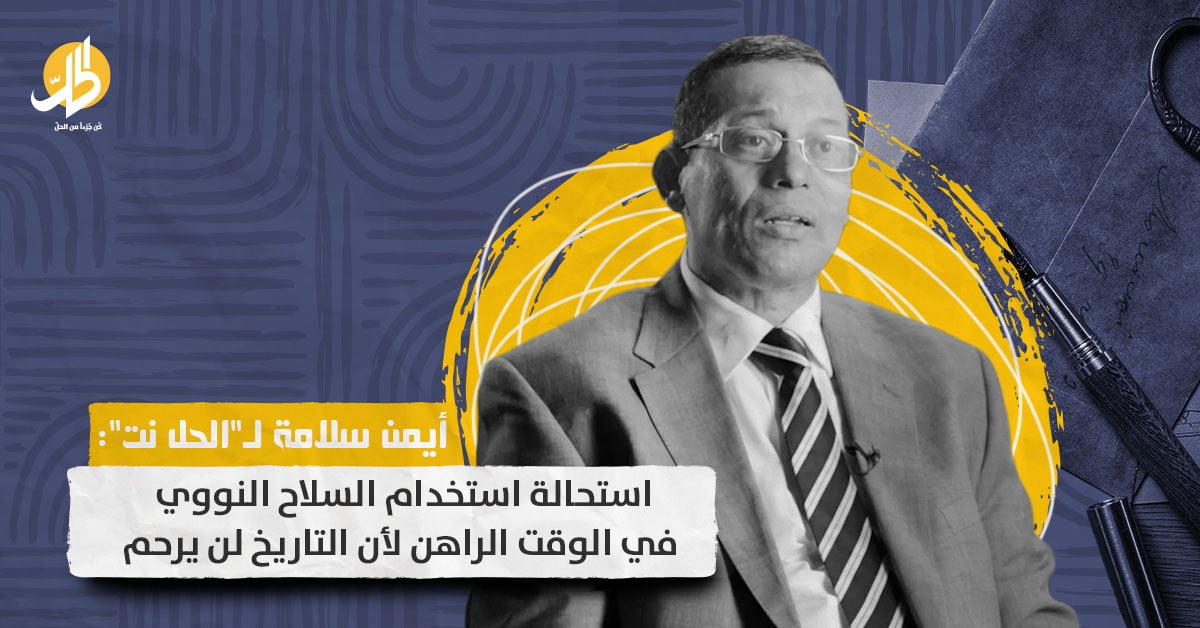
The Russian war in Ukraine has been prolonged, and is likely to be prolonged, amid questions about Russia’s management of its war, the effectiveness of its weapons, and the extent of its success or failure in achieving its strategic goals. On the other hand, there are movements taking place in the region that indicate an attempt to establish an alliance confronting Iran, the aim of which is to reduce the level and degree of damage it has caused in the region after many years. Many questions and topics related to politics, military strategies, and negotiations related to the Russian-Ukrainian war, in addition to questions about the opportunities for forming an alliance against the threat of Iranian expansion in the region, were discussed by “Al-Hal Net” website with Colonel and Dr. Ayman Salama, during a special dialogue. Ayman Salama, retired colonel and former liaison officer in the North Atlantic Treaty Organization (NATO), and a member of the Egyptian Council for Foreign Affairs, a member of the Council of the Faculty of Al-Alsun at Ain Shams University in Egypt. Salama was also nominated to work as a legal advisor to the International Criminal Tribunal for the Former Yugoslavia, in 2001. Salama brings to his credit his experiences and academic career many tasks and works, most notably that he worked as a legal advisor to the “International Committee of the Red Cross” in Geneva between the years 2018-2019. To comment on the comments of the Committee’s experts on the Third Geneva Convention for the Treatment of Internees and Prisoners of War in 1949, as well as the visiting professor of international law at the International Institute for Human Rights in Strasbourg, France, along with the honorary professor of international law at the Institute for Human Rights at DePaul University, Chicago, United States of America. The extent of the need to develop international humanitarian law in the context of the ongoing war in Ukraine, and regarding the extent of the need to develop the rules of international humanitarian law, Salama said in his special interview with Al-Hal Net that the Russian-Ukrainian war will not change in the age of highly complex weapons. This war, which has been raging since February 24, 2022, has confirmed the urgent need to develop the rules of international humanitarian law related to international armed conflicts, given the scale of comprehensive destruction, massive human losses, and human suffering that has affected fighters and civilians alike. According to Salameh’s assessment, despite the development of modern military technologies and the unprecedented use in armed conflicts that emerged in the production of weapons, equipment and tools for armed conflict, these modern technologies were not limited to one branch of combat weapons for both sides of the armed conflict, but rather included all of these branches, but all of this contradicted the scale of destruction that humanity has not witnessed since World War II; Ukraine has become an arena for testing the latest weapons by Russia as well as NATO. Therefore, it has become necessary for the international community to make diligent efforts to develop international covenants of international law and international humanitarian law. Salama Sarrad, in his lengthy conversation with Al-Hal Net, about the concept of lethal explosive weapons that are of concern, added that as a result of what has been witnessed in many military hostilities between the two warring countries Russia and Ukraine, populated areas are targeted with many types of explosive weapons that raise humanitarian concerns when used in populated areas, and these weapons have effects that extend over a wide area, or leave wide-ranging effects and damage. Salama pointed out, “The international media informs us around the clock of the latest Russian weapons that have not yet been tested in the wars that Russia fought in Afghanistan, Chechnya, and Syria, and its famous agent, Wagner, in Libya and Central Africa.” According to Salama, it is clear that combatants, whether in international or non-international armed conflicts, violate many rules of international humanitarian law, and the Russian-Ukrainian war is no exception in this regard. According to what Salama said, international humanitarian law aims to humanize armed conflicts, and that principle is based on a fundamental legal fact, which is the motive of armed conflict, which is to significantly weaken the enemy’s power and not annihilate him, as was the case in ancient centuries, when war was a legitimate means of settling international disputes, before the issuance of the Charter of the League of Nations and after it the Charter of the United Nations. It goes without saying, according to Salama, that international humanitarian law represents the legal framework applied to modern weapons, as the latter sets the rules related to means and methods of combat, in its conventional and customary treaties, as most of these rules related to the organization of modern weapons are found in the first Additional Protocol, especially with regard to their review and legality during their development, modernization, or manufacture, as well as the extent of their compliance with what was stated in the “Martens” clause, which is considered one of the basic principles of international humanitarian law. What is meant by prohibiting or restricting weapons carries a double concept. On the one hand, restriction means the legal restriction of the use of some weapons, that is, the prohibition and prohibition of special methods in using this weapon, meaning that it is permissible to use it under conditions, and on the other hand, the legal prohibition of the use of some weapons, that is, the prohibition of resorting to them in all cases, regardless of the method and purpose. Where the prohibition is therefore intended under the secondary rules of state responsibility, states must take all measures to stop violations of international humanitarian law and provide appropriate means of reparation and investigation in many cases as an initial step in any action, according to Salama. At the conclusion of Salama’s talk on the topic of the need to develop international humanitarian law, he pointed out that the Russian-Ukrainian war revealed many serious violations of the principles and rules of international humanitarian law that govern international armed conflicts, and raised the alarm bell about these violations that were largely caused by modern lethal weapons that do not distinguish between combatants and civilians. Therefore, it has become necessary for the international community, with the International Committee of the Red Cross at the forefront, to work diligently to develop the applicable rules of international humanitarian law related to the use of modern weapons such as drones, as well as the methods and tools of modern warfare such as cyber attacks. You may be interested in: Dr. Mohsen Abu Al-Nour to “Al-Hal Net”: There will be no stability in the Middle East with the presence of Iran, and no Russian-Ukrainian negotiations in the context of the Russian invasion of Ukraine. In response to “Al-Hal Net’s” question about the possibility and feasibility of Russian-Ukrainian negotiations, Salama said that negotiations will not take place between Russia and Ukraine at the present time or in the coming weeks at least, unless a major and important dramatic development occurs, that is, an important development on the battlefield, in military operations, specifically in Ukrainian territory. Occupied by the Russian army, whether in southern or eastern Ukraine. Therefore, the tide of military, economic, financial, and other types of Western military assistance to Ukraine is unprecedented in the history of all wars, meaning that when Hitler’s Nazi forces were on the outskirts of the Russian capital, Moscow, and the German army besieged it, during Hitler’s rule, during World War II, and they inflicted many defeats on the “formerly Soviet Red” Russian army, the United States and its allies sought a military supply, and a land, sea, and air bridge for the Soviet army at the time to withstand Hitler’s army. Without that Western support, the “formerly Soviet Red” Army would not have defeated Hitler’s “German” army at that time. If restlessness occurs on the part of some Western countries, which have begun to see that they are suffering from economic problems as a result of the support provided to Ukraine, this will affect the military operations in the field of Russians and Ukrainians, and thus this would reduce the political weight of Kiev, according to Salameh’s assessment. Salama noted that if Ukraine’s political weight and influence against Russia decreases, this will make Ukraine perhaps submit and go to the negotiating table and thus will not require Russia to impose conditions and a ceiling higher than the Ukrainian demands, which are the immediate withdrawal from all territories occupied by Russia, the first of which is the Crimean Peninsula. You may be interested in: Dr. Osama Al-Qadi to Al-Hal Net: The worst is yet to come in the Syrian economy, the use of nuclear weapons and the consequences of war. If Moscow resorts to using nuclear weapons, there will be positions from Western countries, and there will also be movements and support that Western countries will provide to the Ukrainian government in the event of Russia’s escalation. Within this framework, Salama believes that there is no nuclear state at all in the coming decades that is ready to take the risk of using nuclear weapons again, since the catastrophic “Hiroshima” and “Nakasaki” accidents. The thinking required by the radical transformation in war, which was caused by the invention of nuclear weapons, must also take into account these terrible risks at the local level because in the current global era, they have international repercussions, and the raging and intense war in Ukraine has witnessed repeated threats to resort to the nuclear option, and the world has become, without exaggeration, on the brink of the “Hiroshima” and “Nakasaki” scenario. Salama added, “Russia, specifically Russian President Vladimir Putin and his advisors, retreated after signs of Ukrainian victories began to appear on the horizon. Before these victories, specifically on the southern Ukrainian front, Russian forces withdrew from several regions and sectors, as a result of the United States of America and European countries supplying Kiev with highly advanced weapons, some of which may not have been used yet. As a result of the sudden Russian losses over the past weeks, Putin began threatening to use nuclear weapons.” For its part, Washington received these threats very seriously, and the American response was firm at the time. As a result, Moscow backed down from its serious threats, and then Putin expressed his great welcome to return to the negotiating table, which he did not show at the beginning of his invasion of Ukraine. Peacekeeping Medal for the Italian Armed Forces in Sarajevo for Brigadier General Ayman Salama. As for Salama’s point of view, on the course of the war in Ukraine and where it is heading, and the form of the conflict that will be between the West and Russia in the event of any other development on the battlefield, he said that it is difficult to predict the outcome of the war there, because no one expected or imagined that Ukraine would withstand throughout these ten months against the Russian army, and no one expected that Russia would suffer many major defeats in the last weeks of the war taking place so far between Moscow and Kiev. However, if Putin is certain, despite his stubbornness, insistence, individual management of political and strategic affairs, and his unilateral decisions in the smallest and most minute matters and details of the war with Ukraine, Salama believes that the only case that will make President Putin give up many of his demands and conditions at the negotiating table with Ukraine is that there will be a dramatic qualitative escalation of the war. Likewise, if Putin is certain that it is not what he and the Russian army have lost in recent weeks that will put pressure on him, but if he is also certain that Ukraine will open another front in the occupied territories in the new year 2024, then Putin does not want to lose more in the military field or at the political negotiating table. You may be interested in: Aqeel Abbas: The Iraqi political process is clinically dead and there is no future for Iranian influence. A Western alliance against Iran? Regarding the expansion and expansion of Iranian militias in the region, and the proxy wars, whether in Iraq, Lebanon, Syria, or Yemen, Salama does not believe that there will be any Western action soon against and containing the danger of the expansion of Iranian militias, whether by the Iranian “Revolutionary Guard” with its experts and advisors, or even by the Iranian forces present inside Syria. Salama attributed this to Western countries’ preoccupation with the Ukrainian war. As for the formation of a Western alliance against Iran, it is excluded at the present time except in one case, which already exists in the Arabian Gulf, specifically in the Strait of Hormuz, and is represented by maritime alliances, whether by NATO or other Western countries, in order to secure international navigation, which is threatened from time to time by the Iranian Revolutionary Guard. You may be interested in: Hassan Al-Raddad: Amy Samir Ghanem has a comedic sense and I consult her in some of my roles.


