
اخبار تونس- وطن نيوز
اخر اخبار تونس اليوم – اخبار تونس العاجلة
W6nnews.com ==== وطن === تاريخ النشر – 2026-07-16 12:39:00
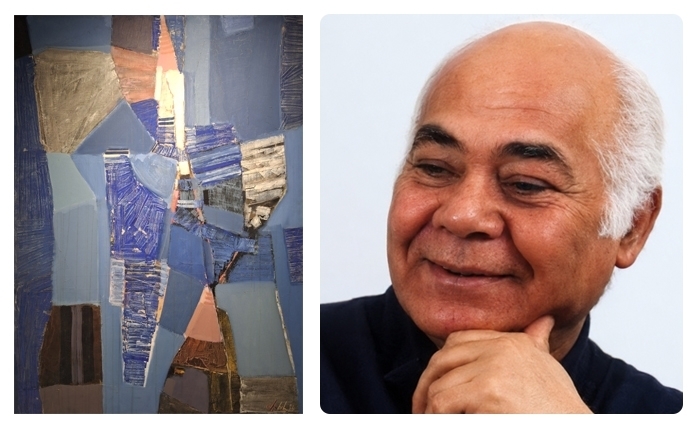
Written by Elham Al-Arabi – Visiting the retrospective exhibition of the late plastic and theater artist Habib Chebil, which was held at the Belvedere Arts House under the title “The Emergence of the Body” from March 28 to April 26 of this year, does not seem like a mere passage through a memorial space that includes works completed in distant times, as much as it seems like an actual entry into a complete moment in the history of painting in Tunisia. What the visitor experiences here is not limited to the pleasure of discovering a coherent individual experience, but rather goes beyond that to the clear feeling that he is being brought back to the heart of the plastic questions that occupied painting in Tunisia between the seventies and the nineties, in a direct extension of the transformations that began since the sixties. This exhibition is, strictly speaking, a travel in time; Not through nostalgia for forms, but rather through the plastic issues themselves that were raised in that period, not only in Tunisia, but even in the cradle of modern art: What remains of the subject in the painting after the experiences of the avant-garde movements? What happens to the body when painting realizes the sovereignty of its own surface? How can a connection with the visible be maintained without relying once again on descriptive illusion? It is precisely at this crossroads that the importance of Habib Chebil’s experience becomes clear. If it is permissible to rely on the dates appearing on some of the signatures, and on the stylistic cohesion that binds this text together, then these works appear to extend from the mid-sixties to the early nineties. Such an extension of time is sufficient to raise it above the level of the occasional stage or circumstantial method. We are facing a long-term investigation, in which the same questions are pursued across multiple decades of late modernity, not as a matter of repetition, but rather as a matter of deepening and reformulating. What is striking from the first glance is that this continuity is not based on a mechanical restoration of subjects, nor on the reproduction of a fixed formal recipe, but rather on a rare fulfillment of a limited number of fundamental problems: the status of the subject after major turning points in modern art, the possibility of constructing a non-illusory pictorial space, the independence of the surface of the painting, and the survival of the visible world within a language that is no longer subject to it but is capable of recomposing it. Hence, the unity of this text appears, at first glance, to be based on clear iconic elements: female bodies, seated figures, body parts, bottles, vases, bouquets, tables, and interior spaces. However, this recurring presence does not fall within the scope of the story, description, or recording. According to Habib Shubil, the subject is not something that is intended to be transferred to the surface as it is, nor is it a ready-made argument to furnish the painting, but rather it is the first material for a continuous process of transformation. The body is not treated here as a portrait, the still life is not treated as an exercise in imitation, and the interior is not so much a domestic scene as a site of deconstruction and reconstruction. Everything undergoes successive transformations: simplification of masses, fragmentation of relationships, compression of space, condensation of form, relative independence of limit, and a gradual transformation of the visible object into plastic language. For this reason, it is difficult to reduce these works to a ready-made binary between diagnosis and abstraction. It is not diagnostic in the traditional sense, nor is it purely abstract. More precisely, it resides, with rare constancy, in that transitional zone where the two coexist without canceling each other out. Some paintings retain relative clarity: a seated woman holding a cat, a vase, a bouquet, bottles on a table, a figure rising from a dark background. But other works push the visual to its extreme limits, so that the sight hesitates between recognizing the object and perceiving the pure organization of spaces, lines and masses. This fluctuation is not a lack of decisiveness, but rather the essence of the project itself. Modern painting, in its most profound form, no longer gives the subject ready to be named, but rather destabilizes the conditions for its appearance, keeping it in a state of constant tension between presence and erasure. Hence, it also seems necessary that this world not be reduced to two single keys: light and body, as this choice is justified in the speech accompanying the exhibition. For Habib Chebil, light is not just an element that illuminates a form that precedes it; It participates in the birth of form, as well as in its concealment, and in keeping it on the threshold of formation. The body, in turn, does not always appear as a complete image, but rather often appears as a body in the process of being formed, extracted from darkness, from colored matter, or from the economy of lines. However, limiting ourselves to these two dimensions alone entails a narrowing of the reading. The matter here is not only related to the phenomenology of appearance, but rather, before that, to a strict structural logic: the painting as a field of forces, space as a composition not a background, and the subject as an unstable formula that is constantly reconstructed. The poetics of light alone is not enough to understand these works; It must be brought back to something deeper: to the issue of construction, and to the fate of the visible when it enters the system of modern painting. At this level, Habib Chebil’s connection with the 1960s generation in Tunisia takes on its true meaning. The reference to his belonging to this generation should not be understood as a mere historical classification. This is because this generation did not content itself with reviewing the references of the “Tunisian School,” but rather moved the plastic question itself from the centrality of the subject to the conditions for constructing the painting. Habib Shabil participated in this transformation, but from a private location. While some artists at the time chose decorative paths, identity signs, or self-sufficient abstract formulas, he remained more faithful than others to a tense and productive relationship with the visual. He does not reject the subject completely, nor retain it descriptively, but rather puts it at the test of modern painting, where the thing is no longer what is seen directly, but rather what is regenerated plastically. This choice is most evident in the construction of space. These works are often not constructed according to a coherent depth of perspective, nor do they present the interior as a space containing objects and bodies in a stable order. It is based, on the contrary, on relative flatness, on compression of levels, and on direct confrontation between masses, lines, axes, and spaces. The table is no longer just a table; It is a base, a threshold, and a carrier level. The bottle does not remain only a household item; It becomes a vertical axis, a column that almost holds the balance of the composition. As for the human form, it does not always appear as a stable body in a place, but rather as a mass, a piece of color, or a formal reserve that pushes the building forward. Thus, space transforms from being a framework for representation to being an internal structure of the painting itself. In quite a few works we see a very precise architectural sense. Even when the touch seems more lively, and the material more vibrating, the painting does not slip into unbridled expressive flow. There is always a hidden order that holds the elements together, and a structural decision that regulates the energy and prevents it from dissolving. In this lies one of the most important characteristics of Habib Chebil’s experience: his ability to reconcile freedom and rigor, between the movement of the material and the discipline of composition, between the color event and the internal order. Therefore, it is not permissible to attribute his works to a general expressive sensibility; At heart, they remain construction works. Colors participate decisively in this construction. Faint blues, pale pinks, violets, variable whites, blacks, red earths, greys, and pastels do not perform the function of matching nature, but rather the function of establishing relationships within the painting. It does not embellish the form; She produces it. In some paintings, colors distribute masses and stabilize balances, in others they condense the surface and make it a vibrant field for work, and in thirds they combine with strokes and incised lines to create an atmosphere that almost approaches writing. Color here is not an appearance but a structure, and not only a sensory effect but a tool for visual thinking. In addition, the linear dimension imposes itself as one of the keys to this experience. Borders, striping, incisions, and linear restorations all play a role that goes beyond the mere external definition of shapes. According to Habib Chebil, the line is not enough to encircle; It splits the surface, re-launchs the form, and sometimes opposes the mass to which it is adjacent. Hence, in many works, that special energy arises that makes the surface appear written as much as drawn. The matter here is not a comparison between drawing and painting, or between line and smudge, but rather a mutual engagement between them, allowing the painting to live in its own tension between structure and vibration, between economy and disclosure, between sign and mass. If we want to place this text in its precise place within the history of painting, it must be said that Habib Shubil does not fall into late cubism in the etymological sense, nor into a lyrical abstraction, nor into a distorted diagnosis in the weak sense of the word. His experience lies at the intersection of multiple modern legacies: the fragmentation of the object in the manner of Cubism, the sovereignty of the surface, the legitimacy of the material effect, and the liberation of painting from classical illusion. However, these elements do not appear to him as quotations from a known dictionary, but rather as components that have been re-fused into a special language. He does not embrace a theoretical program, nor does he seek to embody an aesthetic statement. He works from within the painting itself, and through a relatively limited vocabulary, but it is restored each time in a different way, making each work a new moment in a continuous search. Perhaps this loyalty to problems, not solutions, is what gives this experience its deepest value. Habib Chebil does not prove a theory, nor does he seek to astonish by being different for the sake of being different. His paintings progress through repetition, displacement, and condensation, and through a renewed examination of what can remain visible when it is recomposed according to the conditions of modern painting. To what extent can a shape be simplified without erasing it? To what extent can the painting be constructed without drying it? To what extent can the subject remain present without being returned to the tranquility of representation? These questions, as well as the questions of painting itself, are what give the work its continuity and necessity. This is also where the special emotion that the exhibition awakens comes from. It does not stem only from the value of the works themselves, nor from the effect of restoration after absence, but rather from the emergence of Habib Chebil as one of those painters who did not understand modernity as a break with the world, but rather as another way of restoring it. The world here is neither copied nor canceled, but rather reorganized through the special forces of the painting. Bodies, objects, spaces, signs, and masses are but different instances of one process: the transformation of the visual into a sensitive construction. Celebrating Habib Chebil, in this sense, should not be limited to praising the uniqueness of an experience or the place of an artist in the memory of the Tunisian plastic arts scene. What really deserves recognition is the nature of the contribution he made within the history of late modern painting: a contribution that may be based not so much on the hype of style as on the perseverance of research, and on its ability to keep alive the tension between body and structure, between object and sign, between visual memory and the independence of surface. Thus this exhibition reminds us, with rare precision, that some works survive not only because they represent their era, but because they reflect, from within their material itself, the terms of their own necessity, and give that necessity a form that is difficult to forget. Elham El Arab, visual artist and researcher, former professor at the Higher Institute of Fine Arts in Tunisia, Higher Institute of Arts and Crafts in Kairouan