
اخبار فلسطين – وطن نيوز
فلسطين اليوم – اخبار فلسطين اليوم
W6nnews.com ==== وطن === تاريخ النشر – 2026-06-27 11:39:00
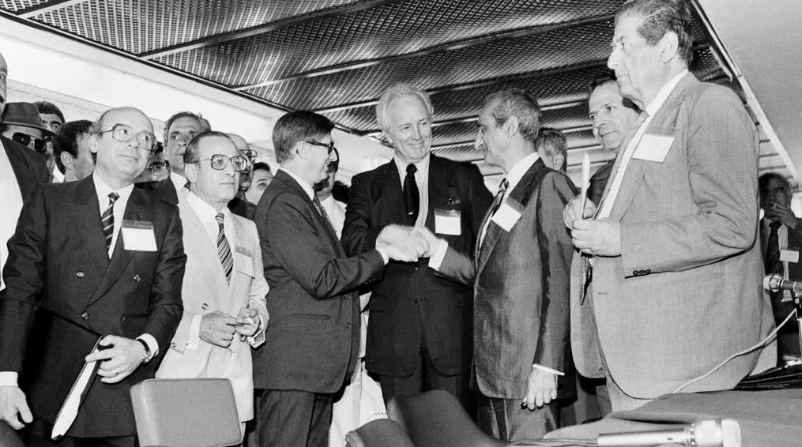
Follow-up – Quds Network: The “Framework Agreement” that “Israel” and Lebanon signed in Washington yesterday, Friday, was not an ordinary event in the history of relations between the two parties, as it quickly brought back to the fore a historical comparison with the agreement of May 17, 1983, which was signed by former Lebanese President Amin Gemayel with “Israel” through American mediation, before it fell after less than a year under the weight of internal Lebanese division, Syrian rejection, and the continuation of the Israeli occupation. Today, after more than four decades, Lebanon finds… Itself is facing a new agreement, also under American sponsorship, and in light of the presence of Israeli forces inside Lebanese territory, and with a sharp internal division over the future of Hezbollah’s weapons and the role of the Lebanese state in implementing security obligations. Despite the difference in regional circumstances between the two phases, the comparison is not based on political or ideological similarity, but rather on clear objective elements. Both agreements were signed after a large war waged by “Israel” inside Lebanon, and both linked the Israeli withdrawal to security arrangements within Lebanese territory, and both came with American mediation, while the Lebanese authority presented it as a gateway to restoring sovereignty, while opposition forces saw it as a dedication to “Israel’s” security demands rather than a complete restoration of national sovereignty. The May 17 Agreement… Negotiations Under Occupation The May 17 Agreement was born after the Israeli invasion of Lebanon in 1982, when the Israeli occupation forces arrived in Beirut for the first time, and besieged the capital, before the PLO forces left it. After the assassination of President-elect Bashir Gemayel, his brother Amin Gemayel was elected President of the Republic in September 1982, entering into indirect negotiations with “Israel” under American sponsorship that ended with the signing of the agreement on May 17, 1983. These negotiations took place in light of an “imbalance of power,” as “Israel” was occupying large parts of Lebanese territory, including the former capital Beirut and large areas of the south, while the Lebanese state was emerging from a civil war. Its army suffers from division and weakness, in addition to the presence of Syrian forces in other parts of Lebanese territory. This reality gave Israel greater negotiating ability, as it linked the withdrawal of its forces to achieving specific security and political conditions, while the Lebanese government did not have the military means to impose an unconditional withdrawal. Therefore, the May 17 agreement was not just a military withdrawal agreement, but rather included security and political arrangements aimed, according to its text, at ending the state of war between Lebanon and “Israel,” preventing the use of Lebanese territory to launch attacks on “Israel,” and establishing security coordination mechanisms, in addition to a gradual Israeli withdrawal linked to the completion of security arrangements inside Lebanon. However, this withdrawal was not absolute, as it was also linked to the withdrawal of Syrian forces, a condition that the Lebanese government did not have the ability to impose, which later turned into one of the most prominent reasons for the faltering of the agreement. Washington Agreement 2026 As for the June 2026 agreement, it came after a war that lasted for several months between “Israel” and Hezbollah, which witnessed Israeli incursions into southern Lebanon and control of border areas, in addition to massive raids targeting the party’s military structure. The negotiations sponsored by the administration of US President Donald Trump ended with the signing of a framework agreement in Washington between representatives of the United States, Israel and Lebanon, which constitutes the beginning of a longer political and security path. The 2026 agreement is based on a similar philosophy in terms of linking the Israeli withdrawal to security arrangements within Lebanese territory. The text talks about a “sequential process,” which means that the implementation of the agreement does not take place all at once, but rather in successive stages, so that the Lebanese state, through the army, undertakes to extend its authority over specific areas, in parallel with “verifying” the disarmament of non-state armed groups, led by Hezbollah, before “Israel” moves to additional stages of redeploying its forces. Another term that requires explanation is “experimental areas,” which was mentioned in statements by Israeli and American officials after the signing of the agreement. What is meant is two areas in southern Lebanon in which the agreement will begin to be implemented first, and the occupation army will gradually withdraw from them, in exchange for the deployment of the Lebanese army, provided that the success of the experiment is evaluated before moving to other areas. Thus, the implementation of the agreement becomes based on the principle of “performance in exchange for withdrawal,” meaning that every Israeli step is matched by a Lebanese step in the field of extending state authority and disarmament, noting that the text of the agreement does not include a timetable for withdrawal or the start of implementing the “experimental zones” plan. Hence the first fundamental similarity between the two agreements appears. In both cases, the Israeli withdrawal was not presented as an immediate and unconditional commitment, but rather was linked to security conditions within Lebanese territory. But the difference lies in the nature of these conditions. In 1983, they centered around preventing armed operations, creating security arrangements in the south, and linking withdrawal to the departure of Syrian forces, while in the 2026 agreement they centered around dismantling Hezbollah’s military structure, disarming it, and deploying the Lebanese army according to a mechanism supervised by the United States through a tripartite military coordination group. Reading the terms of the May 17, 1983 Agreement and the Washington Agreement of June 2026 reveals that the difference between them does not negate the similarity in general philosophy. Both presented themselves as a path to Israeli withdrawal and the restoration of Lebanese state authority, but both made this withdrawal linked to security arrangements within Lebanon. What is meant by the security arrangements here is not merely the deployment of the Lebanese army, but rather the establishment of a field reality that prevents any Lebanese, Palestinian, or regional force from threatening “Israel” from Lebanese territory. In the May 17 agreement, the agreement stipulated an end to the state of war between Lebanon and “Israel,” that each party’s sovereignty and territorial integrity be respected, and that each party refrain from using its lands or allowing them to be used in hostile acts against the other party. It also stipulated the withdrawal of Israeli forces from Lebanon, but this withdrawal was not separate from a long security annex that specifies the nature of the Lebanese military presence in the south, the number of forces, the type of weapons, and coordination and follow-up mechanisms. This is what is meant when it is said that the agreement was not only a “withdrawal agreement,” but rather an agreement to arrange southern Lebanon security-wise in accordance with “Israel’s” concerns. He gave “Israel” more than the demand to leave Lebanon: guarantees regarding what will happen after its exit. As for the 2026 agreement, the text declares “each party respects the sovereignty of the other,” and paves the way for normalization of relations through a gradual path whose official title is “restoring Lebanese sovereignty” through disarming Hezbollah and dismantling its military structure, then withdrawing “Israel” from the lands it occupied in the last war. What is meant by the “gradual path” is that the “Israeli” withdrawal does not happen all at once, nor as an independent commitment, but rather takes place in stages, starting with what are called “experimental areas”, where the Lebanese army is deployed in two specific areas in the south after an “Israeli” withdrawal from them, and then implementation is evaluated before moving on to other stages. This means that “sovereignty” in the two agreements is not understood in the same way as presented in official political language. Sovereignty in official Lebanese discourse means extending state authority over its entire territory. But in practical texts, sovereignty becomes a conditional path: in 1983, Lebanon must prevent any activity hostile to “Israel” and commit to security arrangements in the south, and in 2026, Lebanon must prove its ability to disarm Hezbollah and deploy the army in specific areas before “Israel” goes to a broader withdrawal. This does not mean that the two agreements are identical, but rather it means that both of them transferred the Israeli security demand into the definition of restoring Lebanese sovereignty. The two agreements give priority to the Israeli security demand before complete withdrawal, and turn the Lebanese state into an entity required to implement internal conditions, the most important of which is preventing any threat to “Israel,” before it obtains a complete and clear Israeli withdrawal. In the May 17 agreement, this meaning appeared in three places: The first was that the Israeli withdrawal was linked to security arrangements in the south that were not determined by Lebanon alone. The second is that the agreement obligated Lebanon to prevent activities hostile to “Israel” from its territory, which is a clause that may seem normal between two independent states, but under the occupation it was read as a commitment that precedes the restoration of full sovereign decision-making. The third is that “Israel” also linked the complete withdrawal to the withdrawal of Syrian forces, which is a condition beyond the ability of the Lebanese government. Therefore, opponents of the agreement saw that it gave “Israel” a practical right to remain as long as the territorial condition was not met. In the 2026 agreement, the same logic appears, but in a different way. “Israel” does not only say that it will withdraw when Lebanon requests it or according to a specific schedule, but rather, according to statements by the head of the occupation government, Benjamin Netanyahu, it says that it will remain in the “security belt” in southern Lebanon as long as Hezbollah is not disarmed and as long as there is a threat to “Israel.” This phrase makes the criterion for withdrawal linked to Israel’s assessment of the threat, not just Lebanon’s official implementation. Therefore, Hezbollah and its allies believe that the agreement gives the occupation the right to remain under the title of security, and that it entrusts the Lebanese state with the task of confronting the resistance instead of obligating “Israel” to withdraw first. Here, the phrase “security belt” must be interpreted. Historically, it refers to an area where “Israel” maintains a direct or indirect military presence near the border, under the pretext of preventing attacks on it. In the Lebanese experience, the term was associated with the phase of the Israeli occupation of the south before the withdrawal in 2000. As for the 2026 speech, the term is used to refer to areas in southern Lebanon that Israel says it needs to remain in as long as the Hezbollah threat exists. This use raises great Lebanese sensitivity, because it restores the logic of temporary occupation, which may turn into a long stay if the definition of “danger” remains in the hands of “Israel.” Hence, Hezbollah’s description of the agreement as a “gift to the Israeli enemy” is not based only on a general political rejection, but rather on a reading that says that “Israel” got what it wanted: a temporary military stay open to extension, an international mechanism to monitor Hezbollah’s weapons, and pressure on the Lebanese state to implement the disarmament clause. How was the 1983 agreement marketed and how is the 2026 agreement marketed? Joseph Aoun and Nawaf Salam are marketing the Washington Agreement in a language close to marketing the beautiful: sovereignty, the state, the army, withdrawal, and the return of the population. President Aoun described the agreement, according to what was reported by international and Israeli media, as the “first step” in the path to restoring Lebanese sovereignty. The Lebanese Embassy in Washington said that the agreement begins with an Israeli withdrawal from two experimental areas in the south, and that these measures constitute “the first step towards a gradual and comprehensive withdrawal from all Lebanese territory,” while respecting Lebanon’s sovereignty. As for Nawaf Salam, he linked it to the Taif Agreement, Resolution 1701, and the exclusivity of weapons in the hands of the state, stressing that the goal is to achieve Israeli withdrawal from all Lebanese territories. Hezbollah rejects the agreement. Hezbollah did not delay in responding to the agreement, as the representative in the “Loyalty to the Resistance” bloc and prominent leader in Hezbollah, Hassan Fadlallah, presented the party’s vision of the agreement, and he did not limit himself to announcing his rejection, but rather explained the reasons for this rejection. Fadlallah said, “Our opposition is serious, and we will not allow the authority to implement its pledges on the ground,” considering that the Lebanese authority “gave a gift to the Israeli enemy that will not have any effects on the ground.” He added, “This authority will not be able to impose its will on the Lebanese people,” and that “what happened in Washington is an attempt to disrupt Islamabad’s path, and without resistance nothing will pass.” His position did not stop at the political aspect, but rather went to the essence of the agreement, when he said that “the authority will not be able to impose the implementation of the agreement signed in Washington unless it goes, with American support, to a civil war,” adding that the government “is lacking in constitutional and charter legitimacy,” and that it “does not have the tools to impose dictates.” He also sent a direct message to the Prime Minister of the occupation government, Benjamin Netanyahu, saying: “We say to Netanyahu that you have agreed with those who do not have the power to decide, and the state of hostility towards “Israel” will remain, and whoever shakes hands with the enemy does not represent the Lebanese people.”