
اخبار فلسطين – وطن نيوز
فلسطين اليوم – اخبار فلسطين اليوم
W6nnews.com ==== وطن === تاريخ النشر – 2026-04-02 17:56:00
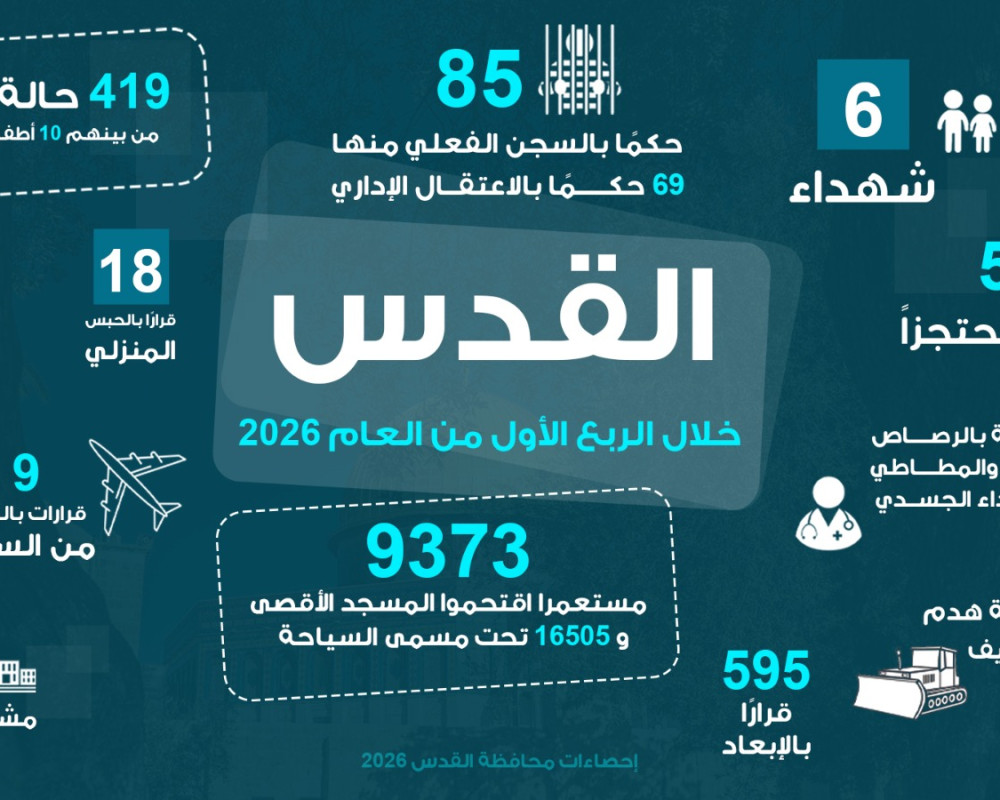
Occupied Jerusalem – PNN – The Jerusalem Governorate’s quarterly report revealed a catastrophic reality that the Holy City has been experiencing since the beginning of 2026, as the “lockdown” turned from a temporary security measure into a systematic policy to reshape the religious and demographic reality. The first three months witnessed the rise of 6 martyrs, and the storming of more than 9,000 colonists to Al-Aqsa, amid the continued closure of the mosque and the Church of the Holy Sepulcher, in a precedent that has not happened since the occupation of 1967. The continuous closure of Al-Aqsa Mosque and the Church of the Holy Sepulcher and a systematic policy to impose a new reality in Jerusalem… (6) martyrs and (9,373) colonists who stormed the blessed Al-Aqsa Mosque, (147) demolition and bulldozing operations, and (419) arrests, (595) Deportation decision, during the first quarter of 2026. The ongoing closure of Al-Aqsa Mosque and the Church of the Holy Sepulcher in Jerusalem constitutes one of the most dangerous features of Israeli policies in Jerusalem, as it is no longer a passing security measure, but rather has turned into a systematic tool to reshape the existing reality in the city. By imposing restrictions on the entry of worshipers, repeatedly closing the doors of the Al-Aqsa Mosque and the Church of the Holy Sepulcher, and controlling the numbers and ages of those arriving there, the occupation authorities seek to establish a new reality based on reducing the Palestinian presence in these holy places, and weakening their religious and national connection. These measures come within a broader context aimed at imposing effective sovereignty over the holy sites in the occupied city, and changing their historical and legal character, taking advantage of the international silence that gives these policies room to continue and escalate. In light of this, the closure turns from a temporary measure into a permanent policy, used as a means of pressure on Jerusalemites, and an attempt to impose a new equation in the heart of Jerusalem based on the gradual exclusion of the indigenous population. The Jerusalem Governorate monitored systematic violations of the Israeli occupation in the governorate during the first quarter of the year 2026, as the occupation continued its measures aimed at imposing more restrictions on the city and its people, and these violations topped the ongoing attacks on the blessed Al-Aqsa Mosque, and the widespread incursions that accompanied them. The colonists are protected by the occupation forces, and attempts are made to establish a new reality that affects the existing historical and legal situation. This was followed by the continuation of demolition and bulldozing operations in multiple neighborhoods of the city, the notification of dozens of facilities, the rise of martyrs, and the recording of injuries among citizens as a result of direct attacks or field repression. Arbitrary detention campaigns also continued, and decisions of actual imprisonment and house arrest were issued against Jerusalemites, in addition to decisions of forced deportation from the Blessed Al-Aqsa Mosque and the city of Jerusalem, in addition to moving forward in depositing and approving new colonial plans aimed at Judaizing the city and changing its demographic and geographic character. Martyrs: During the first quarter of 2026, six martyrs rose from the Jerusalem Governorate, in light of the escalation of organized violence practiced by the Israeli occupation forces and militias. Colonizers, amid a systematic environment of impunity and lack of accountability. Nasrallah Muhammad Jamal Abu Siyam from Mikhmas was martyred following an armed attack carried out by colonialists on the town of Mikhmas on February 18, Murad Shweiki while working as a bus driver inside the Green Line on March 18, and Qasim Amjad Abu Al-Amal Shuqirat (21 years old) after special forces stormed his family’s home in Jabal Mukaber on March 25. Muhammad Faraj al-Malhi (38 years old) also rose from balconies following an armed attack by colonists on March 26, followed by Mustafa Asaad Mustafa Hamad and Sufyan Ahmed Saleh Abu Lail on March 27, after they were targeted by bullets from the occupation forces during the storming of Qalandia camp. Crimes and violations in the Blessed Al-Aqsa Mosque: During the first quarter of 2026, the Blessed Al-Aqsa Mosque witnessed a noticeable escalation in the pace of Israeli incursions and violations, as the total number of intruders reached (9,373) settlers, in addition to (16,505) others who entered under the cover of what is called “tourism,” in light of strict protection from the occupation police and continuous restrictions on the arrival of worshipers, especially during the month of Ramadan. Throughout the month of March 2026, the occupation authorities imposed an almost complete closure on the Blessed Al-Aqsa Mosque, which began on February 28 and continued until the preparation of this report, in a dangerous precedent that is considered the first since the occupation of Jerusalem in 1967 during this period of the year. The presence inside the mosque was limited to a limited number of imams and endowment guards, without the arrival of worshipers, while major prayer halls were closed, and prayers were not heard throughout the Old City, in a measure that reflects an unprecedented escalation aimed at reducing… Islamic presence in the mosque. Injuries: During the first quarter of 2026, the Jerusalem Governorate recorded (106) injuries among Jerusalemites, as a result of continuous attacks carried out by the occupation forces and colonialists, which varied between live and metal bullets, beatings, and tear gas. The infections were remarkably concentrated in the vicinity of the separation wall, especially in Al-Ram, Kafr Aqab, and Qalandia camp, in addition to the towns of Silwan, Anata, Bedouin, Al-Eizariya, and Shuafat camp, in addition to the Bedouin communities in Mikhmas and Khan Al-Ahmar. The data also showed an escalation in settler attacks during February and March, with mass casualties recorded, most notably in Mikhmas and Khallet al-Sidra, which reflects direct targeting of Palestinian communities and attempts to push them towards forced displacement. Settlers’ attacks: During the first quarter of 2026, the Jerusalem Governorate monitored the implementation of (153) attacks by settlers, including (32) physical harm, in various parts of the governorate, in the context of an organized escalation that targeted Al-Aqsa Mosque. Bedouin gatherings, property, and Islamic and Christian sanctities, and resulted in the martyrdom of three Jerusalemites, Nasrallah Abu Sayyam, Murad Shweiki, and Muhammad al-Malhi. The attacks varied between shooting, physical abuse, burning of property, seizing homes, establishing colonial outposts, and blocking roads, in addition to attacks on churches and attempts to bring sacrifices into Al-Aqsa and incite Talmudic rituals inside it. These violations took place under Direct protection from the occupation forces, which reflects the complementarity of roles in imposing new realities on the ground, while the occupation authorities bear full legal responsibility for these crimes in light of the absence of accountability and continued impunity. Cases of arrests: During the first quarter of 2026, the Jerusalem Governorate monitored the arrest of (419) citizens, including (10) children and (7) women, within the framework of a systematic policy of repression that included storming homes and arrests at checkpoints and roads using force and intimidation. The arrests were distributed in several areas, most notably Qalandia Camp, Al-Issawiya, Anata, Silwan, and Kafr Aqab, in addition to the vicinity of Al-Aqsa Mosque, and affected activists, journalists, freed prisoners, and a large number of workers coming from the governorates of the country, which reflects the occupation’s efforts to impose control on various aspects of life in Jerusalem. Decisions of the occupation courts against detainees: The Israeli occupation courts continue to issue arbitrary decisions against Jerusalemites, which include imposing strict restrictions on movement, in addition to financial fines. The high costs that burden families, the imposition of forced home confinement, deportation decisions, and travel bans. These courts also continued to extend arbitrary administrative detention without bringing specific charges, in some cases for long periods, which is a flagrant violation of human rights and the basic principles of legal justice. Actual imprisonment: During the first quarter of 2026, the Jerusalem Governorate monitored the continuation of the Israeli occupation’s repressive policy against Jerusalemite prisoners, as the Israeli occupation issued (85) rulings and decisions against Jerusalemite prisoners, including (69) administrative detention sentences and (16) actual prison sentences. Home detention: During the first quarter of 2026, the Israeli occupation authorities continued the policy of forced deprivation of freedom through home detention against Jerusalemites, targeting in particular young people and journalists, as a punitive tool alternative to direct arrest. During this month, the Jerusalem Governorate monitored (18) house arrest decisions, accompanied by strict conditions that included temporary deportation and a ban on the use of the phone and social media, in a step aimed at restricting their civil and media activity and silencing their voices. Deportation decisions: During the first quarter of 2026, the occupation authorities issued (595) deportation decisions that mainly targeted Al-Aqsa Mosque and the Old City, and the decisions included the stationers, the mosque guards, and the freed prisoners, Journalists, activists, sheikhs and imams of Al-Aqsa Mosque and its employees, with the aim of undermining the Palestinian presence in the city. Travel ban decisions: During the first quarter of 2026, the Israeli occupation authorities continued to use the travel ban as an arbitrary punitive tool against Jerusalemites, targeting religious and national figures and young Jerusalemites, in the context of a policy aimed at restricting freedom of movement and tightening control over the city. During this month, the Jerusalem Governorate monitored (9) travel ban decisions. Demolition, bulldozing, and property confiscation operations: During the first quarter of the year 2026, the Jerusalem Governorate monitored (147) demolition and bulldozing operations, divided into (23) forced self-demolition operations in which Jerusalemite citizens were forced to demolish their homes with their own hands, and (113) demolition operations carried out by occupation mechanisms, in addition to (11) targeted bulldozing operations. Palestinian lands and property, and data indicate that the demolition operations were distributed among several towns and neighborhoods in Jerusalem, including Silwan, Beit Hanina, Sur Baher, Al-Issawiya, Jabal Mukaber, Shuafat, and other neighborhoods, within the framework of a systematic policy aimed at imposing forced displacement and destroying the livelihoods of Jerusalemites. Demolition decisions, forced evictions, and land confiscations: During the first quarter of 2026, the occupied Jerusalem Governorate witnessed an unprecedented escalation in the Israeli occupation’s policies related to With demolition, eviction, and confiscation notices, as part of its effort to reshape the demographic and geographical reality in the city of Jerusalem, especially in neighborhoods with a dense Palestinian population, most notably the town of Silwan, the Batn al-Hawa neighborhood, and the town of Anata. The Jerusalem Governorate documented during this period (214) notices, distributed among (146) demolition decisions, (62) eviction decisions, and (6) confiscation decisions, which reflects a dangerous escalation in the pace of these violations, not Especially the forced evictions that intensively targeted the Batn al-Hawa neighborhood in the town of Silwan for the benefit of settlement associations. Targeting national and religious figures: During the first quarter of 2026, the Jerusalem Governorate witnessed the continuation of the occupation’s systematic policy of targeting Palestinian religious and national leaders, as it continued to judicially pursue the Governor of Jerusalem, Adnan Ghaith, by postponing his trial sessions with the aim of restricting his official role. In January, the occupation authorities renewed the travel ban on Sheikh Ikrima Sabri, and summoned him for investigation in March before imposing his deportation from the Old City for 15 days. Minister Ashraf Al-Aawar has been banned from entering the West Bank since January, and the decision was confirmed in February. Also in February, Sheikh Muhammad Ali Al-Abbasi was arrested from Al-Aqsa Mosque and handed a deportation order, while Sheikh Iyad Al-Abbasi’s deportation from Al-Aqsa was renewed for a period of 6 months via an electronic notice. Crimes and violations against Jerusalem institutions and monuments During the first quarter of 2026, the Jerusalem Governorate monitored a noticeable escalation in Israeli violations that targeted religious, educational, cultural, and media institutions and monuments, within the framework of a systematic policy to impose a Judaizing reality and undermine the Palestinian presence. These violations included closing places of worship, most notably Al-Aqsa Mosque, storming, closing, and demolishing UNRWA institutions in the governorate, targeting cultural centers such as the Yabous Center and the Al-Hakawati Theater, in addition to restricting journalists and classifying media platforms as “terrorist.” The attacks also affected Islamic and Christian sanctities, including attacks on cemeteries and churches, and the imposition of restrictions on religious rituals. The violations were distributed over the course of the three months, starting with vandalizing Islamic cemeteries and cutting off services to vital institutions in January, through closing community institutions, preventing religious and cultural activities, and imposing restrictions on endowments in February, all the way to Judaizing measures in March, such as amending the Silwan plans, targeting markets and community initiatives, and continuing… The attacks on the Bab al-Rahma cemetery are an indication of an organized policy to reshape the religious and institutional reality in the city. Colonial projects: The Jerusalem Governorate documented, based on the daily follow-up of the official announcements issued by the so-called “civil administration” and the occupation municipality in Jerusalem, in addition to what was documented by the Orient House Center, a total of (53) colonial plans during the three months, in a clear indication of the accelerating pace of settlement expansion. The data showed that among these plans, (17) plans have been deposited, including the construction of a total of (2,592) colonial units on a total area estimated at approximately (1,256,978) dunums, while (9) settlement plans have been approved to build (860) colonial units on an area approximately (82,407) dunums, in addition to offering (5) bids and plans for tender that included thousands of colonial units, in addition to economic projects that include operating complexes. And commercial.