

اخبار تونس- وطن نيوز
اخر اخبار تونس اليوم – اخبار تونس العاجلة
W6nnews.com ==== وطن === تاريخ النشر – 2026-05-26 12:05:00
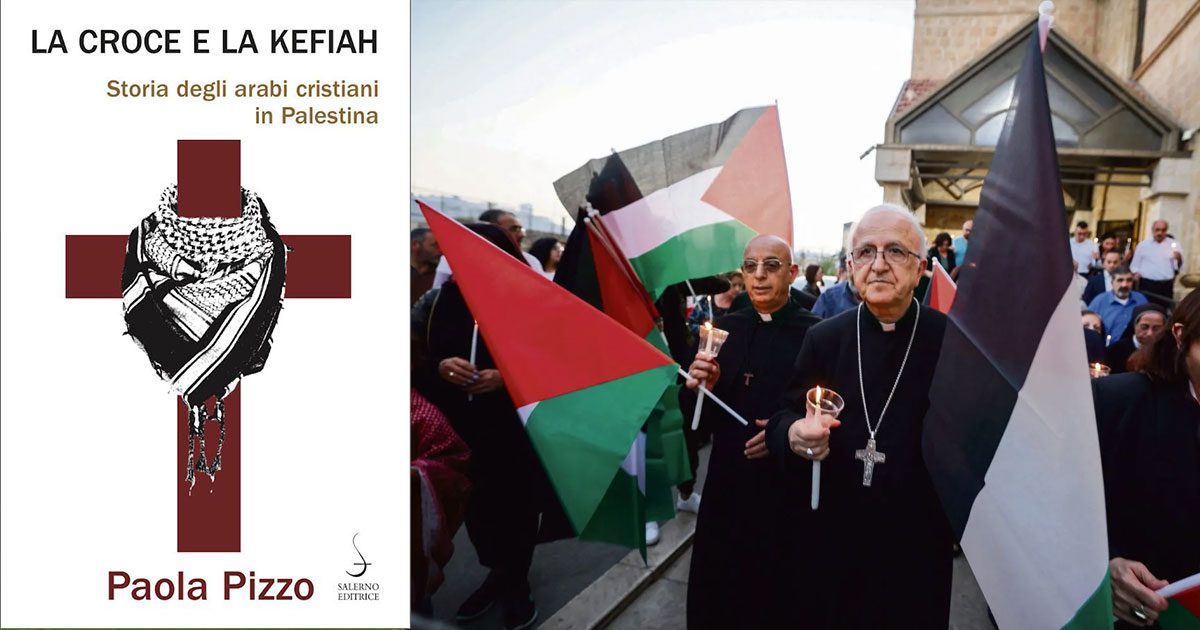
The cross and the keffiyeh appear to be two incompatible symbols, or let us say one in contrast to the other, in the Western imagination, while history reveals a close and living cohesion between the land of Palestine and the Christian faith. An article about the book by Italian researcher Paola Pizzo, “The Cross and the Keffiyeh: The History of Arab Christians in Palestine.” Ezzedine Enaya * There is a wide sector in religious studies that is still dealt with in Arab culture among the tools of comparison, rivalry, lamentations, and the like. These are misleading and distorting tools that have nothing to do with scientific studies of religions. It is due to weak training in a field of knowledge that is essentially based on separating what is subjective from what is objective, and what is theological from what is scientific. Even our writings about Judaism and Christianity, for example, are not considered in the international blog and do not receive favor due to the weakness of their cognitive structure and the confusion of their approach. What makes us, in this available space in presenting Western literature, point to the appreciated achievements in the fields of scientific studies of religions in the Italian language. In this article, we chose to discuss a book specifically related to the history of Palestinian Christianity. With these words, the Italian researcher Paola Pizzo begins her book “The Cross and the Keffiyeh… The History of Arab Christians in Palestine”: “The Cross and the Keffiyeh appear to be two incompatible symbols, or let us say one in contrast to the other, in the Western imagination, while history reveals a close and living cohesion between the land of Palestine and the Christian faith.” Arab Christians have inhabited Palestine and the Fertile Crescent region, without interruption, from the times of early Christianity until today. In this book, researcher Paola Pizzo traces the history of the followers of Christ (peace be upon him) in the land of Palestine, from the beginnings to the facts of contemporary history, in an effort to formulate a comprehensive summary. The research was divided into six basic axes, covering the various stages of Palestinian history and entitled as follows: “The first beginnings of history,” from the appearance of Christ (peace be upon him) to Islam’s embrace of this religion, and the joining of Christians into a comprehensive cultural component. “Christians and the Arab Renaissance,” dealt with the most prominent contributions of Palestinian writers and thinkers in crystallizing the Arab Renaissance project. “Palestinian Identity between Religion and Nationalism,” in which the discussion focused on the pluralistic nature of Palestinian identity and the role of Christians during the British Mandate, as well as the manifestations of resistance to the Zionist tide among Christians. “The Increasing Conditions of Palestine,” dealt with the events of the 1930s that afflicted Palestine, where it was exposed to massive missionary activity, the brutal Zionist attack, and the positions of Palestinian Christians and their rootedness in the resistance movement. “1948… Christians and the Nakba,” focused primarily on the conditions of Christians before and during the Nakba, and highlighted the uprooting that befell them and the harassment and abuse that befell those who remained. “Challenges of the Future.” This axis was concerned with the transformations that shook the situation of Christians in the current era, in addition to its exposure to Christian bleeding in light of the conditions of occupation, and then the research focused on the relationship of Christians with the Israeli entity and the Palestinian Authority. The close connection between the Palestinian Christian and his land. We point out that Paola Pizzo, the author of the book, is an Italian Arabist and historian who teaches the contemporary history of Islamic countries at the University of Chieti Pescara in Italy. All of her research revolves around Christian-Islamic relations in the Middle East. We mention among her published works “Christians and Muslims in Egypt Confronting Nationalist Proposals: 1882-1936” (2003) and “Islam in the Mediterranean… The Encounter with Europe and the Challenges of Modernity” (2010). The interest in the first axis focused on highlighting the close connection between the Palestinian Christian and his land, as the researcher tried to explain the depth of the connection between the Christian and his teacher. Christ (peace be upon him) described his first companions from The inhabitants of Palestine and its environs, or to quote an ancient geographical phrase from the people of Greater Syria, when he said: “You are the salt of the earth… and the light of the world” (Matthew 5: 13-14). Christ bestowed that description on his Shiites before religions became grouped into nationalities, and before they became rigid and fixed titles for peoples, peoples, races, and races. Perhaps that is the essential meaning of the message of religion and religiosity that is limited to it That excessive nationalistic burden, which is contained in the Almighty’s saying: “Ibrahim was neither a Jew nor a Christian” (Al Imran, 67). Let us continue with researcher Paula Pizzo the journey of searching for what remains of that salt in the book “The Cross and the Keffiyeh,” despite all the ordeals that befell the followers of the Nazarenes. The book is one of the serious and sober books in studying the reality of the Christians of Palestine and the history of the region, far from the tone of lamentation that dominates all of his writings. Contemporary Arabs, whenever they address the issue of Christians today, we have previously warned of its negative repercussions on understanding the reality of Arab Christianity and examining its solutions in our book “We and Christianity in the Arab World and in the World” (Al-Atrash Council – Tunisia, 2022), due to our keenness to make the field of knowledge of Arab Christianity a scientific study, far from the rubbish of rhetoric that surrounds many studies Forceful transformations: The Italian researcher was able to provide a solid, documented summary of the reality of a religious community that is threatening to dissolve, in light of the forceful transformations. She believes that cramming Christianity and Islam within a secular nationalist perspective has exhausted its energy, and that pragmatism requires the search for a citizen bond based on equality and dignity and based on a democratic plan for fragile entities, without falling into the bondage of the majority-minority dichotomy. Talking about Palestinian Christians using the logic of a minority is unacceptable and invalid, by all Palestinian actors, because it belittles and denigrates the Christian role. Since the 1920s, when the Arabs began to take the path of liberation and independence, Christian leaders have emerged in Palestine and neighboring countries, taking on the negotiating and communicative role with the West, and since the first years of the British Mandate, the Palestinian national movement has been organized in a united front. It was devoid of a religious character, within an Islamic-Christian agreement that called for the Arab identity of Palestine in the face of the Zionist project. This cohesion was evident, to the point that the Christian Al-Ghouri family of Jerusalem held meetings of Christian notables in the family home to formulate appeals addressed to the British delegate, in which they expressed to him that the Christian community did not recognize a man to assume the position of fatwa for Palestine except the candidate Haj Amin Al-Husseini, during the campaign to install him as mufti. (1921). The researcher points out that the Al-Ghouri family’s early national struggles were divided on several fronts. Emile Al-Ghouri (1907-1984) stood against the Westernization of Eastern Christianity by foreign missionaries, even if the people reluctantly accepted the services available in the educational, cultural, and social fields. The researcher, Paola Pizzo, highlights that Al-Shawam should be alerted. With their Muslims and Christians, he was firm in the first missionary campaigns. During the last decades of the Ottoman presence in the Levant, the people began to seek to support themselves in the face of the increasing missionary activities, and a number of initiatives were established among Muslims and Christians with the aim of repelling these campaigns. In Beirut, Boutros al-Bustani established the “National School” (1868), and ten years later, the “Maqasid Charitable Society” established its schools in Tripoli He opened the “Hamidiyah School” (1895), and in Haifa the “Islamic School” was established, where the martyr Izz al-Din al-Qassam taught, and in Jerusalem the Greek Orthodox Patriarchate sent the Mar Mitri High School. According to what the researcher reported, at the beginning of the century, the Palestinian Christians or Muslims viewed the goals of foreign missionaries as a violation of their national culture and a threat to their unifying identity, and the Christian blocs in Lebanon and Palestine were as it was With the Copts of Egypt, it feels that it is closer to its Muslim partners in the homeland than to the foreign missionaries with whom they share the faith in Christ. The Christians in Palestine have gone through several demographic phases, in which they have fluctuated from the status of an active community to the status of a displaced minority, but what has distinguished the Palestinian Christians, since the beginning of the last century, is that they are an urban community that was accustomed to living in cities, such as Jaffa, Haifa, and Jerusalem, and constituted the majority in Ramallah. And in Bethlehem and Nazareth, only 18 percent of them were farmers, according to a census dating back to 1931. The displacement shook Christians and Muslims alike. In another aspect, the researcher traces the effects of the Nakba on Palestinian Christians and returns the term to the Syrian Christian historian Constantine Zureiq, who used it for the first time, prior to the events of 1948. As a result of that tragedy, the remaining Palestinians suddenly found themselves after operations. Displacement, without a cultural elite, without political leadership, and without a homeland. The displacement shook the middle and affluent urban segments, both Christians and Muslims, and according to what the researcher reported, between 700,000 and 800,000 people left Palestine, and only 160,000 remained under Israeli control, the majority of whom were from rural communities and Bedouins. Regarding what befell the Christians, the researcher says that Ben Gurion took special and firm decisions to protect the landmarks of the city of Nazareth, fearing the reaction of the Christian world, and he said his warning word, “The world is watching our actions!”, at a time when the Israeli army, led by Moshe Karmel, was besieging Nazareth and preparing to storm the city and expel 16,000 residents, including 10,000 Christians. Once the displacement operations calmed down, Nazareth witnessed a rapid doubling of its population 1948 and 1949, and it turned into a semi-refuge for the Arabs of the interior. At the end of the Mandate, the city had 18,000 residents, and with the first Israeli census in 1949, the number reached 30,000. Some studies conducted during the late last century indicate that the city’s population was sixty thousand, 70 percent of whom were Muslims, and the researcher indicated that the number of Christians, by the end of World War II, had reached approximately 135,000 A total of 1,750,000 residents, equivalent to 8.8 percent of the total. The researcher also indicates that 7 percent of the 1948 refugees were Christians, and that approximately 140,000 Christians were residing in Palestine during the year 1948, 50,000 of whom were forced to leave, which means approximately one third, which made the number of Christians decline from 8 percent to 2.8 percent. Some estimated studies conducted during the recent period indicate that the number of Christians was likely to reach 600,000, in the absence of the Nakba, compared to what is currently 170,000. This number represents 28 percent of the general total of Christians, that is, from approximately 600,000 diaspora Christians distributed throughout the world. On the other hand, Israeli statistics dating back to the year indicate 2019 indicates that the number of Arabs in Palestine is 1,916,000, representing 21 percent of the general population, and the number of Christians among them is 177,000, which is equivalent to 2 percent of the general population, and equal to 7.2 percent of the Arab population, excluding foreigners. The Christian bloc recorded an increase of 1.5 percent, compared to the Arab 1.7 percent and the Jewish 2.2 percent, on the other hand The census conducted in the territories of the Palestinian Authority, during the year 2017, reached 46,850, the majority of whom are Catholics, and the majority of them reside in the West Bank, with Bethlehem having 23,165, Ramallah 10,255, Jerusalem 8,558, and the Gaza Strip more than a thousand. We note that 40 percent of the Christians residing in the Gaza Strip have left the Gaza Strip since 2008 and up Until the year 2016. Regarding the situation of the internal churches, the researcher states that Israel recognizes some rights for some Christian groups that have a presence dating back to the Ottoman period, such as special provisions related to personal status in settling matters of marriage, divorce, and inheritance. The Greek Orthodox Church, the Armenian Orthodox Church, the Syriac Orthodox Church, the Roman Catholic Church, the Maronite Church, the Greek Catholic Church (Melkite), and the Syriac Catholic Church also enjoy. The Armenian Catholic Church, the Chaldean Church, and the Anglican Church have some rights, and the Greek Orthodox Church has tried to maintain the status quo, which ensures its advantage over other churches. Therefore, it was keen to cooperate well with the Israeli authorities, and this continued until the mid-1980s. The researcher points out the insistence of the followers of this church, inside Palestine and Jordan, to review the management conditions in this church on the basis of elections The decline in the number of Palestinian Christians does not represent a challenge to the Arab countries alone, but also to the Israeli policy of coexistence. The problem is that it is not only the extremist Jewish groups who are not welcomed by them, as they are considered “deviant,” but even the “unitarian” Muslims. As the researcher estimates, the solution to the issue is not limited to recognizing the rights of the Arab Christian, but rather in creating a social and cultural harmony that would nurture the collective desire to live together And Keffiyeh.. The History of Arab Christians in Palestine, Salerno Publications, (Rome). Paola Pizzo, La croce e la kefiah: Storia degli arabi cristiani in Palestina, Salerno Editrice, Salerno (Italy). * Tunisian professor at the University of Rome, Italy.